-
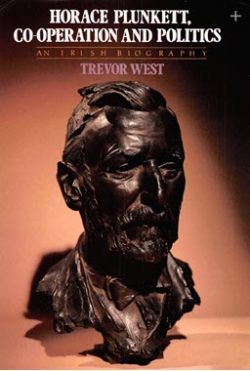 Horace Plunkett is remembered for his efforts to transform Irish agricultural practice, through the Co-operative Movement which he founded in 1889, and its administration via the Department of Agriculture, which he established ten years later. From a protestant ascendancy background, Plunkett was one of those ‘fenian unionists' who were always able to see both sides of the Irish Question, and whose reforming zeal, and frank expression of opinion, during the period in which Ireland moved from benevolent Tory rule by Westminster, to independence for the south and partition of the island, brought him into conflict with all shades of political opinion.
-
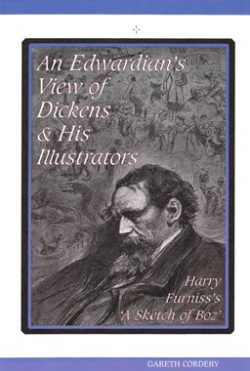 25.5 x 17.8 cm. xii, 116 pp. 2005 with 69 illus. Harry Furniss (1854–1925) was a well-known if somewhat abrasive figure in English literary, artistic and political circles during the half century either side of 1900. In March 1905, at the invitation of the Dickens Fellowship, he delivered in London’s Memorial Hall a platform lecture on Dickens and his illustrators, “A Sketch of Boz,” illuminated by some sixty magic lantern slides. Over the next two years Furniss toured the provinces with an enlarged version of this lecture. An Edwardian’s View of Dickens and His Illustrators is an edited and annotated transcription of the unpublished manuscript of this engaging lecture, together with the original illustrations, some of which are Furniss’s own.
-
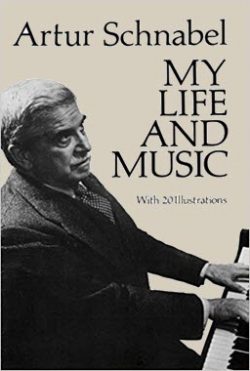 Widely regarded as one of the 20th century’s finest pianists, Artur Schnabel (1882-1951) was especially renowned as an interpreter of Beethoven. In the words of his friend Edward Crankshaw, his performance of the Diabelli Variations in his last years was ‘like looking at the sun without dark glasses’. However, Schnabel also earned high praise for his playing of Schubert, Mozart, and Brahms. Indeed, his later concert repertoire was largely devoted to great composers in the Austro-German tradition. In explanation, Schnabel contended that he wished to play only ‘music that was better than it could be performed’. His uncompromising, passionate commitment to penetrating the mysteries of the greatest music is clearly revealed in this absorbing, highly readable combination of personal reminiscence and musical manifesto. Not a conventional autobiography, it includes a transcript of 12 autobiographical lectures Schnabel gave to music students at the University of Chicago in 1945. The lectures were followed by informal sessions in which the pianist answered questions from the audience on a wide variety of musical topics. These questions and Schnabel’s revealing, unrehearsed replies comprise the second part of this book, offering rich insight into the pianist’s personality and musical philosophy. The final section, ‘Reflections on Music’, is a talk Schnabel gave on the occasion of receiving an honorary degree from the University of Manchester.
-
 Edited by Alan Price paperback 21.4 cm. J.M.Synge died in 1909 and The Works of John M. Synge were published in four volumes by Maunsel & Co., Dublin, in 1910. Since that time, with the exception of a few minor verses and one or two fragments of prose, the canon of his work has remained unaltered. Nevertheless, much unpublished material exists, for the most part of great interest and significance for the understanding of Synge's methods of work and development. This material, including early drafts of the plays, notebooks, poems, and fragments of poetic drama, has now been thoroughly explored in order to create this definitive edition, first published by Oxford University Press 1962-68, which not only collects together all that is of significance in his printed and in his unprinted work, but also, by a careful use of worksheets and early drafts, indicates much of the process of creation which occurred before the production of the printed page. The Collected Works is in four volumes, under the general editorship of the late Professor Robin Skelton, of the University of Victoria, British Columbia, who began the series with his edition of the poems and translations.
-
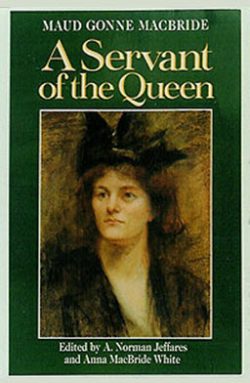 Edited by A. Norman Jeffares and Anna MacBride White 21.6 x 13.8 cm. paperback Maud Gonne MaeBride is part of Irish history: her foundation of the women's group Inghinidhe na hEireann. the Daughters of Ireland, in 1900, was the key that effectively opened the door of politics in the twentieth century to Irishwomen. Still remembered in Ireland for the fiery, emotive public speeches she made on behalf of the suffering – those evicted from their homes in the West of Ireland, the Treason-Felony prisoners on the Isle of Wight, indeed all those whom she saw as victims of the imperialism she constantly opposed – she is known, too, within and outside Ireland as the woman W. B. Yeats loved and celebrated in his poems
