-
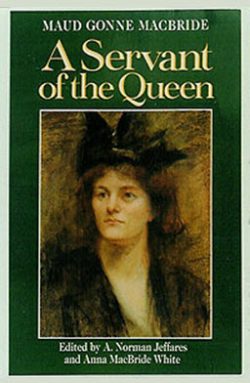 Edited by A. Norman Jeffares and Anna MacBride White 21.6 x 13.8 cm. paperback Maud Gonne MaeBride is part of Irish history: her foundation of the women's group Inghinidhe na hEireann. the Daughters of Ireland, in 1900, was the key that effectively opened the door of politics in the twentieth century to Irishwomen. Still remembered in Ireland for the fiery, emotive public speeches she made on behalf of the suffering – those evicted from their homes in the West of Ireland, the Treason-Felony prisoners on the Isle of Wight, indeed all those whom she saw as victims of the imperialism she constantly opposed – she is known, too, within and outside Ireland as the woman W. B. Yeats loved and celebrated in his poems
 -
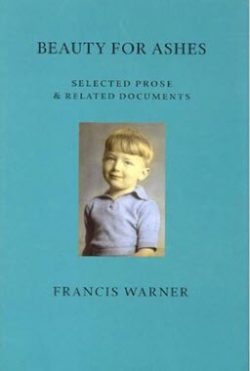 Selected Prose & Related Documents 336 pp. 23.4 x 13.5 cm illus. in colour and monochrome Poet of the Second World War and peacetime dramatist, Francis Warner was 75 this year (2012). This, the first selection from his prose, gives readers of his work some indication of the historical and intellectual background from which his poetry has sprung: of 'the giant race before the flood' who lived on to help shape Britain's post-war imagination. Starting with memories of the Blitz and his poem 'Blitz Requiem', Warner recalls his schooldays at Christ's Hospital, Horsham, recovering from six years of war, and the role played by music. He writes of his friends: 'Henry Chadwick: Musician', Kathleen Raine as fellow poet, C. S. Lewis and the Psalms, Henry Moore, Francis Bacon, Edmond Blunden, and Samuel Beckett, reproducing the manuscripts off two short plays Beckett discussed with and gave to him. Other subjects include W. B. Yeats, Benjamin Britten and the Japanese Noh plays, Samuel Palmer as poet, and Hugh Wybrew's Liturgical Texts of the Orthodox Church.
 -
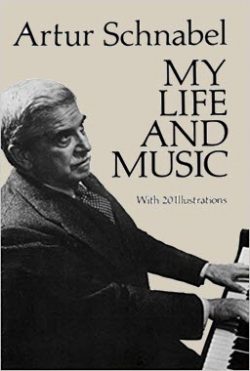 Widely regarded as one of the 20th century’s finest pianists, Artur Schnabel (1882-1951) was especially renowned as an interpreter of Beethoven. In the words of his friend Edward Crankshaw, his performance of the Diabelli Variations in his last years was ‘like looking at the sun without dark glasses’. However, Schnabel also earned high praise for his playing of Schubert, Mozart, and Brahms. Indeed, his later concert repertoire was largely devoted to great composers in the Austro-German tradition. In explanation, Schnabel contended that he wished to play only ‘music that was better than it could be performed’. His uncompromising, passionate commitment to penetrating the mysteries of the greatest music is clearly revealed in this absorbing, highly readable combination of personal reminiscence and musical manifesto. Not a conventional autobiography, it includes a transcript of 12 autobiographical lectures Schnabel gave to music students at the University of Chicago in 1945. The lectures were followed by informal sessions in which the pianist answered questions from the audience on a wide variety of musical topics. These questions and Schnabel’s revealing, unrehearsed replies comprise the second part of this book, offering rich insight into the pianist’s personality and musical philosophy. The final section, ‘Reflections on Music’, is a talk Schnabel gave on the occasion of receiving an honorary degree from the University of Manchester.
