-
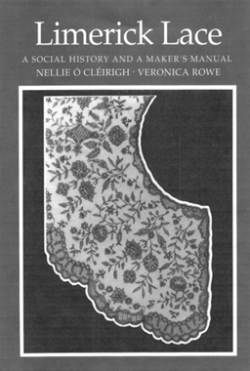 ISBN: 978-0-86140-368-4 29.6 x 21.0 cm. 91 pp. with 115 illus. Limerick is probably the most famous of all Irish laces. When President Kennedy came to Limerick in 1963 the Lord Mayor presented him with a Christening robe of the lace, and other important visitors have been delighted to receive gifts of this prestigious material. The making of this form of lace became possible when machine-made net became readily available, as it is a form of embroidery on net, being either chain-stitch (tambour) or darned net (also called run-lace), or a combination of both techniques. This volume is produced in the same format as Carrickmacross Lace and Mountmellick Work, and is in three sections. The first deals with the invention of Limerick lace and its history, the second with Mrs Florence Vere O'Brien and her contribution to Limerick and its lace-workers, while the third deals with the techniques used in making Limerick Lace, the materials and designs, preparation and sewing, and filling and embroidery stitches. The book contains many illustrations of fine piece of lacework from the authors' collections, as well as pictures of prizewinning examples from photos in the possession of the Royal Dublin Society.
 -
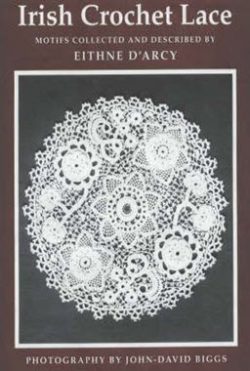 ISBN: 978-0-85105-514-5 29.7 x 21.2 cm. 64 pp. with 215 illus. [1985 Dolmen Press] revised edition 2003 Of all forms of crochet lace, that known as ‘Irish Crochet’ is most sought after and is probably the best known. While the Irish tradition for producing this work dates back to the sixteenth century, when it was known as ‘nuns work’ from the fact that the technique and style was developed in Irish convent communities in imitation of continental lacemaking styles, the manufacture of crochet lace did not become a cottage industry in Ireland until the middle of the nineteenth century, after the devastation caused by the Great Famine of the 1840s, when the development of home crafts was encouraged to create some small income for otherwise destitute families.
 -
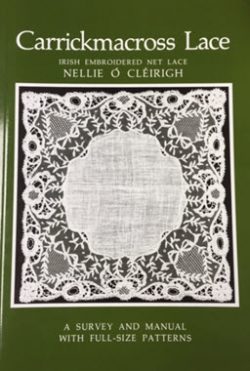 29.5 x 21.0 cm. 64 pp. with 84 illus, incl. 32 patterns 1985 (Dolmen Press) 1990 by Colin Smythe Ltd Carrickmacross lace was originally inspired by some Italian appliqué‚ lace which Mrs Grey Porter, wife of the Rector of Donaghmoyne, a small village northeast of Carrickmacross in County Monaghan, brought back from her continental honeymoon in 1816. Her interest in this lace led to an exploration of the craft with her sewing maid, and by the following decade she had evolved an individual style and established a cottage industry in her home parish, training young women as lacemakers. These in turn spread the craft to other areas in the northern counties of Ireland. In the 1840s a school of lacemakers was established to create gainful work for women after the Great Famine, but overproduction and economic depression led to a decline in the lace industry. The survival of Carrickmacross lace into the twentieth century is due to the nuns of the St Louis order who established a convent in the town and set up a lace-making class in 1897, which still continues the tradition.
 -
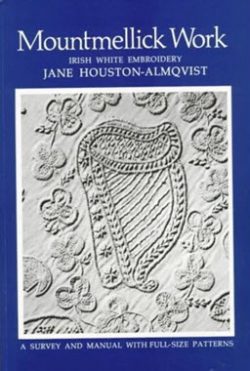 SBN: 978-0-85105-512-1 29.8 x 21.0 cm. 80 pp. 2nd edition 1996 White-on-white embroidery in various forms has been practised in Ireland for several centuries. Mountmellick work is probably the best-known style of Irish white embroidery and is named after the town where the craft was developed in the early decades of the nineteenth century. Mountmellick is in the centre of the area in which Ireland's cotton spinning and weaving industry developed a century earlier and here, in about 1830, Mrs Johanna Carter invented the style of embroidering in thick cotton thread which is named after her native town.
