-
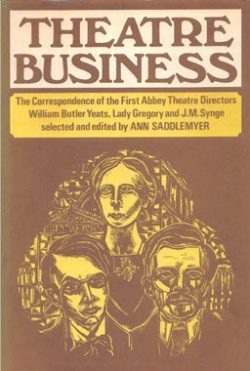 Although the Abbey Theatre directly evolved from the Irish Literary Theatre, its foundation in 1904 was as much a landmark in theatre history as it was in the evolution of the Irish Literary Revival. It proved to be an inspiration for the founding of other national theatres, as well as the little theatre movement in America and throughout the world. The Literary Revival had many notable figures, but three stand out. These were the first directors of the Abbey: W. B. Yeats, poet, dramatist and later a Nobel Prize-winner; J.M. Synge, the greatest dramatist the Abbey produced; Lady Gregory, folklorist, a developing dramatist, and, as Sean O’Casey called her, the Abbey’s fairy godmother. To these, of equal importance to the Abbey, must be added Miss Annie Horniman of the tea family, whose money, advice and active support was equally essential during the early years.
 -
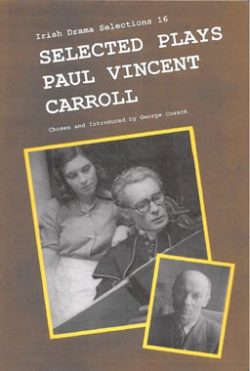 Chosen and introduced by George Cusack The sixteenth volume of the Irish Drama Selections series (ISSN 0260-7962), General Editors: Joseph Ronsley and Ann Saddlemyer. 21.6 x 13.8cm. Contains: The Things That Are Caesar’s, Shadow and Substance, The Conspirators, The White Steed, The Devil Came from Dublin, and Goodbye to the Summer, articles about his and others' plays – 'The Substance of Paul Vincent Carroll', 'On Legend and the Arts', 'The White Steed', 'Scottish Drama', 'Can the Abbey be Restored?', 'Reforming a Reformer, 'The Rebel Mind' – and a bibliographical checklist.
 -
 Foreword by Martin Ebon 22.8 x 15.5 cm. xviii, 186 pp. This book is a challenge to everyone who grants the possiblity of survival of consciousness after physical death. ‘Dr Naegeli provides a scholarly contribution to a better understanding of a complex and disturbing phenomenon. With increasing reports of cases of possession, this book offers a very helpful focus by a highly respected psychiatrist.’ Lee Pulos, PhD, clinical psychologist. ‘this book reveals the courage of a man who unapologetically accepts the reality of possession – a largely unpopular view – and the perspicacity of a thinker who has puzzled through the implications of this phenomenon and the relationship between possession and mental illness. A major step in the attempt to grapple with a most baffling condition.’ Adam Crabtree, psychotherapist and author of Multiple Man: Possession and Multiple Personality
 -
 In 2021, the 50th anniversary of the first publication of Breakthrough, "What happens after physical death?" is still the big question concerning the nature of existence. In his groundbreaking work, psychologist Konstantin Raudive experimented using a communication method known as Electronic Voice Phenomena (EVP), whereby deceased communicators appear to send messages and images via computers, radios, televisions and other electronic devices. In 1959 Swedish artist and filmmaker Friedrich Jurgenson was making a tape recording and during playback he discovered what sounded like a human voice on the tape. He put it down to faulty equipment but when he searched other tapes, he found more voices, which seemed to be messages from his dead mother. Jurgenson recounted the experience in a book titled Voices from Space. The book impressed Raudive and subsequently he and Jurgenson collaborated for a time and encountered more voices. Later, Raudive undertook his own research amassing a collection of thousands of voice recordings and in 1968 his work was published in German under the title, Unhörbares Wird Hörbar (The Inaudible Becomes Audible). In 1969 after being approached at the Frankfurt Book Fair, British publisher Colin Smythe asked his colleague Peter Bander to assess Raudive's book with a view to publishing it in English, and, unbeknown to Bander, did his own experiments with positive results. Since that time Jurgenson and Raudive's experiments have been replicated thousands of times by researchers and enthusiasts all over the world and Breakthrough remains a classic in the genre. The communicators overriding message? "We are not dead!"
