

Studying Oscar Wilde: History, Criticism, & Myth
22.8 x 15.3 cm. 248 pp. 1880-1920 British Authors Series no. 22
Studying Oscar Wilde: History, Criticism, and Myth takes issue with many assumptions current in Wilde scholarship. It sets an engaging course in exploring Wilde’s literary reputation. In particular, Professors Guy and Small are interested in the tension between Wilde’s enduring popularity with the general reading public as a perennially witty entertainer and his status among academics as a complex, politicised writer attuned to the cultural and philosophical currents associated with modernity. Their argument focuses initially on the prominence of biographical readings of Wilde’s literary works, drawing attention to the contradictions in the ways biographers have described his life and to the problems of seeing his writing as a form of self-disclosure.
Subsequent chapters assess the usefulness of other forms of academic scholarship to understanding works that are not, on the surface, “difficult.” Here a number of commonly held views are challenged. To what extent is De Profundis autobiographical? How sophisticated is the learning exhibited in Intentions? In what ways are the society comedies “about” homosexuality? And how does The Picture of Dorian Gray relate to Wilde’s “mature” style?
The volume also examines some of Wilde’s lesser-known, unfinished works and scenarios, including The Cardinal of Avignon, La Sainte Courtisane, and A Florentine Tragedy (all printed as appendices), arguing that these “failed” works provide important insight into the reasons for Wilde’s popular success.
Since Guy and Small have authored numerous articles and books on Wilde, Studying Oscar Wilde: History, Criticism, and Myth will be a must read for scholars, but it is also written in a jargon-free language that will speak to that wider audience of readers who enjoy Oscar Wilde.

Gaston de Latour: The Revised Text
Edited by Gerald Monsman
ISBN: 978-0-944318-09-6
22.6 x 14.8 cm 384 pp. 1995
This is the most complete edition ever published of Pater's last work. Although a version was published in 1896, two years after his death, Charles L.Shadwell, its editor, omitted six chapters that existed in manuscript.
Scarcely two years after Walter Pater's death, Macmillan & Company published Gaston de Latour: An Unfinished Romance. The author of works critical to the formation of the Transition and Modernist periods set his last novel in the turbulent years following the Reformation. Selected chapters first appeared serially in Macmillan's Magazine and the Fortnightly Review, but the posthumous volume edited by Charles L. Shadwell, Pater's long-time friend, remains controversial. For a century readers have seen only a portion of what Pater wrote for Gaston de Latour. Shadwell withheld six manuscript chapters.
Pater's prominence and widening influence in late-nineteenth and early twentieth-century studies makes those missing chapters more intriguing than ever. ELT Press is pleased to publish this long-awaited new edition Gaston de Latour: The Revised Text.
Edited from the holographs and based on definitive material incorporating all known fragments, The Revised Text includes the crucial suppressed chapters. Professor Gerald Monsman's edition, meticulously edited and researched, is far more revelatory of Pater's intimate thoughts than the book Macmillan printed in 1896.
The Revised Text is notable in other ways. Pater's study of eroticism in his portrait of Queen Marguerite is a significant contribution to gender studies in the late-Victorian period. Through the imaginary portrait of Gaston and Gaston's contemporaries (Ronsard, Montaigne, Bruno, King Henry III) Pater's fictional fantasia perceptively confronts and admonishes the Yellow Nineties, Oscar Wilde not least. As Monsman says, the Pater of the 1890s, pondering the issues of art and morality, eroticism and guilt, "is in may ways the most interesting of all the successive Paters – certainly wearier, but also more candid, consummately polished artistically, self-consciously aware of a dawning modernism."
Gerald Monsman is a Professor of English at the University of Arizona and former Head of the Department. He has worked for nearly a decade to bring this authoritative edition to print. His contributions to the field are well known. Among other publications, he has written three books on Pater: Pater's Portraits (Johns Hopkins University Press, 1967), Walter Pater (G. K. Hall, 1977), Walter Pater's Art of Autobiography (Yale University Press, 1980).
Gaston de Latour: The Revised Text is a significant achievement. Scholars and students will find Monsman's Introduction, Explanatory Notes, Diplomatic Transcriptions, Emendations and Variants invaluable.
More info →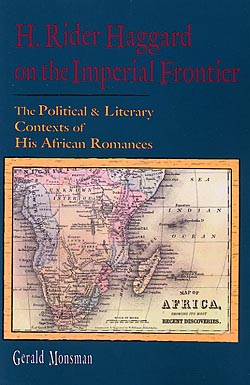
H. Rider Haggard on the Imperial Frontier: The Political and Literary Contexts of His African Romances
22.9 x 15.3 cm. 304 pp. 2006
H. Rider Haggard on the Imperial Frontier, the first book-length study of H.R.H.'s African fiction, revises the image of Rider Haggard (1856–1925) as a mere writer of adventure stories, a brassy propagandist for British imperialism. Professor Monsman places Haggard’s imaginative works both in the context of colonial fiction writing and in the framework of subsequent postcolonial debates about history and its representation.
Like Olive Schreiner, Haggard was an Anglo-African writer straddling the moral divide of mixed allegiances—one empathetically African, the other quite English. The context for such Haggard tales as King Solomon’s Mines and She was a triad of extraordinary nineteenth-century cultures in conflict—British, Boer, and Zulu. Haggard mined his characters both from the ore of real-life Africa and from the depths of his subconscious, giving expression to feelings of cultural conflict, probing and subverting the dominant economic and social forces of imperialism. Monsman argues that Haggard endorses native religious powers as superior to the European empirical paradigm, celebrates autonomous female figures who defy patriarchal control, and covertly supports racial mixing. These social and political elements are integral to his thrilling story lines charged with an exoticism of lived nightmares and extraordinary ordeals.
H. Rider Haggard on the Imperial Frontier will be of interest to readers of imperial history and biography, “lost race” and supernatural literature, tales of terror, and heroic fantasies. The book’s unsettling relevance to contemporary issues will engage a wide audience, and the groundbreaking biographical account of Haggard’s close contemporary Bertram Mitford in the appendix will add appeal to specialists.
More info →