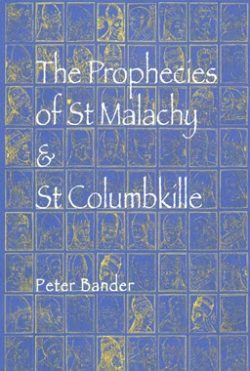
• 19.5 x 13.6 cm. 6th edition 2005 illustrated with papal coasts of arms from 1198 - Pope Innocent III to Pope Benedict XVI (1st edition 1969) This has been and still is one of the most popular books with which Peter Bander has been associated. It has gone through six editions and over a dozen printings, has been published in the USA and Europe, and since its first publication in 1969, extracts have appeared in many magazines, newspapers and journals. The present edition takes the reader up to the election of Pope Benedict XVI, 'gloriae olivae'. in 2005, the last pontiff to be given an epithet by St Malachy before 'Petrus Romanus'. So who will occupy the papal throne after the present pope and before Peter the Roman? His Excellency, the late Archbishop H.E. Cardinale, who was Apostolic Nuncio to Belgium, Luxembourg and the Common Market, following his term as Apostolic Delegate to Great Britain, wrote in his foreword to the Malachy Prophecies: "Here is a fascinating study which provides the curious reader with much profit and pleasure", quoting the Italian proverb "Se non è vero, è ben trovato" - If it isn't true, it's well thought out!
  • 21.6 x 13.8 pp. 170 pp. 1992 pbk repr. of 1980 edition Holy wells have been a feature of the religion of the Irish people for longer than records have existed, and while pilgrimages to them are not as common as in the last centuries, many wells are still visited, particularly on the Saints’ or ‘Pattern’ Days, and even now new wells occasionally appear. In this survey Dr Patrick Logan, author of The Old Gods, Irish Country Cures and Fair Day: The Story of Irish Fairs and Markets, describes many of those wells that are still visited, detailing the features of the pilgrimage and the benefits obtained, together with the legends attached to the wells, the saints they are dedicated to and their Pattern Days, the sites, trees and stones associated with them, and fish that some of them have; he also gives information about the holy islands that have wells.
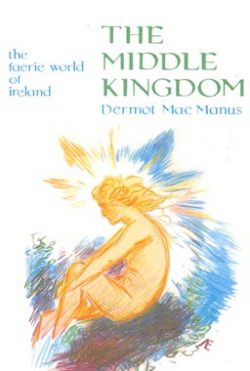
  • ISBN: 978.0.900675.82.9 21.6 x 13.0 cm. 191 pp. + 8 pp. illus. "[Among the books I read at the Beaconsfield Public Library] I remember being impressed by Dermot MacManus' The Middle Kingdom, which had a great effect on me, and is probably one of the most influential books I've ever read", Terry Pratchett (in his 1999 talk to the Folklore Society) 'No matter what one doubts,' wrote W.B.Yeats, 'one never doubts the faeries for . . . they stand to reason.' The author, an intimate friend of Yeats and a friend too of the great folklorist Douglas Hyde and the myriad-minded mystic G.W.Russell ('A.E.'), was a staunch believer in 'the ancient and continuing spirit life of the countryside'.
  • Foreword by Kathleen Raine

    21.6 x 13.8 cm.    xxxviii, 524 pp.    [1911]   1977 by Colin Smythe Ltd

    First published in 1911, The Fairy-Faith in Celtic Countries has become a classic on the subject, even though it is less well-known that his Tibetan Book of the DeadTibetan Yoga and Secret Doctrines, and The Tibetan Book of the Great Liberation, for example. This has been largely due to its having been out of print for so long. The appearance of this edition in 1977 was therefore extremely timely.

     
  • In 2021, the 50th anniversary of the first publication of Breakthrough, "What happens after physical death?" is still the big question concerning the nature of existence. In his groundbreaking work, psychologist Konstantin Raudive experimented using a communication method known as Electronic Voice Phenomena (EVP), whereby deceased communicators appear to send messages and images via computers, radios, televisions and other electronic devices. In 1959 Swedish artist and filmmaker Friedrich Jurgenson was making a tape recording and during playback he discovered what sounded like a human voice on the tape. He put it down to faulty equipment but when he searched other tapes, he found more voices, which seemed to be messages from his dead mother. Jurgenson recounted the experience in a book titled Voices from Space. The book impressed Raudive and subsequently he and Jurgenson collaborated for a time and encountered more voices. Later, Raudive undertook his own research amassing a collection of thousands of voice recordings and in 1968 his work was published in German under the title, Unhörbares Wird Hörbar (The Inaudible Becomes Audible). In 1969 after being approached at the Frankfurt Book Fair, British publisher Colin Smythe asked his colleague Peter Bander to assess Raudive's book with a view to publishing it in English, and, unbeknown to Bander, did his own experiments with positive results. Since that time Jurgenson and Raudive's experiments have been replicated thousands of times by researchers and enthusiasts all over the world and Breakthrough remains a classic in the genre. The communicators overriding message? "We are not dead!"
Go to Top