
General Editors of the Coole Edition: T.R.Henn CBE and Colin Smythe
Edited and Introduced by James Pethica
23.4 x 15.5 cm. x, 248 pp. + 32 illus.
This sixteenth volume of the Coole Edition contains Lady Gregory’s first writings on Ireland. They include the two surviving versions of her unpublished first attempt at autobiography, 'An Emigrant's Note Book' (1883); three short stories she wrote under the pseudonym ‘Angus Grey’ —'A Philanthropist', 'A Gentleman' and 'Peeler Astore' (1890-91); and her anonymously-issued anti-Home Rule pamphlet A Phantom's Pilgrimage, or Home Ruin (1893). Appendices contain her lyric 'Alas, a woman may not love' (1886) and the poems she sent to Wilfrid Scawen Blunt following his imprisonment in Galway in 1888 for participating in a banned tenant protest against evictions. Also included is the newly-rediscovered text of Sir William Gregory’s prescient 1881 pamphlet on the Land League.
-
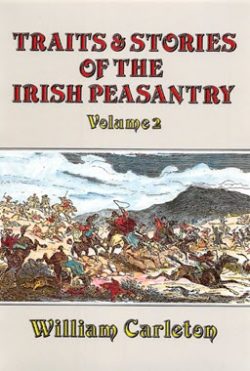 21.6 x 13.8 cm. with all the original illustrative etchings Traits and Stories of the Irish Peasantry can be considered to be Carleton’s greatest work. It went through a number of transformations before the ‘definitive edition’ was published in 1842-44. This edition was the last that Carleton actually oversaw; thus it is the culmination of his own work on the collection, and for this reason is the edition we publish. Traits and Stories contains a wealth of illustrations by famous illustrators of the time. They give a good impression of the tales themselves, being crowded with laughing, weeping, fighting, working, playing, dying, and praying peasants in sublime scenery, poverty-stricken cottages, cosy public houses, trim farms, broken-down barns, hillside chapels, hedge schools, and hovels. The inhabitants of Carleton’s world are villains, scholars, horse-thieves, pig-drivers, priests, farmers and shopkeepers. He aimed to show the Irish peasant honestly to the world, choosing simple, strong plots. Contemporary critics praised Carleton most for the ‘light and shade’ of his depictions of Irish character, and much of his power lies in the combination and contracts of light and shade, good and
 -
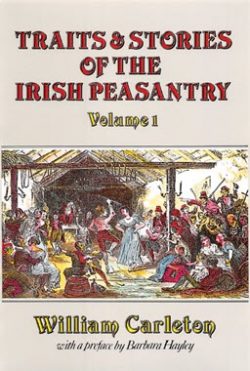 With an Introduction by Barbara Hayley 21.6 x 13.8 cm. with all the original illustrative etchings Traits and Stories of the Irish Peasantry can be considered to be Carleton’s greatest work. It went through a number of transformations before the ‘definitive edition’ was published in 1842-44. This edition was the last that Carleton actually oversaw; thus it is the culmination of his own work on the collection, and for this reason is the edition we publish. Traits and Stories contains a wealth of illustrations by famous illustrators of the time. They give a good impression of the tales themselves, being crowded with laughing, weeping, fighting, working, playing, dying, and praying peasants in sublime scenery, poverty-stricken cottages, cosy public houses, trim farms, broken-down barns, hillside chapels, hedge schools, and hovels. The inhabitants of Carleton’s world are villains, scholars, horse-thieves, pig-drivers, priests, farmers and shopkeepers. He aimed to show the Irish peasant honestly to the world, choosing simple, strong plots. Contemporary critics praised Carleton most for the ‘light and shade’ of his depictions of Irish character, and much of his power lies in the combination and contracts of light and shade, good and evil, fun and tragedy. He is a writer of great comic genius, as well as being able to convey the horrors of poverty and the peasant life.
 -
General Editors of the Coole Edition: T.R. Henn CBE and Colin Smythe
Edited and Introduced by James Pethica
23.4 x 15.5 cm. x, 298 pp.
This first volume of Lady Gregory’s Shorter Writings covers the years 1882-1900. Edited and introduced by James Pethica, whose authorized biography of Gregory is in preparation for Oxford University Press, it makes available all the previously uncollected work she wrote for publication during the period, including newly-discovered articles, material that was never printed, and items that appeared anonymously or pseudonymously.
The volume begins with her first independent publication, Arabi and His Household (1882), written in support of the deposed leader of the Egyptian Nationalist rebellion, who faced likely execution by the British. Gregory's travel journalism and other occasional writings of the 1880s were sufficient to catch the attention of Oscar Wilde, who praised her "clever pen" and invited her to contribute to The Woman’s World, the periodical he edited. Also included here are more than a dozen unpublished poems, often highly personal, written during her travels to India and Ceylon, along with the sequence of twelve sonnets she gave Wilfrid Scawen Blunt in 1883 as they ended their clandestine affair. Writings from the early 1890s include one short story set in Italy, and another with a plot her friend Henry James briefly considered using as the basis for a novel.
Gregory’s publications from the mid-1890s offer sharp new insight into her growing interest in Irish folklore, her emergence as an Irish nationalist, and her enthusiasm for the Irish language and the Gaelic League. Key works include a previously unpublished pamphlet on the inequities of Irish taxation, and Gregory’s first substantial folklore essays. The last writings in the volume register her increasing centrality in the emergence of the Irish Literary Theatre, her developing friendship and collaborations with W.B.Yeats, and her growing confidence in her creative voice as she began her rise to prominence.
James Pethica teaches Irish Studies, Modern literature, and drama at Williams College in Massachusetts. He is preparing the authorized biography of Lady Gregory for Oxford University Press.
-
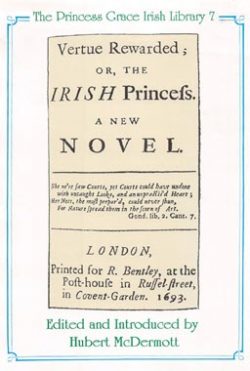 21.6 x 13.8 cm. Princess Grace Irish Library series (ISSN 0269-2619) volume 7 Published for the first, and (until now) only, time in 1693, this novel is set in Ireland immediately after the Battle of the Boyne, and describes the courtship of a young lady of Clonmel by a prince, who is on his way to take up a post in Limerick. The story is humorous and engaging. As the editor points out, its interest lies not only in it calling itself `A Novel', but that it may well have been known to Samuel Richardson, and influenced his Pamela (itself subtitled Virtue Rewarded), published fifty years later. This work can lay claim to being the first Irish novel ever published – certainly the earliest that is extant, and as such will be of interest to all students of literature in the English language.
 -
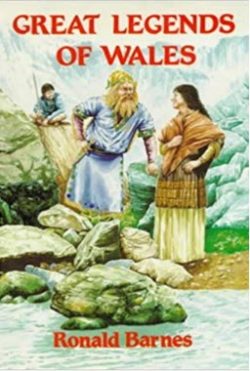 ISBN: 978-0-86140-317-2 21.6 x 13.8 cm. xvi, 156 pp. 1991 These ten original tales, some dating from the 11th century, have been painstakingly unearthed and written up by Ronald Barnes. Several of these stories surfaced in Yorkshire, whence Welsh monks had fled during religious purges, and are published for the first time. These have been relatively unaltered by retelling over the centuries while others are attributed to bards who changed the story lines almost beyond recognition. There was an abundance of other legends, too, many attributed to resourceful bards who, over the centuries, changed the story lines almost beyond recognition. Some of the greatest legends, particularly those based upon proven historical facts, owe their survival to monks and others who fled to Yorkshire during religious purges. There they lay dormant and thus escaped the ravages of repetition.
 -
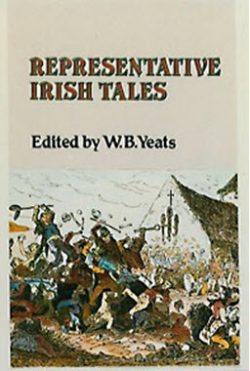 With a foreword by Mary Helen Thuente This anthology of Irish fiction edited by W.B. Yeats was first published in 1891, but despite its significance in his early career, was out of print for nearly eighty years. Representative Irish Tales is a fine selection of Irish fiction – as representative of Yeats himself as it is of Irish novelists. His introductory commentary and his editorial emendations provide an interesting perspective on an influential, but relatively unknown phase of his early work. Novelists represented are: Maria Edgeworth, John & Michael Banim, William Carleton, Samuel Lover, William Maginn, T. Crofton Croker, Gerald Griffin, Charles Lever, Charles Kickham, and Miss Rosa Mulholland.
 -
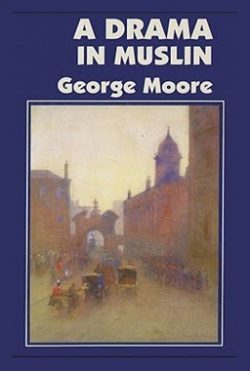
ISBN: 978-0-86140-056-0
21.6 x 13.8 cm xvi, 329 pp. 1981
Always an ambitious novelist, George Moore realised early in the composition of his third novel, A Drama in Muslin, how his chosen subject – the sentimental education of five girls born into the gentry of the West of Ireland – could be extended to encompass a study of the prevailing social conditions of the Irish people, who were desperate for political change and growth.
-
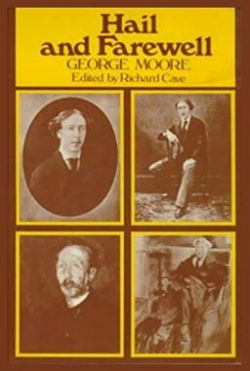 ISBN: 978-0-86140-198-7 21.6 x 13.8 cm. 774 pp. with four illustrations by Grace Plunkett Hail and Farewell! can be considered George Moore’s masterpiece. Since it was first published, it has coloured many people’s view of the Irish Literary Revival and its members – W.B.Yeats, Lady Gregory, George W. Russell (AE), Edward Martyn, Sir Horace Plunkett, and J.M.Synge. It is a prodigious work, containing Moore’s assessment of the Irish Literary Revival, the Abbey Theatre and its predecessors, as well as remarkable insights not only into the literature and tastes in painting (particularly French Impressionism) and music (the influence of Wagner and the revival of polyphony) at the beginning of the twentieth century, but into the social and religious background to the Irish scene at that time – all viewed through his eyes, the eyes not only of an Irish country gentleman, but of a European man of letters. First published 1911-14, Moore revised it for the second edition (1925), and the text remained the same for the Uniform (1933) and Ebury (1937) Editions. This is the first edition to appear since then, and uses the most recent text.
 -
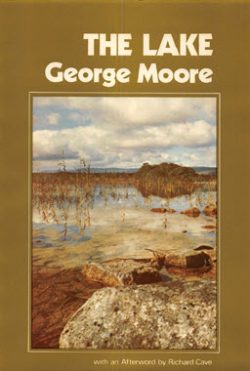 With an Afterword by Richard Allen Cave ISBN: 978-0-901072-82-5 21.6 x 13.8 cm. xii, 274 pp. 1980 The Lake is George Moore’s most poetic and perfectly crafted novel. It tells of a priest’s loss not of faith, but of commitment to the principles fostered in him during his training and his discovery of a more fulfilling religion that celebrates instinct as being, if rightly understood, man’s true mode of communion with his soul. Father Gogarty’s parish is in a remote district of Mayo beside Lough Carra and his new philosophy is worked out during his long walks and rides round the lake where he learns how the changing quality of his perceptions of the landscape about him can reveal the fluctuating moods of that ‘underlife’ of his psyche that shapes his being.
 -
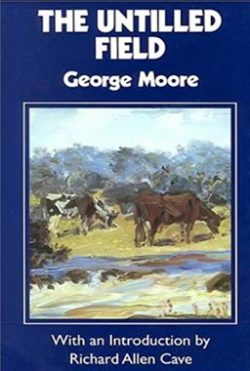 With an Introduction by Richard Allen Cave 21.6 x 13.8 cm. xxxiv, 225 pp. 1903, and revised by Moore in 1926, and 1931. This edition first published in 2000 Bubbling with enthusiasm for the revival of Gaelic in Ireland, George Moore suggested to the Gaelic League that it should publish a translation of a modern work that children might study in school and that artists might imitate and so begin a new tradition of Gaelic Literature. It was a sensible idea that was delayed at first for want of agreement within the League over a suitable text. Spurred on by his friends, Moore himself then set about writing some tales of Irish life for this end. They were translated by Taidgh O’Donohue and published in 1902 in the New Ireland Review. Later a collection of these and more stories appeared under the title An T-Úr-Gort, Sgéalta; a version of this, reworked by Moore in English as The Untilled Field, followed in 1903. It proved subsequently the one of his works that pleased Moore best for its affectionate portraits of Irish rural life.