

Hearts And Minds
The Princess Grace Irish Library’s 2000 symposium brought together Irish critics and historians to assess the state of culture and society in the 'long nineteenth century' – 1800-1922 – during which the Act of Union defined the form of government and representation in Ireland as well as, to a great extent, the forms of opposition. Besides investigating the nature of the Union – its strengths and weaknesses, its character and progress – this bicentenary collection considers questions of private conscience and popular consciousness, language and iconography, science and evangelism, Diaspora and disempowerment, terror and consent, memory and amnesia, separation and adherence in the connected spheres of society, politics and culture.
The contributors are Anthony Cronin, Thomas Bartlett, Síghle Breathnach-Lynch, Claire Connolly, Tom Dunne, Marianne Elliott, J. W. Foster, Roy Foster, Luke Gibbons, Liam Kennedy, Joep Leerssen, W. J. McCormack, James Murphy, Patrick O'Sullivan, Gearóid Ó Tuathaigh and Norman Vance. It is the thirteenth publication in the Princess Grace Irish Library Literary series (ISSN 0269-2619).
BRUCE STEWART is the Literary Adviser of the Princess Grace Irish Library, Monaco, and teaches Anglo-Irish Literature at the University of Ulster at Coleraine. He served as Assistant Editor of The Oxford Companion to Irish Literature edited by Robert Welch (1995). More recently he was responsible for the setting up of PGIL EIRData, a large-scale website dedicated to Irish literary and biographical information and containing at its heart a bio-bibliographical account of some 4,500 Irish authors of all periods. It was launched by Her Excellency Mary McAleese, President of Ireland, and H. S. H. Prince Albert during the symposium, and is located at http://www.pgil-eirdata.org.
Front cover illustration (continuing onto front flap): 'The Wedding of the Princess Aoife of Leinster with Richard de Clare, Earl of Pembroke (Strongbow)' by Daniel Maclise.
More info →
That Other World
Volume 1 ISBN: 0-86140-417-2 / 978-0-86140-417-9 £40.00
Volume 2 ISBN: 0-86140-418-1 / 978-0-86140-418-6 £40.00
The Pair ISBN: 0-86140-419-X £80.00 / 978-0-86140-419-3
The Supernatural and the Fantastic in Irish Literature & its Contexts
As with every other region of Europe and the world, the traditional folklore of Ireland abounds with tales involving the supernatural and the fantastic, but nowhere else have these tales so influenced the literature and the shaping of that country, and no other country has produced so many world-famous authors whose work has shown those influences.
These intermingling themes were therefore the ideal subject for a symposium held at the Princess Grace Irish Library, Monaco, in May 1998 to which, reflecting the international interest in the subject, a host of international scholars contributed, and whose papers are published in these two volumes.
The subjects range from early Irish history and folklore to the present day, but mainly deal with nineteenth and twentieth century literature, from Gothic novels, Sheridan Le Fanu, Bram Stoker, and Oscar Wilde, through W.B.Yeats, Lord Dunsany, Elizabeth Bowen, Samuel Beckett, and Flann O'Brien, to Seamus Heaney and Nuala Ní Dhomhnaill.
More info →
The Irish Book Lover. An Irish Studies Reader
With an Introductory Lecture by Nicholas Allen and an Integrated Index by Bruce Stewart.
The Irish Book Lover ranks as the longest-lasting of all twentieth-century Irish literary journals, with a run of 227 issues published under the editorships of John S. Crone (1909-25), Séamus Ó Casaide (1928-1930) and Colm Ó Lochlainn (1930-57). As a bibliographical and reviewing journal rather than a forum for commentary, poetry or fiction, it is less often consulted than literary journals such as the Irish Review or The Bell but nevertheless illustrates with great clarity some of the key changes in modern Irish culture and society between 1909 and 1957.
While offering a unique source of information on older, antiquarian books in Ireland, The Irish Book Lover throws open a window on the attitude of the contemporary intelligentsia to works such as James Joyce’s Portrait of the Artist and W. B. Yeats’s Responsibilities, the novels of Liam O’Flaherty and Kate O’Brien or those of less-remembered writers of the day such as Temple Lane and Mrs. Thomas Concannon. Though superseded by a variety of reviewing organs, it gives an inspiring example to Irish book lovers in our own time.
The Princess Grace Irish Library has compiled a sampler of the journal here, together with an index of the entire series. The present volume also contains the introductory lecture given by Dr. Nicholas Allen at the “Irish Book Lover” Symposium held in Monaco to commemorate the journal. The symposium was also afforded a planned opportunity to survey existing resources for Irish literary history in the company of fifteen Irish publishers, librarians, teachers, critics and – last but not least – owners of Irish-studies websites.
The present volume is mirrored on the PGIL EIRData website, giving access to a body of digitised text that embraces a wider selection of the long-running journal together with an electronic index of its pages. This new departure for Irish studies has been conducted by Dr. Bruce Stewart under the terms of a contract between the Ireland Fund of Monaco to the University of Ulster under the aegis of the Princess Grace Irish Library (Monaco).
Bruce Stewart was Lecturer in Irish Literary History and Bibliography at the University of Ulster and Literary Adviser (Conseiller Littèraire) of the Princess Grace Irish Library in Monaco and director of the Library’s Biennial Symposium Series. He has edited three volumes in the Princess Grace Irish Library series and managed the production of several more. His articles and essays have been published in several leading Irish journals including Irish Review and Studies. Born in Dublin and educated at Glenstal Abbey School, Trinity College, Dublin, and the University of California, he has studied, worked and taught in America, the Middle East and England as well as Northern Ireland.
Contents
Editor’s Preface
Nicholas Allen: Introductory Lecture
The Irish Book Lover: An Irish Studies Reader
The Irish Book Lover: An Integrated Index
Bruce Stewart: Afterword
Appendix I: Chronology of Issues
Appendix II: Participants & Programme
More info →
Selected Plays of George Shiels
Chosen and Introduced by Christopher Murray
The fifteenth volume of the Irish Drama Selections series (ISSN 0260-7962), General Editors: Joseph Ronsley and Ann Saddlemyer.
21.6 x 13.8cm.
Contains The Retrievers (hitherto unpublished), Professor Tim, The New Gossoon, The Passing Day, The Rugged Path, and The Summit, bibliographical checklist.
George Shiels (1886-1949) was one of the most prolific and most successful playwrights in the history of the Abbey Theatre. Before his debut at the Abbey, Shiels's early work was staged by the Ulster Literary Theatre in Belfast and later on his work was taken up by the dynamic Group Theatre, also in Belfast. As a Northerner, Shiels embraced the whole island in his work, his use of dialect and his characterisation. Moreover, while his plays were broadly popular and wonderfully well suited to the acting talents of theatre companies North and South, his all-Ireland perspective lent his work a keen critical edge masked by easy realism and hilarious comedy. Nowadays, we turn to the dark comedy of a play like The Passing Day to re-adjust our view of Shiels and to see his plays as seriously concerned with the land question and issues of identity, gender and the law in post-colonial Ireland. From that perspective, The New Gossoon and in particular The Rugged Path (which in 1940 broke all previous box-office receipts at the Abbey, when the production played for an unprecedented twelve weeks, all previous plays having been limited to two) challenge us to look again at Shiels and see him as public commentator as well as consummate entertainer.
The present collection attempts to facilitate this needed redefinition of Shiels's place in the Irish dramatic canon. To that end it includes The Retrievers (1924), his first full-length political play, never before published, together with Professor Tim (1925), The New Gossoon (1930), The Passing Day (1936), The Rugged Path (1940) and its sequel The Summit (1941), together with a Bibliographical Checklist.
Christopher Murray is Professor Emeritus in the School of English and Drama at University College Dublin. He is former editor of Irish University Review and former chair of the International Association for the Study of Irish Literatures (IASIL). Among his publications are Twentieth-Century Irish Drama: Mirror up to Nation and Sean O'Casey, Writer at Work: A Biography.
More info →

The Poetry of Austin Clarke
Late in his career, the Irish poet Austin Clarke was asked by Robert Frost what kind of poetry he wrote. ‘I load myself with chains,’ Clarke replied, ‘and try to get out of them.’ ‘Good Lord!’ Frost said. ‘You can’t have many readers.’ Despite a distinguished career spanning almost sixty years, Austin Clarke has not had many readers outside Ireland. Inside Ireland, many critics ranked Clarke as the most important Irish poet writing after Yeats, but his work has not received extensive critical attention — partly because it is often difficult and complex, and partly because Clarke was committed to writing not just about the Irish, but also for the Irish.
In The Poetry of Austin Clarke, the first published book-length study of Clarke’s poetry, Gregory Schirmer argues against seeing Clarke as a provincial writer. Rather, he sees Clarke’s large and varied canon as informed by a broad humanistic vision that enables it to transcend Clarke's commitment to the local.
Clarke once said that in reading Joyce’s A Portrait of the Artist as a Young Man he had difficulty distinguishing between Stephen Dedalus and himself. Like Joyce, Clarke (1896-1974) came to see Irish Catholicism as a powerful and complex threat to his freedom and artistic vocation. In The Poetry of Austin Clarke, Schirmer asserts that almost all of Clarke’s poetry moves between two poles: his view of Irish Catholicism as a repressive, life-denying force, and his humanistic faith in man’s inherent goodness and right to moral, intellectual, and spiritual freedom.
This argument is advanced through a detailed reading of Clarke’s poetry, beginning with the early narrative poems, which are based on the same pre-Christian Irish legends that inspired Yeats and the Irish Literary Revival, and then turning to Pilgrimage (1929) and Night and Morning (1938), two volumes of lyrics that are central to understanding Clarke’s poetry as a whole. In these books, Clarke sets forth the terms that govern all his art – the struggle between humanism and religion, flesh and spirit, reason and faith. Clarke’s satirical poems and epigrams of the 1950s and 1960s are then examined in terms of this tension. Finally the book discusses Clarke’s later poetry, including the long, semi-autobiographical Mnemosene Lay in Dust (1966), the late erotic poetry, and Clarke’s free translations of Gaelic verse.
Throughout all this varied writing, Schirmer argues, Clarke is celebrating the human in the face of the forces that he sees ranged against it. It is this vision that makes Clarke’s poetry an important part, not just of Irish literature, but of all literature attempting to express man’s condition in the twentieth century.
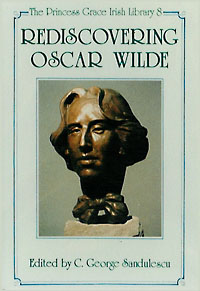
Rediscovering Oscar Wilde
The Princess Grace Irish Library 8
In the same way that students of Shakespeare discuss their `Supreme Quartet' of plays, so Irish Studies has its own quartet of writers – Yeats, Joyce, Beckett and Wilde – whose fame is outstanding and world-wide. Over the past years, conferences on all four members of this Irish quartet have been organised by the Princess Grace Irish Library of Monaco, the most recent, on Wilde, in 1993. The inclusion of Wilde in the quartet may surprise some, but it is an incontrovertible fact that scholars are coming to appreciate Wilde’s intrinsic importance as a writer, and as a major influence on 20th century literature.
Over the past years, conferences on all four members of this Irish quartet have been organised by the Princess Grace Irish Library of Monaco (the proceedings of each being published in this series), the most recent, on Wilde, in 1993. This collection of papers given then covers every aspect of Wilde's oeuvre, not only considering his plays, poetry and novels, but his family, his influence on writers both in English (such as Joyce and Stoppard) and in other languages (including, Martí, Darío, Borges and Lispector).
Quite how influential and far-reaching he has become can be seen by the names of the universities at which the contributors teach: Antonio Ballesteros González and Mariano Baselga (Universidad Autónoma, Madrid), Pia Brinzeu (Timisoara, Romania), Edward Burns (Liverpool), Richard Allen Cave (London), Davis Coakley (TCD), Jean M. Ellis D’Allessandro (Florence), Masolino D’Amico (Rome), Lawrence Danson (Princeton), Denis Donoghue (New York), Joseph Donohue (Massachusetts), Irène Eynat-Confino (Tel-Aviv), Michael Patrick Gillespie (Marquette, WI), Robert Gordon (London), Warwick Gould (London), Merlin Holland (Wilde’s grandson), Joel H. Kaplan (British Columbia), Patricia Kellogg-Dennis (Rider College, NJ), Melissa Knox (St Peter’s College, NJ), Jacques de Langlade (Paris), Donald Lawler (East Carolina, NC), Jerusha McCormack (UCD), Bart J. Moore-Gilbert (London), Isobel Murray (Aberdeen), Sylvia Oslermann (Jena), Norman Page (Nottingham), Keny Powell (Miami, Ohio); María Pilar Pulido (Lyon), Peter Ruby (Cambridge), Gerd Rohmann (Kassel), Roy Rosenstein (American University of Paris), Neil Sammells (Bath College), Ronald Schuchard (Emory), Theoharis Constantine Theoharis (MIT), Deirdre Toomey, Emmanuel Vemadakis (Angers), and Marie- Noelle Zeender (Nice).

Assessing the 1984 ‘Ulysses’
Alongside Eliot's Waste Land and Ezra Pound's Cantos, Ulysses is unquestionably the most important literary text of this century. That is why it is both natural and necessary to pay more than the usual attention to the significant detail embedded in that monumental work.
Joyce demanded that Ulysses be published on his fortieth birthday, 2 February 1922. He forced the non-English-speaking printers in Dijon to work against next to impossible deadlines, and from almost unreadable manuscripts and proofs, so clotted were they with revisions. For this and other reasons, Joyce himself was acutely aware of the unusually large number of 'errors' in the body of the book, and said as much in his letters to friends. There 'errors' irritated him so much that he even issued a number of errata lists during his lifetime, but to no avail. All editions of Ulysses teemed with misprints and other 'errors': this is about the only statement on which there is genuine critical consensus.
In the late 1970s a comprehensive research project was mounted in Munich in systematically to deal with these 'errors' with the aid of a sophisticated computer program. The outcome was the 'error-free' edition of Ulysses published on Bloomsday 1984.
The sole purpose of the conference held in Monaco in 1985, bringing together some of the most outstanding experts of the Joycean text, was to scrutinise collectively the validity of the changes made by the Munich team.
Anthony Burgess points out in his Preface that in Ulysses as in Finnegans Wake, 'it is virtually impossible to divide substance from form... the characters are so embedded in their mode of presentation that it would be dangerous to release them from their verbal ambience'. It is precisely that point that makes this collection of papers an indispensable companion to the New Text of Ulysses as it has emerged from its 1984 facelift.
The outstanding Joyce scholars contributing to this work include Richard Ellmann, Clive Hart, Fritz Senn, David Hayman, and Richard Kain.

Lady Gregory, Fifty Years After
It is now over fifty years since the death of Augusta Gregory, who as a playwright, folklorist, essayist, poet, translator, editor, theatre administrator and nationalist, contributed so much and so uniquely to the realisation of modern Ireland. Yet soon after her death she seemed to be virtually forgotten, and the words on her gravestone – ‘she shall be remembered for ever’ – had a very hollow ring about them.
It has only been in the last twenty-five years that Lady Gregory’s reputation has turned round, beginning with Elizabeth Coxhead’s biography, and the subsequent appearance of the Coole Edition of her works. The publication of Mary Lou Kohfeldt's biography in 1985 and now the appearance of this volume – the first collection of essays to be devoted to her – must surely create a greater awareness of her importance as a cornerstone of the Irish Literary Revival.
Her books and plays, together with her work for the Abbey as manager, playwright, play-reader and fund-raiser, have had an influence on the literary life of Ireland in the first half of this century that has been greatly underestimated.
This collection opens with fragments of memory about Lady Gregory, and then brings together leading critics to write about various aspects of her life, her work, and her friendships with Yeats, W. S. Blunt, Sean O’Casey, John Quinn, and Douglas Hyde. There is also a checklist of her contributions to periodicals (over 180 items so far discovered), and an assessment of the work of her son, Robert Gregory.
Fragments of memory come from George Moore, The Sunday Herald (Boston), Signe Toksvig, Sean O’Casey, The Rt. Rev. Arnold Harvey, Anne Gregory, W. B. Yeats, Anne Yeats, Maire nic Shiubhlaigh, W. G. Fay, Brinsley MacNamara and Gabriel Fallon.
The contributors are Andrew E. Malone, Mary FitzGerald, Mary Lou Kohfeldt Stevenson, Brian Jenkins, James Pethica, Elizabeth Longford, Daniel J. Murphy, Gareth W. Dunleavy, Maureen Murphy, John Kelly, Richard Allen Cave, Ronald Ayling, Robert Welch, Bernard Shaw, Dan H. Laurence, Lorna D. Young, Ann Saddlemyer, Colin Smythe.
INTRODUCTION. Ann Saddlemyer and Colin Smythe
Acknowledgements
CHRONOLOGY. Colin Smythe
FRAGMENTS OF MEMORY
Pen Portraits: George Moore Sunday Herald (Boston) Signe Toksvig Sean O'Casey
The Chatelaine of Coole: The Rt. Rev. Arnold Harvey, Anne Gregory, W. B. Yeats, Anne Yeats, Sean O'Casey, W. B. Yeats
At the Abbey Theatre: Maire nic Shiubhlaigh W. G. Fay Brinsley MacNamara Gabriel Fallon
LADY GREGORY, 1852–1932. Andrew E. Malone
'PERFECTION OF THE LIFE': LADY GREGORY'S AUTOBIOGRAPHICAL WRITINGS. Mary FitzGerald
THE CLOUD OF WITNESSES. Mary Lou Kohfeldt Stevenson
THE MARRIAGE. Brian Jenkins
LADY GREGORY AND WILFRID SCAWEN BLUNT. Elizabeth Longford
'A WOMAN'S SONNETS'. Lady Gregory, with a Commentary by James Pethica
'DEAR JOHN QUINN''. Daniel J. Murphy
THE PATTERN OF THREE THREADS: THE HYDE-GREGORY FRIENDSHIP. Gareth W. Dunleavy
LADY GREGORY AND THE GAELIC LEAGUE. Maureen Murphy
LADY GREGORY AND SEAN O'CASEY: AN UNLIKELY FRIENDSHIP REVISITED. Ronald Ayling
'FRIENDSHIP IS ALL THE HOUSE I HAVE': LADY GREGORY AND W. B. YEATS. John Kelly
A LANGUAGE FOR HEALING. Robert Welch
NOTE ON LADY GREGORY'S PLAYS. Bernard Shaw, edited by Dan H. Laurence
FOUR FRENCH COMEDIES: LADY GREGORY'S TRANSLATIONS OF MOLIÈRE. Mary FitzGerald
IN RETROSPECT: LADY GREGORY'S PLAYS FIFTY YEARS LATER. Lorna D. Young
THE GLORY OF THE WORLD AND THE PEASANT MIRROR. Ann Saddlemyer
LADY GREGORY'S CONTRIBUTIONS TO PERIODICALS: A CHECKLIST. Colin Smythe
APPENDIX: ROBERT GREGORY: ARTIST AND STAGE DESIGNER. Richard Allen Cave
Notes
Notes on Contributors
Index
More info →

Denis Johnston, A Retrospective
Published to mark Johnston's eightieth birthday, when he was the doyen of Ireland's living playwrights, this volume brings together memories from friends and critical essays on his work and achievement by leading scholars – John Boyd, Curtis Canfield, Richard Allen Cave, Mark Culme-Seymour, Cyril Cusack, Hilton Edwards, Maurice Elliott, Harold Ferrar, Robert Hogan, Thomas Kilroy, Roger McHugh, Micheál mac Liammóir, D.E.S.Maxwell, Vivian Mercier, Christopher Murray, B.L.Reid, Joseph Ronsley and Christine St Peter – together with a checklist of Denis Johnston's writings compiled by the editor of this volume.
Included as an appendix are some recent revisions by Denis Johnston to his A Bride for the Unicorn.
CONTENTS<br
Introduction <br
List of Illustrations <br
AN APPRECIATION. Hilton Edwards<br
THE OLD LADY SAYS `NO!' Micheál MacLiammóir<br
THE OLD LADY: IN PRINCIPIO. Christine St Peter<br
WAITING FOR EMMET. D.E.S.Maxwell<br
A NOTE ON THE NATURE OF EXPRESSIONISM AND DENIS JOHNSTON'S PLAYS. Curtis Canfield<br
THE MOON IN THE YELLOW RIVER: DENIS JOHNSTON'S SHAVIANISM. Thomas Kilroy<br
DENIS JOHNSTON'S HORSE LAUGH. Robert Hogan<br
JOHNSTON, TOLLER AND EXPRESSIONISM. Richard Allen Cave<br
THE GOLDEN CUCKOO: `A VERY REMARKABLE BIRD'. Christopher Murray<br
'HE IS ALWAYS JUST ROUND THE NEXT CORNER.' DENIS JOHNSTON'S IN SEARCH OF SWIFT . Maurice Elliott<br
'A HUMANE AND WELL-INTENTIONED PIECE OF GALLANTRY': DENIS JOHNSTON'S THE SCYTHE AND THE SUNSET Joseph Ronsley<br
THE ENDLESS SEARCH. John Boyd<br
THE PLAYS OF DENIS JOHNSTON. Roger McHugh<br
DEAR DENIS! Cyril Cusack<br
DENIS JOHNSTON'S SPIRITUAL QUEST. Harold Ferrar<br
JOHNSTON IN ACADEME. B.L. Reid<br
WITH DENIS JOHNSTON IN THE WESTERN DESERT. Mark Culme-Seymour<br
PERFECTION OF THE LIFE OR OF THE WORK. Vivian Mercier<br
CHECKLIST-LIST OF DENIS JOHNSTON'S WRITINGS. Joseph Ronsley<br
APPENDIX: REVISIONS TO A BRIDE FOR THE UNICORN, ETC. Denis Johnston<br
Notes on Contributors<br
Index

Selected Plays of Lennox Robinson
Chosen and Introduced by Christopher Murray
The first volume of the Irish Drama Selections series (ISSN 0260-7962), General Editors: Joseph Ronsley and Ann Saddlemyer.
ISBN: 0-86140-087-9 / 978-0-86140-087-4 £25.00
Paperback ISBN: 0-86140-088-7 / 978-0-86140-088-1 £9.95
Contains: Patriots, The Whiteheaded Boy, Crabbed Youth and Age, The Big House, Drama at Inish, Church Street, bibliographical checklist.
Lennox Robinson was one of the leading playwrights of Dublin's Abbey Theatre as well as being its general manager and a director for many years. As with many other playwrights of the twentieth century, his work has been unjustly neglected, this volume, published in 1982, being the first of his plays to have appeared for over a quarter of a century. It is fitting, therefore, that this selection should be the first of a new series, Irish Drama Selections, which has sought to remedy the shortage of texts of the work of Ireland's dramatists, which with the exception of perhaps ten authors, are virtually unobtainable except in rare editions, long out of print.
Christopher Murray is Emeritus Professor of Drama and Theatre History, School of English, Drama and Film, University College Dublin. He is former editor of Irish University Review and former chair of the International Association for the Study of Irish Literatures (IASIL). Among his publications are Twentieth Century Irish Drama: Mirror up to Nation and Sean O'Casey, Writer at Work: A Biography. He also chose and introduced the fifteenth volume in the Irish Drama Selections series, Selected Plays of George Shiels.
More info →

Kate O’Brien, a Literary Portrait
21.6 x 13.8 cm
Although Kate O’Brien is coming to be classed among the most original novelists of this century, her reputation underwent the usual period of eclipse that follows the decease of most writers. Now, just twelve years after her death in 1974, her novels are coming back into favour on both sides of the Atlantic.
At first glance, a romantic realist whose field of operations was the rise of the middle-class from post-Famine Ireland to the second half of the present century, on closer inspection she will be seen to be a subtly feminist writer whose heroines are in search of both freedom and love, freedom as a pre-requisite of love – and education as the first necessity of either.
Highly responsive though she was to the lyrical beauty of the Irish landscape and appreciative of Irish wit and charm, she was, nevertheless, contemptuous of narrow nationalistic claims, and would set Ireland always among the nations of Europe. Long before Europe set up its present Economic Community, of which Ireland in due course became a member state, she saw her country as linked by old associations of religion, history and culture to a continental civilisation.
Readers of a generation new to Kate O’Brien see her as depicting an Ireland they scarcely knew existed, an educated, aspiring, sometimes wealthy middle-class Ireland. On one side of her, just before her beginnings as an artist, lies the wild Ireland of the dispossessed, and on the other the Ireland of what she called the ‘Top People’, whose sole criterion is success in making money, and whom she despised.
This is the first study of Kate O’Brien’s novels as a whole, in which her development as a writer is traced and the underlying themes of her work revealed.

Yeats the Initiate. Essays on certain themes in the writings of W.B.Yeats
For many years Kathleen Raine has been known as the leading exponent of what she herself calls ‘the learning of the imagination’ in the work of Blake, Yeats and other poets and scholars within (using the word in its broadest sense) the Platonic tradition. Yeats the Initiate contains all Dr Raine’s essays on Yeats, covering many aspects of the traditions and influences that informed his great poetry. Several of her essays in this field are already regarded as definitive evaluations of their subjects and these, with other hitherto uncollected studies and some new papers here printed for the first time, all fully illustrated and annotated, make Yeats the Initiate one of the most important publications of recent years in the field of Yeats studies.
The essays collected in Yeats the Initiate include ‘Hades Wrapped in Cloud’, a study of Yeats and the occult, Dr Raine’s introduction to Yeats’s collections published as Fairy and Folk Tales of Ireland, and three major studies previously published separately – Yeats, the Tarot and the Golden Dawn; From Blake to ‘A Vision’ and ‘Death-in-Life’ and ‘Life-in-Death’. A major paper on ‘Yeats on Kabir’ is printed for the first time, as is a topographical paper on the Sligo area in the West of Ireland. A long essay on Yeats’s debt to Blake has been extensively revised, and other topics discussed include the play Purgatory, Yeats’s contemporary, Æ (G.W.Russell, the visionary), and Kathleen Raine’s own poetic debt to Yeats.
The essays that make up this volume reflect a lifetime’s knowledge presented with the fine perception of a great poet. The many illustrations form a graphic accompaniment to the text. It is essential reading for all students of the life and work of William Butler Yeats.

Irish Literature in English, The Romantic Period
Vol 1 ISBN: 0-86140-272-3 / 978-0-901072-272-4 £30.00 <br
Vol 2 ISBN:0-86140-273-1 / 978-0-901072-273-1 £30.00 <br
The Pair ISBN: 0-901072-40-0 / 978-0-901072-40-5 £60.00 Originally advertised as Ireland and Romanticism, Patrick Rafroidi’s work is a revised and updated translation of his much acclaimed L’Irlande et le romantisme (1972). It is now published for the first time in English in two volumes, the first a study of the period and its authors, and the second an important work of reference on all the Irish literary figures of the time. The study is divided into three sections, ‘Prelude to Romanticism’, ‘Nationalist Romanticism’, and ‘The Impact of Irish Romanticism’, with extensive notes and an index. Professor Rafroidi studies the causes of the movement, how it was influenced by political and literary landmarks of the time, and how the authors themselves influenced others, not only in England but also in the United States, in France and in Germany, and their rediscovery and use of Ireland’s early history and myths. The reference section contains a general bibliography, bio-bibliographies of the Irish authors whose work was published between 1789 and 1850, information as to the performances of their plays in the most important theatres in the British Isles, and a list of the principal Irish periodicals of the time. This is therefore a most useful work for all those interested in the period, and the bibliographies make it an essential work of reference which all libraries and students of Anglo-Irish Literature will need on their shelves, for continuous referral.

Irish Poetry after Feminism
These essays are revised versions of lectures given at the Princess Grace Irish Library in Monaco, and address some of the most exciting developments in Irish poetry over the last thirty years, concentrating especially on the work of Derek Mahon, Medbh McGuckian, Vona Groarke and Sinéad Morrissey. Irish Poetry after Feminism also includes forthright debate between the contributors about the relations between ideology and poetics. Gathering some of the finest critics, the volume makes an important contribution to one of the central debates about Irish literature.
'Feminism and Irish poetry are . . . natural allies, not antagonists; to posit them otherwise is to declare the redundancy of art in its capacity to change lives on its own terms. With such an understanding, students of the topic of Irish poetry after feminism are released to seek out its neglected aspect in an investigation of Irish feminism after poetry, in confidence that relations of hospitality and exchange, rather than those of absolutism and hierarchy, can be expected to prevail between the art form and the intellectual, social and political tradition concerned.' Catriona Clutterbuck
CONTENTS<br
Justin Quinn: Introduction<br
Moynagh Sullivan. Irish Poetry after Feminism: In Search of 'Male Poets' <br
Peter McDonald. The Touch of a Blind Man: Forms, Origins and 'Hermeneutics' in Poetry <br
Catriona Clutterbuck. An Unapproved Alliance: Feminism and Form in the Irish Poetry Debate <br
Derek Mahon: First Principles <br
Fran Brearton. On Derek Mahon's 'First Principles' <br
Lucy Collins. Northeast of Nowhere: Vona Groarke, Sinéad Morrissey and Post-Feminist Spaces <br
Selina Guinness. The Annotated House: Feminism and Form <br
Leontia Flynn. On the Sofa: Parody & McGuckian <br
David Wheatley. That They May Be Damned: Samuel Beckett and the Poetry of Misogyny</i

Francis Warner’s Poetry: A Critical Assessment
The poetry of Francis Warner is unlike that of any of his contemporaries in its blend of passion and scholarship. It is the work of a mind steeped in the great traditions of poetry – work that is learned and allusive, but simultaneously intense in its lyricism.
Glyn Pursglove, author of an earlier study of Warner's plays Francis Warner and Tradition, provides a detailed account of this fascinating body of work, demonstrating both its indebtedness to tradition and its profound originality. In a manner both scholarly and sensitive he clarifies the complex craftsmanship of Warner's major poems and demonstrates the extraordinary formal inventiveness which characterises so much of his work.
Central to Francis Warner's achievement as a lyrical poet are several remarkable sequences of love poems. Theses are here afforded a poem-by-poem examination so that readers will find their pleasure in them enhanced by these meticulous and lively studies.
For all his attention to the detail of the poems, Glyn Pursglove does not neglect the larger themes that give continuity to Warner’s work. The reaffirmation of biblical and classical concepts of love – not just as a scholarly exercise but felt in the ' blood – is at the heart of all of his work as a poet and as a dramatist. It was perhaps inevitable that a poet so steeped in the lyrical forms of the Renaissance (the canzone, the madrigal, and above all the sonnet) should eventually turn his attention to Verse Drama. This study closes fittingly with two lengthy chapters devoted to Warner's verse plays Moving Reflections and Living Creation, theatrical and poetic explorations of love and creativity set in the age of the Gospels and Renaissance Florence.
When Francis Warner's Collected Poems appeared in 1985, The Scotsman described him as 'one of the most adroit and adventurous of living English poets' and observed that 'it is about time that critical appreciation caught up with him'. Glyn Pursglove's assessment answers that demand.
More info →
The Literary Works of Jack B. Yeats
There is far more to Jack Yeats than meets the eye, and it is to be hoped that he will soon be recognised as deserving of a place in the forefront of Irish letters. In recent years, however, his greatness as a painter has eclipsed his writings and this work seeks to redress the position. John Purser brings a knowledge of symbolism and language used in the West of Ireland to his study, and with the aid of previously unused evidence and a new chronology, new interpretations are given for many of Jack Yeats's works and an overall pattern is revealed.
The religious imagery of The Careless Flower and The Amaranthers is developed, and the significance of the theme of inheritance in the latter work is brought out for the first time, allowing the two halves of the novel to be seen more clearly as an integrated whole. The Charmed Life is shown to have an underlying Faustian and Christian significance, related to the progress of Ireland as a nation, and Ah Well is interpreted as a remarkable fable of a kind of Eden in reverse. Harlequin's Positions is interpreted as a riposte to Shaw and an assertion of Ireland's need and ability to maintain her independence in the face of the approaching war, and La La Noo, The Green Wave and In Sand are seen in part as approving extensions of that theme.
As well as his father, major literary figures recognised his genius – Synge (who shared a journey and vision of Ireland with him), Joyce (who recognised a shared methodology), his brother (who knew that few would recognise Jack's genius, though he saw it himself), and Beckett (who learned much from him and wrote in profound admiration of The Amaranthers). One day John Butler Yeats's prophecy, 'Some day I shall be remembered as the father of a great poet, and the poet is Jack', will come true.
More info →
Irishness in a Changing Society
In late May 1986, following the success of its first annual conference in 1985, the Princess Grace Irish Library hosted its second conference. It was attended by over thirty scholars, writers, journalists and policy-makers, who heard and gave papers concerning the concept of national identity, north and south of the Border.
This collection of the papers given at the conference has a wide-ranging appeal to anyone interested in what Irishness means. The lectures were delivered by experts in many fields: religion, history, politics, literature, economics and philosophy. The cross-currents and exchange of information and ideas between their various disciplines combined to present an exciting and thought-provoking view of Irishness as it has evolved, and is continuing to evolve today.
The contributors include R.V.Comerford, Hugh Leonard, Louis le Brocquy, Patrick Rafroidi, Maurice Harmon, Terence Brown, Richard Kearney, Mary E. Daly, Joseph Lee, David Harkness, John A. Murphy, Dermot Keogh, Maurice Goldring, Mark Mortimer, Garret Fitzgerald, John Hume, and Andy O'Mahony.
More info →
The Celtic Connection
The Celtic nations of Brittany, Cornwall, Ireland, the Isle of Man, Scotland and Wales are well known for their literature, mythology, poetry and song. This volume is a study of the linguistic and literary achievements of those nations and provides a much-needed overview of the condition of all the Celtic languages. By emphasising the connection, these studies taken together illuminate the whole Celtic domain.
As the Editor points out, the Celtic identity is not one of race – the genetic links, if they are there at all, just cannot be proved – but it is of a common linguistic and cultural heritage. The Celtic Connection focuses on the similarities and differences in language across the Celtic nations and contributes to the resurgence of interest in the Celtic identity which is increasingly being supported by official bodies, both national and international.
The collection commences with a description of the languages and origins of early Celtic society. Each language is then examined by a leading expert in linguistics and literature. All the contributors have written their contributions keeping in mind the theme of the title – the extent to which links among the Celtic peoples have (or, indeed, have not) been significant.
Contents: The Celtic Languages (Glanville Price) – The Early Celts (Miranda J. Green) – The Irish Language (Máirtín Ó Murchú) – Early Irish Literature (Pádraig Ó Riain) – Post-Norman Irish Literature (Séamus Mac Mathúna) – The Scottish Gaelic Language (John MacInnes) – Scottish Gaelic Literature (Derek S. Thomson) – Manx Language and Literature (Robert L. Thomson) – The Welsh Language, Its History and Structure (David Thorne) – The Welsh Language (Glanville Price) – Welsh Literature (David R. Johnston) – The Breton Language (Humphrey Ll. Humphreys) – Breton Literature (Rita Williams) – Cornish Language and Literature (Glanville Price) – The Celtic Connection Today (Glanville Price). With a Foreword, 'Brittany and Myself', by Prince Louis de Polignac.
The Princess Grace Irish Library 6
More info →
Theatre of Shadows: Samuel Beckett’s Drama 1956-1976
21.6 x 13.8 cm. pbk edition of Irish Literary Studies Series (ISSN 0140-895X) volume 28
Perhaps nothing is more fascinating to the student of literature than an insight into a writer's creative process, a study of how the published works, from All That Fall to Footfalls, came to be as they are.
Theatre of Shadows both defines and takes as its subject the middle period of Samuel Beckett's dramatic writing. By making a close study of the structure, and of the largely unpublished manus-cript drafts, of the plays written from 1956 to 1976, this book offers considerable insight into Beckett's creative process. A combination of rigorous patterning and a movement away from concrete expression (what Beckett himself called a 'vaguening' of the text) is seen to be his customary working method during this period. Dr Pountney goes on to discuss how the plays work in the theatre, through a detailed analysis of Beckett's stagecraft.
In order to set the middle period in context some discussion of Beckett's early work for the theatre is included, and a final chapter on the late plays shows his dramatic imagination still finding new channels to explore. The book provides the student with as comprehensive an approach as possible to two decades of Beckett's drama. This is a paperback edition of the original 1988 publication.
Rosemary Pountney, whose first training was in theatre, performed the Irish premières of Not I (Mouth) and Footfalls (May) at the Dublin Theatre Festival in 1978. She combines her Lectureship in English at Jesus College, Oxford, with touring (most recently in Eastern Europe and New Zealand), lecturing on Beckett's work in the theatre, and performing Rockaby and other one-woman plays.
'a marvellous contribution to Beckett criticism.... painstakingly scholarly, meticulous in its observations, and illuminating in its detail' Review of English Studies, 1990
'If you want the best book on the background to Beckett's plays (without jargon) this is it. It is also the most useful for the actor.' Barry McGovern