

The Poems And Plays of Oliver St John Gogarty
Collected, edited and annotated by A. Norman Jeffares
23.5 x 15.5 cm. xxxii, 861 pp. 2001
ISBN: 978-0-86140-404-9
Poems and Plays brings together the contents of Oliver St John Gogarty’s fifteen volumes of poetry, including his Collected Poems. It also contains poems published individually in various journals and 232 hitherto unpublished poems; as well, there are his three Abbey plays – Blight, A Serious Thing and The Enchanted Trousers – published under the nom-de-plume Gideon Ouseley, together with Incurables and the incomplete Wavelengths.
Much of Gogarty’s poetry was classically inspired; his witty lyric poems have the elegant grace of Herrick or the terse eloquence of Marvell. His appreciative poems about his friends and his elegies for some of them are balanced by Martial-like satires; his enthusiastic enjoyment of beauty is matched by the encomiastic treatment of places, itself reinforced by a keen awareness of their historical and often dramatic associations.
Gogarty, the son and grandson of doctors, was born in Dublin in 1878. His novel, Tumbling in the Hay (1939; 1996) gives a sparkling account of medical student life in Dublin at the beginning of the twentieth century. When he was an undergraduate at Trinity College, Dublin, Gogarty was befriended by the famous classical dons Tyrrell and Mahaffy and the philosopher Macran. At the same time he had a circle of contemporaries (many met earlier when he was briefly a student at University College, Dublin) known for their raffish behaviour and mocking, bawdy wit; among them were James Joyce, John (‘Citizen’) Elwood and Vincent Cosgrave. James Starkey (‘Seumas O’Sullivan’) was another contemporary companion. And Gogarty’s acquaintanceship widened to include George Moore and W.B.Yeats who, despite thirteen years difference in age, became a lifelong friend.
An all-round athlete who was a champion cyclist, who successfully rescued drowning men on three occasions, Gogarty followed up his medical degree with a spell of study in Vienna, returning to become a successful Ear, Nose and Throat Specialist in Dublin. His lively autobiographical As I was going down Sackville Street (1937; 1994) records something of the entertaining eccentricity of many of the city’s citizens in the 1920s as well as the characters of those involved in its cultural and political life.
Gogarty’s wit irradiated his exuberant conversation. Many of his Rabelaisian poems have remained unpublished until now. They circulated freely, however, in the talk of Dublin, especially among the group who met in Fanning’s public house or the Bailey, such fellow wits as George Redding and Neil Montgomery.
Gogarty, whose politically active friends included Arthur Griffith, Michael Collins and Michael Cusack, became a Senator of the Irish Free State. Kidnapped by the I.R.A. in the Irish Civil War in 1923, he escaped being shot by plunging into the River Liffey and swimming downstream to safety. Renvyle, his large house in Connemara, bought when he realised that cars made it more accessible from Dublin (he was an enthusiastic early motorist and Ireland’s first amateur aviator) was burnt down by the I.R.A. shortly afterwards. When it was rebuilt in 1930 Gogarty turned it into a hotel. There, as in Dublin, he and his wife entertained generously, their circle of friends ever-widening.
As he moved away from medicine Gogarty sold his Dublin house, 15 Ely Place, finding more time for writing in Connemara. In 1939 he went on a lecture tour in the United States and, disillusioned by de Valera’s Ireland, stayed on, supporting himself and his family (there were two sons and a daughter) in Ireland, by writing and lecturing. He came back at intervals, transport permitting, but died in New York in 1957, the year that he had decided to return permanently to Ireland.
Now that his work is being made available again, readers have the opportunity to appreciate the lively evocative writings of this Renaissance man whose poetry W.B.Yeats so admired, including more of Gogarty’s work in his Oxford Book of Modern Verse 1892-1935 than of any other living poet. His poetry conveys his infective love of beauty of all kinds, the fundamental seriousness beneath his witty persiflage, his moving awareness of Time’s inexorable pressures, and his emphasis upon the need to face death with dignity.
The collection is divided under the headings chosen by Gogarty himself for Collected Poems
Part 1 - Collected Poems (1951): Odes and Addresses - Earth and Sea - Satires and Facetiae - Love and Beauty -Life and Death - Elegies.
Part 2: Poems in Various Volumes - published and unpublished, not included in Collected Poems. Hyperthuleana (1916), Secret Springs of Dublin Song (1918), The Ship and Other Poems (1918), An Offering of Swans (1923), An Offering of Swans and Other Poems (1924), Wild Apples (1928, 1929, 1930), Selected Poems (1933), Others to Adorn (1938), Elbow Room (1939), Perennial (1944, 1946), Unselected Poems (1954), Penultimate Poems (prepared but unpublished).
Part 3: Poems published in journals and unpublished volumes. Odes and Addresses - Earth and Sea - Satires and Facetiae (Dislikes and Disapprobations, Limericks, Parodies, Light-hearted Verses, Some Martello Tower Poems, Seamus O’Sullivan Poems, Poems concerning Dermot Freyer, Jesting about the Sinclair Brothers, Classical Themes, Religious Thoughts, Political Poems, On Drinking, Medical Meditations, Monto Poems) - Love and Beauty -Life and Death - Elegies.
Appendices, Notes, Notes on the texts, and Addenda, including ‘Delphi’, written as an entry for the Newdigate Prize.
More info →


The Letters of Saint Oliver Plunkett 1625-1681
Edited by Mgr John Hanly
ISBN: 978-0-85105-344-8
27.2 x 18.0 cm.
The illustrated end-papers reproduce a map of Rome published in 1676.
Note that our copies do not have a dust-jacket, only a clear protective cover. We took over a quantity of book blocks from the liquidators of Dolmen Press in 1987, which we then had cloth-bound. We were unable to find any jackets.
In March 1670 St. Oliver Plunkett, his long exile over, stepped ashore at Ringsend to the welcome of friends and relatives. For twenty-two years he had lived in Rome as clerical student and professor of theology. It was an exciting if also a sad time. Oliver Plunkett stepped into Restoration Ireland as Archbishop of Armagh and Primate. For ten years, until his arrest in December 1679, he applied himself to the task of rebuilding and repairing, knowing that the storm was by no means over. In the early years he was a man in a hurry, taking full advantage of a period of relative toleration and peace. In 1674 he was for many months a fugitive, determined not to forsake his flock until ‘they drag us to the ship with the rope around our necks’. The last few years of his life, including eighteen months in prison, were the years of the infamous Popish Plot of Titus Oates, of which he was the final victim, the last of the martyrs of Tyburn.
For the first time a complete chronological edition of Saint Oliver’s letters enables us to follow the story, as it evolves in his own words, of his work as Archbishop in Ulster, where the Plantation was barely two generations old. He emerges as a man of immense courage, deep conviction and priestly zeal with the sometimes all too human side of one who grew into sainthood; and in the final documents the magnificent calm with which he faced his cruel death stands out.
The Letters of Saint Oliver Plunkett give many interesting insights into various events and characters of his time. His pen ran freely, his policy was to be well informed, and to give a clear picture of all matters touching the Church in Ireland. There are many light-hearted passages too, as when he tells us that the farmer in whose barn he was hiding, and on whom he depended for his food, sometimes came back a little too merry from town, and his guest had to fast. . . .
The letters are printed in their original language, almost always Italian, with translation and commentary. The book is edited by Monsignor John Hanly who first worked on these letters for a doctoral thesis at the Gregorian University from 1959 to 1961, and who was Postulator of the Cause of Saint Oliver from 1968 until the canonisation in 1975.
Designed by Liam Miller.
More info →

Dialogues in the Margin: A Study of the Dublin University Magazine
x, 252pp. 21.6cm
For decades, commentators on nineteenth-century Irish literature or history have routinely mentioned the significance of the Dublin University Magazine. Published monthly from January 1833 to December 1877, the DUM attracted as its contributors – and in several cases its editors – nearly every major Irish writer from this period. Prior to the publication of this work, however, there has been no systematic, book-length discussion of the magazine’s entire career.
In this study, Wayne Hall traces the dual nature of the magazine, its attention to both England and Ireland, which helps us to understand the sometimes guilty and reluctant, sometimes celebratory and passionate, union of these different cultural traditions and values. The DUM expressed a complex brand of Irish national identity that defines itself partly in cultural and partly in political terms.
In seeking its own balance between excluding and including, between culture and politics, the DUM developed one main pattern in its pages: the magazine’s political commentary stakes out the ideological ground with varying degrees of rigidity and exclusivity, while its literary contributions expand the magazine’s total scope to embrace a much wider and more generous vision of ‘Irishness’.
Within the terms and tensions of the journalistic dialogue, then, readers can see the political and the literary values jostling against each other. The magazine serves as a detailed and thorough record of conservative political thought in the nineteenth century, and also shows that Irish political events have drawn much of their shape from the literature, even as that literature was being shaped in turn by politics.
Wayne E. Hall is an associate dean at the McMicken College of Arts & Sciences at the University of Cincinnati, as well as a faculty member of the Department of English and Comparative Literature. His previous book was Shadowy Heroes: Irish Literature in the 1890s.

Heraldry in the Vatican
Edited and Introduced by Peter Bander van Duren
A historical walk with the Prefect of the Pontifical Household through the treasures of papal heraldry
ISBN: 978-0-905715-25-4
24.8 x 18.8 cm. 285 pp. + nearly 400 b/w illus. with the text and 24 pp. with 54 colour illus.
Captions to all illustrations are in English, Italian and German
In the late 1960s Cardinal Martin conceived the idea of having an authoritative heraldic guide for the Vatican where hundreds of coats of arms date back to Pope Eugene IV (1431-1447) the earliest armorial bearings of popes who resided in the Vatican. When Pope Paul VI had consecrated him Bishop of Neapolis in Palaestina during the papal visit to the Holy Land in 1964 and appointed him the first Prefect of the Pontifical Court, Monsignor Martin spent his free time writing profusely illustrated articles for the Holy See's Sunday newspaper L'Osservatore della Domenica on heraldry in the Vatican.
At that time he already had lived in the Vatican for over thirty years. When Pope John Paul II ascended the See of St. Peter in 1978 and, like his immediate predecessor, John Paul I, appointed him Prefect of the Papal Household and the Pontifical Court, Monsignor Martin had himself become a unique figure in the history of heraldry. He was the first Prelate of the Roman Church who was able to impale his personal coat of arms with that of the three Popes under whom he had served as Prefect of the Pontifical Court.
When Mons. Martin approached me in 1983 about the possibility of producing a book on heraldry in the Vatican, he had lived over fifty years in the Vatican. His knowledge about the Vatican and the people who had lived there was phenomenal. After the book had been published, several prominent members of the Roman Curia suggested that the book's title was in many respects a misnomer. All the Popes and other famous residents of the Apostolic Palace were profusely represented with their armorial bearings, but Monsignor Martin, who personally had served six Popes, added countless anecdotes and curiosities about people and places inside the Vatican. The book reminds one of the succinct and sometimes hilarious accounts in Aubrey's Brief Lives. For example, he recalls his first years in the Vatican when he worked in the Papal Secretariat of State of Pope Pius XI, under whom the present Vatican City State came into existence. Pope Pius XI checked the signatures of all the members in his Secretariat, and anybody whose signature he considered illegible was dismissed from service in the Secretariat of State.
The idiosyncrasies of many popes and cardinals resident in the Vatican during the last 550 years were often expressed in heraldic ornaments, on ceilings, walls and fountains. Bernini placed statues of 140 Popes, Cardinals and Bishops who had lived in the Vatican on his colonnades of St. Peter's Square. Monsignor Martin knew who everyone was, their life stories and why Bernini had chosen them to be immortalised.
We worked on his book for four years. I have never ceased to be amazed by Cardinal Martin's phenomenal memory. As Prefect of the Pontifical Household, he was always at the Pope's side. Sometimes I was privileged to be present when he introduced visitors to the Pope; he had this charming way of briefing the Holy Father not only on who the person was, but always with personal information about the visitor. Everybody was astonished at the ease with which the Pope walked among the many visitors and seemed to know everybody personally. Few realised that the Pope's Prefect was that walking encyclopedia on which not only the Pope but countless Cardinals and members of the Curia could rely to provide accurate and detailed information. As far as the Vatican Palaces were concerned, he knew of rooms and entire suites nobody but he had entered since the days of Pope Pius IX (1846-1878). He found heraldic curiosities nobody had seen for hundreds of years. Cardinal Martin, more than any prelate who had lived in the Vatican has enriched the wealth of human knowledge of heraldry in the Vatican.
Without fear of contradiction I can say that Cardinal Jacques Martin was one of the most loved men in the Vatican, and the warmth of his love and care for others permeated the Apostolic palace for many decades. Cardinal Martin's love and devotion to the successors of St. Peter was unparalleled. His sense of humour was infectious, and he could speak about the follies of some illustrious residents over the last 550 years without malice. Coats of Arms came to life and spoke to those who were fortunate to be guided by him.
HERALDRY IN THE VATICAN is in a manner of speaking a legacy Cardinal Martin left behind when he died in 1992. It is far more than a guide to the hundreds of heraldic emblems in the Vatican or a history of their bearers. It brings alive 500 years of one of the most fascinating places on earth. The author himself had become part of the rich tapestry of the Vatican.
This is not just a book for any serious scholar of heraldry or Vatican history; it is an indispensable companion for anybody fortunate enough to visit Rome and the Vatican, and it will compensate those who cannot do so.
Peter Bander van Duren
More info → 
Shaw, Lady Gregory, & the Abbey: A Correspondence and a Record
22.8 x 15.0 cm.
Bernard Shaw, who made his international reputation as a playwright in London, and Augusta Gregory, founder-director of the Abbey Theatre in Dublin, are generally considered as belonging to different theatrical traditions. But in 1909, when the Abbey produced The Shewing-up of Blanco Posnet, which had been banned in England, there began a close involvement of Shaw with Irish theatre and a warm personal friendship with Lady Gregory.
The complete surviving correspondence between the two, published for the first time, reveals their developing relationship: the battle with Dublin Castle over Blanco, Shaw’s support for Lady Gregory in the rows over Synge’s Playboy in America; the controversy with military authorities over O’Flaherty V.C., written for the Abbey in 1915; the lively exchange of views on Ireland, politics, the Hugh Lane pictures, the schooling of the Gregory grandchildren; which ended only with Lady Gregory’s death in 1932.
Drawing upon letters to and from other correspondents, diaries and engagement books, private memoranda, newspaper reports, and press releases, the editors have enlarged the correspondence into a comprehensive record of Shaw’s important and previously unrecognised contribution to the Irish theatre. Shaw and Lady Gregory’s crisp, witty and informal letters, in the context of their joint commitment to the Abbey, make the book rewarding reading for all those with an interest in the theatre.
More info →

Writings on Literature and Art
Edited and Introduced by Peter Kuch
32.6 x 13.8 cm. xxii, 474 pp. + 2pp. with three colour illus. 2011 Part 4 of the Collected Works of G. W. Russell - 'A.E.'
George William Russell, or AE as he was more familiarly known, was mentor and friend to three generations of Irish writers. To visit or to be sought out by AE was to be assured of a place in Irish literary history. The young James Joyce knocked on his door at midnight; Lady Gregory looked forward to his visits to Coole; Patrick Kavanagh walked from Inniskeen to Dublin to meet him; Yeats regarded him as his ‘oldest friend’; Liam O’Flaherty sought his patronage; Frank O’Connor asked his advice.
As if to guarantee Russell would not be forgotten, George Moore concluded his engaging, gossipy account of the literary movement, Hail and Farewell (1911-14), with a benediction for ‘AE and the rest’. Whether aspiring, accomplished, real or imaginary, Irish writers inevitably found themselves indebted to his practical help and inspired by his spiritual and critical insights. Even Stephen Dedalus admits to himself AEIOU.
This scrupulously researched volume brings together for the first time all of Russell’s writings on poetry, prose, drama and painting—writings central to understanding the role of literature, theatre and art in Ireland’s quest for self-realisation. Included are reviews, prefaces, introductions and articles; letters to the press on censorship and the Irish Academy of Letters; and The Honourable Enid Majoribanks, a hitherto unpublished play. Extensive notes drawing from published and unpublished sources situate each item in terms of text, intertext and context.
Peter Kuch is the inaugural Eamon Cleary Professor of Irish Studies at the University of Otago in Dunedin, New Zealand. The Director of the Centre for Irish and Scottish Studies at Otago, he is also an Honorary Professor at the John Hume Institute for Global Irish Studies at the University of New South Wales. He holds an Honours degree from the University of Wales and an M.Litt and D.Phil from Oxford. He has held posts at the Universities of Newcastle and New South Wales, Australia; L’Université de Caen, France; and been a Visiting Fellow at the Humanities Research Centre at the Australian National University, and the Anthony Mason European Fellow at Trinity College, Dublin. The author of Yeats and AE: ‘the antagonism that unites dear friends’ (Colin Smythe, 1988), he is currently researching a cultural history of the performance of Irish theatre in colonial Australasia.
CONTENTS<br
Preface <pr
Acknowledgements<br
Introduction<br
1. “The Poetry of William B. Yeats”; 2. “A New Irish Poetess”: review of Eva Gore-Booth, Poems; 3. “Literary Ideals in Ireland”; 4. “Nationality and Cosmopolitanism in Literature”; 5. Review of Eleanor Hull, The Cuchullin Saga in Irish Literature; 6. Review of Edward Martyn, The Heather Field and Maeve 7. “Politics and Character”; 8. “Fiona Macleod’s New Book”: review of The Dominion of Dreams; 9. Review of Fiona Macleod, The Divine Adventure; 10. “A Note on William Larminie” in Stopford Brooke and T.W. Rolleston, eds., A Treasury of Irish Poetry; 11. “The Dramatic Treatment of Heroic Literature”; 12. “The Character of Heroic Literature”: review of Lady Gregory, Cuchulain of Muirthemne; 13. “The Poetry of William Butler Yeats”; 14. “A Book about the Earth Life”: review of Ethel Longworth Dames, Myths; 15. “A Note on Standish O’Grady” in Justin McCarthy, ed., Irish Literature; 16. “Preface” to New Songs; 17. “A Note on Seamus O’Sullivan”; 18. Review of T.W. Rolleston, The High Deeds of Finn; 19. “The Poetry of James Stephens”; 20. “The Boyhood of a Poet”; 21. “A Tribute to Standish O’Grady”; 22. “On Quality of Sound”; 23. Foreword to Shan F. Bullock, Mors et Vita; 24. Foreword to Liam O’Flaherty, The Black Soul; 25. Foreword to F.R. Higgins, Island Blood; 26. Foreword to Hugh Alexander Law, Anglo-Irish Literature; 27. “Address to the Thirtieth Annual Dinner of the American-Irish Historical Society”; 28. “The Censorship in Ireland”; 29. Introduction to Oliver St. John Gogarty, Wild Apples; 30. Foreword to Katharine Tynan, Collected Poems; 31. Review of Humbert Wolfe, Snow; 32. Introductory Essay to Hugh MacDiarmuidFirst Hymn to Lenin and Other Poems; 33. “On the Character in Irish Literature” in Frank O’ConnorThe Wild Bird’s Nest: Poems Translated from the Irish; 34. "The New Irish Academy – AE replies to Father Gannon”; 35. “The Irish Academy of Letters: Letter from AE”; 36. “The New Irish Academy: Letter from AE”; 37. “The New Irish Academy: Letter from AE”; 38. “Oliver St. John Gogarty: An Appreciation”; 39. Foreword to Oliver St. John Gogarty, em>Selected Poems; 40. Introduction to Seamus O’Sullivan, Twenty-five Lyrics; 41. Introduction to Irene Haugh, The Valley of Bells and Other Poems; 42. “Memories of A.R. Orage”; 43. “An Appreciation” of Ruth Pitter, A Mad Lady’s Garland; 44. Foreword to Joseph O’Neill, Land Under England; 45. “The Sunset of Fantasy”; 46. Deirdre: A Legend in Three Acts; 47. The Honourable Enid Majoribanks: a Comedy; 48. “Art in Ireland”; 49. “An Irish Sculptor: John Hughes”; 50. “The Spiritual Influence of Art”; 51. “Two Irish Artists”; 52. “An Artist of Gaelic Ireland”; 53. “Art and Literature”; 54. “Art and Barbarism”; 55. “The Lane Bequest”; 56. “An Appreciation” of J.B. Yeats, Essays: Irish and American; 57. “Hugh Lane’s Pictures”; 58. “Some Irish Artists” Appendices:<br
Preface to Some Irish Essays; Prefaces to Imaginations and Reveries; “Nationality or Cosmopolitanism – 1925 text”; The Countess of the Wheel; Britannia Rule-the-Wave: A Comedy; “AE’s Oration: George Moore”; “An Artist of Gaelic Ireland – 1908 text”<br
Abbreviations used in Glossary of Mythological References and Notes and Commentary; Glossary of Mythological References; Guide to Notes and Commentary; Notes and Commentary – Literary Writings; Notes and Commentary – Writings on Art; Notes and Commentary – Appendices; Bibliography; Index

Irish Influences on Korean Theatre during the 1920s and 1930s
21.6 x 13.8 cm. 262 pp. 2003
ISBN: 978-0-86140-453-7
It is well known that through their plays and lecture tours the dramatists of the Irish Literary Revival influenced and inspired those of America and elsewhere to set up their own national theatres and theatre movements, but most students of the Revival are unaware of just how far this influence extended. It would surely have surprised the founders and early playwrights of the Abbey Theatre to learn that their plays were not only being published in Japan (which they knew), but were also influencing translators, playwrights, critics and theatre associations in Korea – though it is hardly surprising that with little knowledge of Irish culture the translators often misinterpreted the plays and gave them political or social slants entirely lacking in the originals.
In the present work, Won-Jae Jang describes the development of Korean theatre societies such as the Theatre Arts Association, the Earth Moon Society, and the Theatre Arts Research Association during the first quarter of the 20th century, how plays by Lady Gregory, J.M. Synge, Lord Dunsany, Sean O’Casey and T.C. Murray were interpreted – or misinterpreted – by Korean translators, and then describes their impact on Korean dramatists, showing in particular how the work of Synge and O’Casey influenced Chi-Jin Yoo (translations of three of whose plays – The Cow, The Mud Hut and The Donkey – are published in a companion volume, ISBN 978-0-86140-452-0), and Murray influenced Se-Deok Ham. This work therefore opens up Irish Drama’s hitherto little-known influences on a region of the Eastern hemisphere.
Won-Jae Jang was born in Seoul, graduated from Korea University (BA), and Goldsmiths College, University of London (MA), and was granted his PhD from Royal Holloway, University of London in 2000. He is now working for Soongsil University as a Junior Professor.
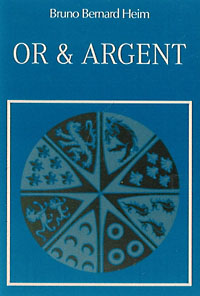
Or and Argent
Hardcover ISBN: 0-905715-24-1 / 978-0-905715-24-7
Limited signed edition, three-quarter leather, ISBN: 0-9-5715-36-5 / 978-0-905715-36-0 £250
24.5 x 18.3 cm. 135 pp. 1994 Van Duren with 23 pages of colour plates, and numerous b/w illus.
With a Preface by the Duke of Norfolk, KG, GCVO, CB, CBE
Earl Marshal of England
As a record of past glories, nothing delights the student as much as heraldry. The information that a coat of arms can give the serious scholar is considerable, and over the past 800 years rules have been evolved to control what can be put in one’s personal arms and how to show one’s descent from other armigerous families.
One of the most intriguing rules is that one is not allowed to put metal on metal – gold and silver (Or and Argent in heraldic terms) – or next to each other. Similarly one must not put colour on colour. The reasoning behind these rules has long been suspect, however, so Archbishop Heim’s work on the history of, and rules concerning, this subject is most timely. While many authorities maintain that the rules of heraldry forbid such neighbourliness, the author here provides ample evidence that this rule is broken as often as it is adhered to.
As a lifelong heraldist and one whose own arms break this ‘sacred’ rule, Archbishop Heim has always been interested in where and when it was made, so he has researched hundreds of works, some dating from the twelfth century, in an attempt to track down its origins. As a result of his detective work he has painted many examples of arms that break the rule, and also shows how earlier writers have got round such a tricky subject.
Or and Argent contains twenty-four full colour plates containing over 360 coats of arms, with examples from every European country, and many others in black and white in the text, all of which break this so-called immutable rule, and a bibliography giving the most important authorities.
As well as the standard edition there is an edition limited to 50 numbered copies hand-bound in morocco and vellum, and signed by the author.
Published by VAN DUREN, an imprint of Colin Smythe Limited
More info →

Armorial Bruno B. Heim
Edited and Introduced by Peter Bander van Duren
Preface by The Earl Marshal of England Major General His Grace the Duke of Norfolk CB, CBE, MC
Blazons for the 'Liber Amicorum et Illustrorum Hospitum' by John George, Garioch Pursuivant
21.5 x 15.5 cm. 224pp. with reproductions in b/w of 143 pages + 18 colour illus Van Duren 1981
This is by any standard the most unusual armorial ever to have been published. In his Preface the Earl Marshal, His Grace the Duke of Norfolk, says: ‘What makes the Liber Amicorum an unusual armorial is that it extends beyond national insularity and embraces heraldry varying in origin and authority, but whatever the source, the creative and imaginative style which Archbishop Heim has developed, makes every shield and crest and device which he treats, a spectacular example of heraldic art. Here the heraldry of Europe is represented side by side with British armorial bearings, and while different heraldic tastes and practices are catered for, by Archbishop Heim’s artistic skills all are brought into colourful harmony. No more fitting tribute could be paid to Archbishop Heim than the first publication of this important and unique work of art.’
In his introduction, the Editor presents a profusely illustrated biographical chapter on Archbishop Bruno B. Heim, the Holy See’s Authority on heraldic matters and the man to whom heraldry in the Catholic Church owes the high standards today.
This is not just an armorial but a unique historic record of one of the most exciting periods in the history of the Catholic Church. Archbishop Bruno B. Heim, the Apostolic Delegate to Great Britain, has done more than any other man towards the creation of harmony and unity between the Holy See and Great Britain, whose relations had been strained for over four hundred years. Historians and heraldists of the future will find this armorial an invaluable source of information because many of the armigers in this volume have a share in the joyful development of those relations between the Holy See and Great Britain.
Some words by Peter Bander-van Duren
Archbishop Heim's ARMORIAL or Liber Amicorum, his guest book for special friends, was published in 1981 to celebrate his seventieth birthday and the centenary of the birth of Pope John XXIII. Apart from having been Pope John's Secretary when the Pontiff was still Archbishop Angelo Roncalli, Apostolic Nuncio to France, none of Pope John's biographies had made mention of his contribution to heraldry. The appointment of Mons. Bruno Heim to his first diplomatic post under Archbishop Roncalli was the beginning of a close cooperation between two outstanding heraldic artists.
'Although I was able to include several facsimile letters from Archbishop Roncalli and other high dignitaries who consulted him on heraldic matters, unfortunately too late for inclusion in the book was a manuscript thesis by Pope John XXIII, written four weeks before his death, explaining the meaning of his personal coat of arms.
'Mons. Heim continued to add armorial bearings of friends and of illustrious guests who paid him a visit, especially when he himself had been consecrated Archbishop and appointed Apostolic Delegate and later Nuncio. During Mons. Heim's appointment to the Court of St. James (1973-1982 as Apostolic Delegate and from 1982 - 1985 as Nuncio) he entertained kings, queens, princes as well as prime ministers and leading figures in literature and the arts, not to mention Pope John Paul II and many eminent men of the Church.
'He had started his work as an heraldic painter at the age of sixteen, and by the time he arrived in the United Kingdom, Archbishop Heim was a well known and highly respected ecclesiastical heraldic artist.
'Medieval simplicity in his heraldic representations was his hallmark, but he was adventurous and never hesitated to give a "rebus" (a heraldic emblem) to those visitors who were not armigerous. Two of them were published all over the world: that of Dame Agatha Christie, the author, and that of The Rt. Hon. Margaret Thatcher, MP, PC, (later Prime Minister and then Baroness Thatcher, Dame of the Noble Order of the Garter). Lady Thatcher is now armigerous; her heraldic banner hangs in St. George's Chapel, Windsor.
'Archbishop Heim designed the coats of arms for Pope John XXIII, Pope Paul VI, Pope John Paul I and Pope John Paul II as well as the armorial bearings for countless cardinals, patriarchs, archbishops and high prelates in the Catholic Church. His book HERALDRY IN THE CATHOLIC CHURCH became the standard reference work in ecclesiastical heraldry. After his retirement from the Holy See's diplomatic service in 1985 it took him more than ten years to complete his last heraldic work Or and Argent, which was originally planned for publication in 1983 but eventually appeared in 1994.
'On occasion Archbishop Heim gave reign to a wicked sense of humour. When a prelate asked him to design for him a coat of arms appropriate to his high social status, he proposed a donkey's head.
Archbishop Heim was later to issue a reproduction of the Liber Amicorum in full colour, with the limitation notice: 'Only thirty copies of this privately produced and augmented coloured edition of my "Liber Amicorum" were made. They are not for sale. This is number [30]"

A Bibliography of the Writings of William Carleton
ISBN: 978-0-86140-188-8
21.6 x 13.8 cm. 241 pp. 1985
William Carleton epitomised the search by nineteenth century Irish writers for a national identity. He spoke in the voice of the Irish peasant and was heard all over the literary world. His books, from the early collection Traits and Stories of the Irish Peasantry (1830) to the late novel Willy Reilly (1855), were tremendously popular, running into many editions in Ireland, England and America. He revised, retitled, and regrouped his works frequently, producing a rich yet confusing body of work, which is fully explored and identified in the first part of this work, the first complete bibliography to have been compiled of the works of William Carleton.
Carleton wrote for a wide range of magazines, from the ultra-Protestant Christian Examiner to the ultra-Catholic Duffy’s Hibernian Magazine. He often used his magazine stories as the basis for later publication in book form, frequently altering and adapting. Dr. Hayley lists Carleton’s contributions to periodicals in their chronological order, also indicating when and where they later appeared. She then devotes a section to criticism of Carleton’s work as it appeared in a surprisingly wide variety of journals and newspapers, from the earliest criticism in his own time up to the present day.
Carleton’s work has long awaited a bibliographer, and Dr. Hayley gives it the full, detailed and illuminating treatment it deserves. It is absolutely essential for everyone studying or collecting his works.

The Harvest Festival
ISBN: 978-0-86140-045-4
22.9 x 14.5 cm. xvi, 91 pp. 1979
The Harvest Festival is Sean O’Casey’s earliest extant play. Written in about 1918 or 1919, it was the second play that O’Casey offered the Abbey Theatre. It was turned down, but he kept the manuscript and it now forms part of the extensive O’Casey archive in the Berg Collection of the New York Public Library. It has never been performed, and this is its first publication in the U.K. and Ireland, following on its U.S. publication by only a few months.
The plot focuses on the turmoil of an outside world of strikes and riots converging on a Dublin city church in the midst of its preparations for a harvest festival. Set in 1913, it deals with Irish workers’ battles against economic oppression and religious hypocrisy, with that vital combination of passion, humour and pathos that distinguishes O’Casey’s later plays. It is a rich melodrama of class struggle, with ironically pointed clashes involving representatives of Church, Employers and Labour.
An incomplete revision of the first act, which O’Casey kept with the original manuscript, is included as an Appendix to show the direction the playwright might have gone had he chosen to revise the entire play: as it is, students of drama will see in The Harvest Festival the seeds of O’Casey’s later works, and the lineal descendants of its characters appear in Red Roses for Me, The Drums of Father Ned, and The Bishop’s Bonfire.
Eileen O’Casey has contributed a foreword entitled ‘Clench Your Teeth’, and John O’Riordan has written an Introduction.
A three-quarter leather edition with wood veneer panels, marbled endpapers, top edges gilt, intended to be limited to 50 copies, ISBN 0-86140-052-6, signed by the writers of the Foreword and Introduction, Eileen O'Casey and John O'Riordan, was also published, but of the 50 copies only 30 were actually bound.
More info →
A History of Chalfont St Peter and Gerrards Cross, and A History of Bulstrode
ISBN: 978-0-86140-319-6
23.4 x 15.5 cm. 189 pp. incl. over 100 illus.
This book contains Revd Geoffrey Edmonds’ work, last published by this company in 1968, and Dr Audrey Baker’s hitherto unpublished history of Bulstrode, past home of Judge Jeffreys, the Dukes of Portland and then the Dukes of Somerset.
While Chalfont St Peter dates back to before the Norman Conquest, and Bulstrode to the time of the Knights Templar, the parish of Gerrards Cross is a newly formed entity, being carved out of five neighbouring parishes, and greatly expanded following the 1906 opening of the London to High Wycombe Great Western & Great Central Joint Railway line which passed through the village.
Through their separate histories both Dr Baker and the Revd Edmonds chart the history of the locality through the centuries, showing how it has evolved from Anglo-Saxon and medieval times, through the Reformation, the Cromwellian period and Restoration, the Hanoverian and Victorian eras to the 20th century, and how the great families who came to live here gained or lost power, rose, fell or moved on, as well as the creation of Gerrards Cross over the past century.
In addition to the hundred or so illustrations within the book (including a number showing the construction of the railway through Gerrards Cross), the cover reproduces a watercolour of Chalfont Park by J.M.W.Turner, that was unknown until 2002.
The index features every person, place and house mentioned by the authors so residents can see what parts of the book relate to their home or the part of the villages in which they live
The Revd Geoffrey Edmonds (1902-75) was born in Rochester, Kent. He obtained an MA degree at Pembroke College, Cambridge, before studying Divinity at Mansfield College, Oxford. He was Congregational Minister at Oxted, Surrey, and in 1950 moved to Gerrards Cross, where he was Minister until his retirement in 1972, and where he continued to live until his death. Apart from being a keen chess player, and a keen historian, he was very interested in the activities of the village, being a Trustee of the Gerrards Cross Memorial Centre, a Governor of the local school and a Rotarian.
After reading Modern History at St Hilda’s College, Oxford, Audrey Baker studied History of Art at the Courtauld Institute and received her doctorate from the University of London. She specialised in medieval art, and published a number of long and detailed articles in major periodicals such Archaeologia, and the Archaeological Journal. She sometimes collaborated with Dr E. Clive Rouse. In the last years of her life she concentrated on local history and published various articles in The Records of Buckinghamshire, the journal of the Buckinghamshire Archaeological Society. Dr Baker and the Revd Geoffrey Edmonds were co-founders of the Chalfont St Peter and Gerrards Cross Local History Society.
More info → 
Yeats at Songs and Choruses
23.3 x 15. 8 cm. xxiv, 283 pp. with over 50 illustrations
A critical work about one of the leading figures in modern poetry, this book shows how Yeats perfected great songs – “Crazy Jane on the Day of Judgment”, “Three Things”, “After Long Silence”, “Her Triumph” – and great choruses – “Colonus’ Praise”, “From ‘Œdipus at Colonus’” and “From the ‘Antigone’”. The author follows the manuscript development of each poem to discover its full context in life and culture, to illuminate obscurities in the finished text, or simply to witness in amazement the emergence of a true poem from a tangle of abstractions. As a result, the reader is given original and interesting interpretations of the songs and choruses as final works of art.
“When I prepared ‘Œdipus at Colonus’ . . . wrote Yeats, “I saw that the wood of the Furies . . . was any Irish haunted wood.” Clark shows that Yeats remembered Greece when he wrote songs for Crazy Jane. Greek myth appears in the songs, and Greek choruses appear in the “Irish” song cycles. The last word in “A Man Young and Old” is spoken of Œdipus and the last word in “A Woman Young and Old” of Antigone. Classical figures rub elbows with Huddon and Duddon and Daniel O’Leary. In “Her Triumph” the woman sees herself and her lover as Perseus and Andromeda.
Paintings, often of mythological subjects, were part of the context for Yeats’s poems. Yeats was an art student and the son and brother of well-known painters. The manuscripts show exactly what paintings – by Bellini, Carpaccio, Titian – were in Yeats’s thought when he wrote “Her Triumph” and Clark concludes that one of Burne-Jones’s Perseus series was the chief model for the poem’s imagery. Other poems, too, were written in the context of Yeats’s knowledge of art. Relevant illustrations are included. Manuscripts too are photographically reproduced.
Among the many comments on Clark’s skill as an interpreter of Yeats are: “Clark varies his approach to fit the materials at hand: with one poem he will emphasize the visual sources, for example, whereas with another lyric he will concern himself with biographical matters . . . Clark’s scholarship is quite sound, and he is working at the frontiers of Yeats scholarship.” – Richard J. Finneran, editor, Anglo-Irish Literature, A Review of Research
“Clark’s intricate analysis of Yeats’s ‘After Long Silence’ is a jewel of scholarship, moving and illuminating: in his analysis of the poem, and of the manuscripts out of which it emerged, Clark seems to have moved for a moment into Yeats’s mind.” - Robert O’Driscoll, The University of Toronto Quarterly.
'A pleasure to read....a book for anyone interested in Yeats or the creative process, a real contribution to Yeats studies.' Books Ireland'A pleasure to read....a book for anyone interested in Yeats or the creative process, a real contribution to Yeats studies.' Books Ireland
Professor of English at the University of Massachusetts, Amherst, David Clark was the author of Lyric Resonance: Glosses on Some Poems by Yeats, Frost, Crane, Cummings and Others and of Dry Tree: Poems. He has also either edited or coedited a number of works on modern literature and on Irish culture.

Four Plays by The Charabanc Theatre Company: ‘Inventing Women’s Work’
Chosen, edited and introduced by Claudia Harris
ISBN: 978-0-86140-438-4
21.6 x 13.8 cm. liv, 258pp. + 8pp. with 16 illus. hardback November 2005
>
The Charabanc Theatre Company played a major role in Northern Ireland’s theatrical renaissance during the 1980s. Charabanc was formed by five out-of-work Belfast actresses (Marie Jones, Maureen Macauly, Eleanor Methven, Carol Moore, Brenda Winter) who first collected stories and then collaborated in writing and performing highly original plays for enthusiastic audiences. From 1983 to 1995, the company toured twenty-tour productions extensively throughout Ireland and the world, spreading their own particular brand of exuberant, dark humour.
The four plays in this collection – Now You’re Talking (1985), Gold in the Streets (1986), The Girls in the Big Picture (1986), and Somewhere Over the Balcony (1987) – represent the creative high point of the company. These entertaining plays show the broad range of the company’s work: portraits of urban and rural women; early, mid-, and late twentieth century settings, and various social, religious, historical political, or personal relations.
Marie Jones, Eleanor Methven, and Carol Moore were the remaining company principals during the mid-1980s when these four plays were created and performed. Marie Jones became the main writer for Charabanc and after leaving the company in 1990 has continued to write, notably the award-winning Stones in His Pockets. Eleanor Methven and Carol Moore continued on as artistic directors until they disbanded the company in 1995. Eleanor Methven now lives in Dublin and is a sought-after actress for stage and screen, and her first screenplay is in development with Journeyman Films. Carol Moore obtained an MA from Queen’s University, Belfast, and still acts for stage and film, but is now primarily an accomplished stage and screen director; in May 2005 she received a NESTA (National Endowment for Science Technology and the Arts) Fellowship.
More info →
An International Companion to the Poems of W. B. Yeats
ISBN: 978-0-86140-193-2
21.6 x 13.8 cm 255 pp. 1989
W.B.Yeats is one of the most important and widely-read poets of the twentieth century, occupying a central position in literature courses throughout the world. Yet he is often presented in critical works as a ‘difficult’ poet who can only be understood by reference to other writings that must be used as keys to unlock the mysteries of his work. It is the belief of the authors of this book that the poetry must be approached on its own terms, and its meanings established in as simple a way as possible before these texts can be enriched by knowledge of the biographical, historical, philosophical or aesthetic contexts.
This book is an essential companion to the poetry of Yeats for students in every country where his work is known. It sets out to meet the demands both of those whose first language is English, and of those for whom it is their second. Consequently the core of this volume is a detailed study of some ninety poems which cover all phases of Yeats’s poetic development. Each poem is provided with a summary, glossary and commentary, based on the primary meaning. The poems are also set in both the immediate context of the collections in which they were first published, and the wider context of the evolution of Yeats’s art and philosophy.
The Companion has a general commentary section dealing with Yeats’s style, his symbolism, his vision, the people and places that appear in his works, and the role of magic, myth, legend, history, civilization, nationalism and politics in the poems. There is also a useful list of recommended works, and basic texts.

Kahlil Gibran of Lebanon: A Re-evaluation of the Life and Works of the Author of ‘The Prophet’
ISBN: 978-0-86140-279-3
21.6 x 13.8 cm.
Kahlil Gibran of Lebanon is a guide for all those interested in the life and work of Kahlil Gibran who want further information, be they general readers or scholars.
It explains the fascinating world of the author of The Prophet which is one of the most celebrated works of the twentieth century. Modelled on Gibran’s own writings, simple and concise in presentation, the first half of this work is devoted to significant events in Gibran’s life. It provides the reader with the necessary back ground to his writing and painting, with particular reference to the individuals and and works that have been major influences. These are further explored in the second half, which is a critical study of Gibran’s work and contribution to the literature of the world.
Suheil died in September 2015. Obituaries can be found at http://ysnews.com/news/2015/09/suheil-badi-bushrui and at http://www.baltimoresun.com/news/obituaries/bs-md-ob-suheil-bushrui-20150927-story.html, https://arabhyphen.wordpress.com/2015/09/10/suheil-badi-bushrui-passes-away-1929-2015/ and elsewhere.
CONTENTS
Introduction
PART 1, HIS LIFE: Family background and early years - Kahlil Gibran and Mary Haskell - Early career in Boston, Paris and New York - Maturity - Last years.
PART 2, HIS WORK: Early Arabic writings - Influences and parallels in the mature works - Mature works up to The Prophet - The Prophet - Last works.
Notes.
Bibliography
More info →

Orders of Knighthood and of Merit
The Pontifical, Religious and Secularised Catholic-founded Orders and their relationship to the Apostolic See
Hardcover ISBN: 0-86140-371-1 / 978-0-86140-371-4 £70.00
Limited signed edition, three-quarter morocco, vellum panels, marbled end-papers, in slip-case ISBN: 0-86140-380-0 / 978-0-86140-380-6 £450.00
23.4 x 15.5 cm. xvi, 714 pp. + 48pp colour illustrations and with c.400 b/w illustrations within the text
Since the publication in 1983 of Archbishop Cardinale’s Orders of Knighthood, Awards and the Holy See, and the two later editions (1984 and 1985) edited and revised by Peter Bander van Duren, whose own work The Cross on the Sword appeared in 1987, there have been major changes in the Holy See’s attitude towards Orders of Knighthood. These changes have meant that large sections of both books are now out of date, so it has been necessary for Peter Bander van Duren to completely rewrite and update the work Archbishop Cardinale began, and without which this book could not have been written.
Orders of Knighthood and of Merit presents the many Catholic-founded Orders of Knighthood in a new perspective, and deals not only with the Pontifical Equestrian Orders and the two surviving religious Orders of Knighthood, but with the many Catholic-founded but secularised Orders – dynastic, state and crown – that exist today. He examines their relationship, where one exists, to the Apostolic See and the Papacy in the light of the changes that have taken place, as well as the dichotomy between the different rôles and functions of the Holy See and the Apostolic See, the Mater et Magistra of all Catholic-founded Orders of Knighthood. Having been able to study various source materials hitherto and not since available to others, he exposes the misunderstandings and misinformation that exist in this field, and highlights errors that have been perpetuated, sometimes for centuries, through genuine lack of information, as well as those that, for political expediency, have been deliberately concealed.
The chapter and appendices on the Pontifical Orders of Knighthood are designed to assist papal knights in their rôle and functions that their appointments have given them.
The author places the Catholic-founded Orders of Knighthood in perspective, and shows that the continued existence of many of them is based not only on authoritative ecclesiastical and temporal documents of foundation, Papal Briefs and Bulls, but also on their lay apostolate which has continued without interruption.
Neither the Codex Iuris Canonici in force from 1917 to 1983, nor that governing the Catholic-founded Orders during the pontificate of St. Pius X (who more than any other pope laid the foundations for the Pontifical Orders as we know them today), created the present situation where necessity dictates that one has to distinguish between the rôle and functions of the Apostolic See and the Holy See: this dichotomy was created by the 1983 Codex Iuris Canonici. The author shows the paradox that would arise if those who wish to equate them according to the latter’s rather vague Canons are not challenged to clarify their positions: their rulings would nullify the present enormous value of many of the Catholic-founded Orders to the Apostolic See and, indeed, to the whole Church. The author goes so far as to suggest that if the authority and the supremacy of the Apostolic See were to be further diminished, those mighty armies that once protected our Christian civilisation will have lost their raison d’être.
Special attention is paid to dynastic Orders of Knighthood, especially those that although secularised, in some cases for centuries, still fulfil a lay apostolate. Many state and dynastic Orders were secularised during the Reformation, and while they no longer have any link with the Apostolic See, they retain the character and insignia of their former existence, and now have a reciprocal relationship with the Holy See in its capacity as a sovereign power. Extinct Catholic-founded Orders, as well as those organisations that without justification claim chivalric status, are dealt with in detail. One of the most important matters dealt with by the author, and not hitherto considered elsewhere, is the raison d’être of several Orders, and some aspects of Hospitaller as well as Military Orders are also examined.
For over half the last millennium, from the time of the first Crusade to the latter half of the seventeenth century, members of Catholic-founded Orders of Knighthood were at the forefront of the defence of West European civilization, and the author suggests that they may once again find a rôle. There are also many appendices that give a wealth of information not readily available to those interested in phaleristics – the study of Orders, decorations and honours bestowed on meritorious individuals. Orders of Knighthood and of Merit is therefore one of the most important contributions to the study of phaleristics that has been published in the past decades.
CONTENTS
I. The involvement of the Apostolic See and the Holy See in the field of chivalry – The origin and evolution of Orders of Knighthood.
II. THE PONTIFICAL ORDERS OF KNIGHTHOOD. The origin and evolution of Pontifical Orders of Knighthood and the attitude of individual pontiffs to the Orders – The Supreme Order of Christ – The Order of the Golden Spur, or The Golden Militia – The Golden Collar of the Pian Order – The Order of Pius IX – The Order of St. Gregory the Great – The Order of Pope St. Sylvester – Corollary on non-Catholic Knights of the Order of St. Gregory the Great.
III. PAPAL KNIGHTS. The rôle and function of the Pontifical Equestrian Orders – The procedure for admission – The implications of the Supreme Pontiff being the fons honorum of Pontifical Knighthoods.
IV. PONTIFICAL RELIGIOUS AWARDS OF MERIT. The Golden Rose – The Cross ‘Pro Ecclesia et Pontifice’ – The Medal ‘Benemerenti’.
V. RELIGIOUS BUT NON-PONTIFICAL ORDERS OF KNIGHTHOOD. The Sovereign Military Hospitaller Order of St. John of Jerusalem, of Rhodes and of Malta – The Most Venerable Order of the Hospital of St. John of Jerusalem – The Equestrian Order of the Holy Sepulchre of Jerusalem.
VI: A TRANSFORMED RELIGIOUS ORDER OF KNIGHTHOOD: The Teutonic Order.
VII. CATHOLIC-FOUNDED DYNASTIC ORDERS. Their nature, rôle and function, and their relationship with the Apostolic See
The Noble Order of the Golden Fleece of Burgundy
The Imperial and Royal House of Habsburg-Lorraine – The Noble Order of the Golden Fleece of Austria – The Order of the Dames of the Starry Cross
The Royal House of Bragança of Portugal – The Order of Our Lady of the Conception of Vila Viçosa – The Royal Order of Saint Isabel
The Royal House of Bourbon of the Two Sicilies – The Sacred Military Constantinian Order of St. George – The Royal Order of St. Januarius
The Royal House of Savoy-Italy – The Supreme Order of the Most Holy Annunziata – The Order of SS. Maurice and Lazarus
The Royal House of Bavaria Wittelsbach – The Order of St. George – The Order of St. Hubert – The Order of St. Michael
The Royal House of Bourbon of France – The Royal House of Bourbon Orléans – The Order of the Holy Ghost – The Royal and Military Order of St. Louis – The Order of St. Michael of France
The Ducal House of Habsburg-Tuscany: The Grand Duchy of Tuscany – The Order of St. Stephen – The Order of St. Joseph.
VIII. SECULARISED CATHOLIC-FOUNDED ORDERS OF KNIGHTHOOD STILL BESTOWED AS CROWN OR STATE ORDERS
Denmark: The Order of the Elephant; The Order of the Dannebrog
Great Britain and Northern Ireland: The Most Noble Order of the Garter; The Most Ancient and Most Noble Order of the Thistle; The Most Honourable Order of the Bath; Knights Bachelor
Monaco: The Order of St. Charles
The Republic of Poland: The Order of the White Eagle; The Order of ‘Polonia Restituta’
The Republic of Portugal: The Riband of the Three Orders; The Military Order of the Tower and the Sword, of Valour, Loyalty and Merit (although not a Catholic-founded Order); The Military Order of Christ; The Military Order of Avis; The Military Order of St. James of the Sword
San Marino: The Equestrian Order of St. Marino; The Equestrian Order of St. Agatha
Spain: The Noble Order of the Golden Fleece (Spanish branch); The Monastic Military Orders of Alcantara, of Calatrava, of Montesa & of Santiago; The Most Distinguished Order of Carlos III; The Order of Isabella the Catholic; The Military Order of St. Ferdinand; The Royal & Military Order of St. Hermenegildus; The Orders of Cisneros, & of St. Raymond of Peñafort
Sweden: The Royal Order of the Sword (The Order of the Yellow Ribbon); The Royal Order of the Seraphim
IX. EXTINCT CATHOLIC-FOUNDED ORDERS OF KNIGHTHOOD
X. THE MILITARY AND HOSPITALLER ORDER OF ST. LAZARUS OF JERUSALEM
XI. RECOGNIZED KNIGHTLY ORGANISATIONS. The Association of the Knights of Columbus -
The Knights and Dames of St. Michael of the Wing
XII. THE SPIRIT OF CHRISTIAN CHIVALRY TODAY
XIII. UNRECOGNISED ORGANISATIONS STYLING THEMSELVES ORDERS OF KNIGHTHOOD
APPENDICES
1. Pontifical Equestrian Orders: Papal Letters of Foundation and Decrees
2. Additional Guidelines for Papal Knights and Investitures
3. Conferment of Pontifical Religious Awards
4. The Pontifical Medal
5. The Pontifical Corps of Guards: the Pontifical Noble Guard – The Pontifical Swiss Guard – The Palatine Guard of Honour – The Pontifical Gendarmerie
6. Perrot’s List of Extinct Orders
7. On Chronological Lists of Orders of Knighthood
8. The Prerogatives of the Dukes of Bragança
9. Bull of Foundation of the Portuguese Order of Christ and Royal Brief of Acceptance by King Dom Dinis I
10. Insignia as objets d’art
11. Orders and Decorations of the Republic of Poland
12. Appointment of S.A.R. Don Carlos de Borbón-Dos Sicilias y Borbón-Parma as Infante of Spain
SELECT BIBLIOGRAPHY
Index
More info →

The Cross on the Sword
A Supplement to 'Orders of Knighthood, Awards and the Holy See'
ISBN: 978-0-905715-32-2
23.5 x 15.5 cm. 196 pp. illus. Van Duren 1987
With an Introduction by Archbishop, later Cardinal, Jacques Martin
This book attests to the fact that there is nothing more ancient, more venerable, more diversified than the Orders of Chivalry that have existed or still exist, and more desired, more sought after by certain people, than a papal decoration. It is always necessary to underline the essential differences between temporal decorations and those that are conferred by the sovereign Pontiff. A papal knighthood is not to be viewed solely as an honour, as a reward: it also incorporates a duty and a mission, that of serving and protecting the person of the Vicar of Christ. Papal Knights form a sort of army, on the devotion of which the Pope must be able to rely. To the Knight it is not the honour that matters but his obligations and services. + Jacques Cardinal Martin
Peter Bander van Duren's The Cross on the Sword is a supplement to his edition of the late Archbishop H.E. Cardinale's Orders of Knighthood, Awards and the Holy See (1985), and consolidates his revisions and additions that appeared in that work.
The first part deals with the statutes and regulations concerning the Pontifical Equestrian Orders of Pius IX, St. Gregory the Great and Pope St. Sylvester, the privileges granted to Papal Knights and their juridical position. As His Excellency Archbishop Jacques Martin writes in his introduction the author had to rely, for the information in this section, on ‘the Papal Briefs of the Orders' founders and the provisions made for the Papal Knights by Pope St. Pius X, many of which were contained in personal directives. It was left to Peter Bander van Duren to interpret them in the light of today's need as the Holy Father wrote them over eighty years ago.’
For the first time in the history of the Papal Knights, guidelines have been devised for an investiture ceremony, and the question of precedence has been examined in the light of the privileges granted to Papal Knights by Pope St. Pius X.
Part II deals with general juridical questions arising from Archbishop Cardinale's work, particularly the position of Catholic Orders of Knighthood that he stated were ‘extinct’, ‘abolished’, ‘suppressed’ or ‘in abeyance’. The author also examines the degree of importance that should be attached to the Bullarium Romanum when establishing the status of an Order.
Part III contains addenda to the 1985 edition of Orders of Knighthood, Awards and the Holy See concerning Catholic and Catholic-founded Orders of Knighthood, and Part IV introduces two Christian but not Catholic Orders, each unique in their nature.
The Cross on the Sword is a most useful work, not only for Papal Knights and everyone who may at one time or another be connected with their investiture ceremonies — Parish Priests, Masters of Ceremonies, diocesan and parochial administrations, for example — but also for everyone who is interested in Orders of Chivalry, and their continuing role in the world today. The illustrations not only show insignia — medals and uniforms — of the Orders examined in this book, but also illustrate the ceremonies themselves, adding a further dimension to the help that this work provides for the reader.

Ze-Ami and his Theories of Noh Drama
ISBN 978-0-86140-214-4 21.6 x 13.8 cm.
For over five centuries the essays of Ze-Ami – considered, with his father Kan-Ami, to be the founder of Noh, the classical dance-drama of Japan – were kept secret. They were not shown to more than one Noh actor in each generation until recently. Though they contain a large number of paradoxes and contradictory statements as well as a great deal of repetition, they were regarded as a Bible by actors in the Noh technique. As repetition was a constant feature in training and in techniques in many arts in Japan, and as paradox had often been used in the search for the truth in Zen, so Ze-Ami's essays were accepted, despite their repetitions, paradoxes and contradictions. They were not. however, easily translatable, and they benefit from being edited.
In this work therefore, Ze-Ami's ideas are dealt with in eight chapters: The History of Noh: Five Groups of Noh Plays: Training: Acting: Writing a Play: Public Tachiai Competitions and Grades of Acting: The Audience: and Hana. This arrangement presents Ze-Ami's ideas with some order and consistency. Relevant sections of eighteen essays by Ze-Ami are translated and discussed. These include Fushi-kaden, Kashū, Ongyoku-Kowadashi-kuden, Kukyō, Shikadō, Nikyoku-Santai-Ningyōzu, Sandō, Fushizuke-shidai Fukyokushū, Yūgaku-Shūdō-Fūcken, Goi, Kyūi, Rikugi, Shūgy-okutokuka, Goonkyoku-Jōjō, Goon, Shūdosho, Kyakurui-ku, and Zeshi-Roku-juigo-Sarugaku-Dangi.
This volume is a most useful introduction to an understanding of Noh history, practice, and technique, for all readers in the West, written as it is by a trained Noh actor..

A Dictionary and Glossary for the Irish Literary Revival
ISBN: 978-0-86140-359-2
This work is intended to provide the general reader, as well as the specialist, with access to an important but neglected element of Irish literature in English: its vocabulary and idioms.
Over seventy years have elapsed since the establishment of an independent Irish state, but for complex socio-political reasons there is, as yet, no dictionary of Irish-English to which readers can turn for assistance when they encounter unfamiliar words and phrases or apparently familiar words usedunconventionally by Irish writers.
The focus of this work is the writers of the Irish Literary Revival, but their use of Irish-English is so extensive that it is relevant to the entirefield of Irish literature in English from its beginnings in the seventeenth century to the present.
Almost all aspects of Ireland and Irish life over the past 400 years are mirrored here: agricultural, economic, educational, linguistic, military, political, religious and social history as well as animals, emigration, drink, food, folklore, geography, music, mythology, plants, sports and even the mercurial Irish weather.
More info →