

Yeats at Songs and Choruses
23.3 x 15. 8 cm. xxiv, 283 pp. with over 50 illustrations
A critical work about one of the leading figures in modern poetry, this book shows how Yeats perfected great songs – “Crazy Jane on the Day of Judgment”, “Three Things”, “After Long Silence”, “Her Triumph” – and great choruses – “Colonus’ Praise”, “From ‘Œdipus at Colonus’” and “From the ‘Antigone’”. The author follows the manuscript development of each poem to discover its full context in life and culture, to illuminate obscurities in the finished text, or simply to witness in amazement the emergence of a true poem from a tangle of abstractions. As a result, the reader is given original and interesting interpretations of the songs and choruses as final works of art.
“When I prepared ‘Œdipus at Colonus’ . . . wrote Yeats, “I saw that the wood of the Furies . . . was any Irish haunted wood.” Clark shows that Yeats remembered Greece when he wrote songs for Crazy Jane. Greek myth appears in the songs, and Greek choruses appear in the “Irish” song cycles. The last word in “A Man Young and Old” is spoken of Œdipus and the last word in “A Woman Young and Old” of Antigone. Classical figures rub elbows with Huddon and Duddon and Daniel O’Leary. In “Her Triumph” the woman sees herself and her lover as Perseus and Andromeda.
Paintings, often of mythological subjects, were part of the context for Yeats’s poems. Yeats was an art student and the son and brother of well-known painters. The manuscripts show exactly what paintings – by Bellini, Carpaccio, Titian – were in Yeats’s thought when he wrote “Her Triumph” and Clark concludes that one of Burne-Jones’s Perseus series was the chief model for the poem’s imagery. Other poems, too, were written in the context of Yeats’s knowledge of art. Relevant illustrations are included. Manuscripts too are photographically reproduced.
Among the many comments on Clark’s skill as an interpreter of Yeats are: “Clark varies his approach to fit the materials at hand: with one poem he will emphasize the visual sources, for example, whereas with another lyric he will concern himself with biographical matters . . . Clark’s scholarship is quite sound, and he is working at the frontiers of Yeats scholarship.” – Richard J. Finneran, editor, Anglo-Irish Literature, A Review of Research
“Clark’s intricate analysis of Yeats’s ‘After Long Silence’ is a jewel of scholarship, moving and illuminating: in his analysis of the poem, and of the manuscripts out of which it emerged, Clark seems to have moved for a moment into Yeats’s mind.” - Robert O’Driscoll, The University of Toronto Quarterly.
'A pleasure to read....a book for anyone interested in Yeats or the creative process, a real contribution to Yeats studies.' Books Ireland'A pleasure to read....a book for anyone interested in Yeats or the creative process, a real contribution to Yeats studies.' Books Ireland
Professor of English at the University of Massachusetts, Amherst, David Clark was the author of Lyric Resonance: Glosses on Some Poems by Yeats, Frost, Crane, Cummings and Others and of Dry Tree: Poems. He has also either edited or coedited a number of works on modern literature and on Irish culture.

A Study of the Novels of George Moore
21.6 x 13.8 cm. 271 pp. 1978 Irish Literary Studies series (ISSN 0140-895X) volume 3
George Moore once complained, after warmly appreciative reviews of a novel, 'So few bother to analyse the book carefully. It would have been very easy to discuss the form, compare my treatment of it with others' treatment of similar themes and so on, yet apparently no one has ever thought of that.' This rueful remark was the starting point in Richard Cave's design of this study. He has examined each of Moore's novels in detail and viewed them within the pattern of his total development and in the context of Moore's current reading and ideas about technique, as well as assessing the value of a wide range of influences to him. Professor Cave's study is basically divided into three parts: 'The Novel of Social Realism', which deals with A Modern Lover, A Mummer's Wife, A Drama in Muslin and Esther Waters; 'A Phase of Experiment' deals with new influences and the resultant problems, the four novellas, Wagner's influence, Evelyn Innes and Sister Teresa; and 'Styles for Consciousness' – The Lake, The Brook Kerith and the late historical novels, followed by a conclusion.
Author's Note<br
Introduction Part One: THE NOVEL OF SOCIAL REALISM<br
1. A Modern Lover<br
2. A Mummer's Wife<br
3. A Drama in Muslin<br
4. Esther Waters Part Two: A PHASE OF EXPERIMENT<br
5. New Influences – New Problems<br
6. Four Novellas<br
7. Wagner and the Novel<br
8. Evelyn Innes and Sister Teresa Part Three: STYLES FOR CONSCIOUSNESS<br
9. The Lake – The Wagnerian Novel Perfected<br
10. The Brook Kerith and the Late Historical Novels<br
Conclusion Notes Index Richard Allen Cave, Emeritus Professor of Drama and Theatre Arts at Royal Holloway in the University of London, has published extensively in the fields of renaissance drama (Jonson, Webster, Brome), modern English and Irish theatre (Wilde, Yeats, Pinter, Beckett, Friel, Mc Guinness), dance (Ninette de Valois, Robert Helpmann), stage design (Charles Ricketts, Robert Gregory) and direction (Terence Gray). Most recently, he devised and was General Editor of an AHRC-funded project to create an online edition of The Collected Plays of Richard Brome (2010), and published the monograph, Collaborations: Ninette de Valois and William Butler Yeats (2011). The Collected Brome is soon to be published in a more traditional book-format by Oxford University Press (2020). He has also edited the plays of Wilde, Yeats and T.C. Murray; and the manuscript versions of Yeats’s The King of the Great Clock Tower and A Full Moon in March. Professor Cave is a trained Feldenkrais practitioner who works on vocal techniques with professional actors and on extending movement skills with performers in physical theatre.
<br

New British Drama in Performance on the London Stage 1970-1985
ISBN: 978-0-86140-321-9
21.6 x 13.8 cm revised edition of the 1988 hbk
The works of established dramatists and of new talents are examined from the stand-point of the original production and initial casts, the major dramatists studied being Alan Ayckbourn, Samuel Beckett, Edward Bond, Trevor Griffiths, David Hare, Harold Pinter, Tom Stoppard, and David Storey. A central theme of the book is the current relationship between the author and the actor.
CONTENTS
Harold Pinter
New Forms of Comedy: Ayckbourn and Stoppard
Monologues and Soliloquies: Samuel Beckett
Poetic Naturalism: David Storey
Political Drama and David Hare
Trevor Griffiths
The History Play: Edward Bond
'As drama in performance is now, rightly, given such prominence in the study of playwrights and plays there is obvious need for an intelligent and sensitive book which looks at recent drama in the context of the stage. This is exactly what Richard Cave presents in his latest work. . . . this is a book which future historians will be grateful for, and which ordinary readers can dip into for the pleasure of reliving, or vicariously experiencing for the first time, the peculiar excitement of seeing new plays that constitute a new theatrical event.' R.P.Draper in Times Higher Education Supplement
Richard Allen Cave, Emeritus Professor of Drama and Theatre Arts at Royal Holloway in the University of London, has published extensively in the fields of renaissance drama (Jonson, Webster, Brome), modern English and Irish theatre (Wilde, Yeats, Pinter, Beckett, Friel, Mc Guinness), dance (Ninette de Valois, Robert Helpmann), stage design (Charles Ricketts, Robert Gregory) and direction (Terence Gray). Most recently, he devised and was General Editor of an AHRC-funded project to create an online edition of The Collected Plays of Richard Brome (2010), and published the monograph, Collaborations: Ninette de Valois and William Butler Yeats (2011). The Collected Brome is soon to be published in a more traditional book-format by Oxford University Press (2020). He has also edited the plays of Wilde, Yeats and T.C. Murray; and the manuscript versions of Yeats’s The King of the Great Clock Tower and A Full Moon in March. Professor Cave is a trained Feldenkrais practitioner who works on vocal techniques with professional actors and on extending movement skills with performers in physical theatre.
More info →
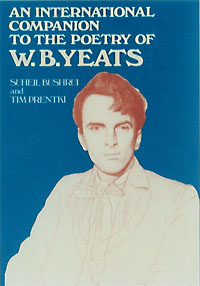
An International Companion to the Poems of W. B. Yeats
ISBN: 978-0-86140-193-2
21.6 x 13.8 cm 255 pp. 1989
W.B.Yeats is one of the most important and widely-read poets of the twentieth century, occupying a central position in literature courses throughout the world. Yet he is often presented in critical works as a ‘difficult’ poet who can only be understood by reference to other writings that must be used as keys to unlock the mysteries of his work. It is the belief of the authors of this book that the poetry must be approached on its own terms, and its meanings established in as simple a way as possible before these texts can be enriched by knowledge of the biographical, historical, philosophical or aesthetic contexts.
This book is an essential companion to the poetry of Yeats for students in every country where his work is known. It sets out to meet the demands both of those whose first language is English, and of those for whom it is their second. Consequently the core of this volume is a detailed study of some ninety poems which cover all phases of Yeats’s poetic development. Each poem is provided with a summary, glossary and commentary, based on the primary meaning. The poems are also set in both the immediate context of the collections in which they were first published, and the wider context of the evolution of Yeats’s art and philosophy.
The Companion has a general commentary section dealing with Yeats’s style, his symbolism, his vision, the people and places that appear in his works, and the role of magic, myth, legend, history, civilization, nationalism and politics in the poems. There is also a useful list of recommended works, and basic texts.

James Joyce: an International Perspective
21.6 x 13.8 cm. xiv, 301 pp. 1982 Irish Literary Studies series (ISSN 0140-895X) volume 10
Published to mark the centenary of Joyce's birth, this collection has a foreword by Richard Ellmann, a message from Samuel Beckett, and essays by Bernard Benstock, Paul & Sylvia Botheroyd, Terence Brown, Suheil Bushrui, Paul van Caspel, Dominic Daniel, Phillip Herring, Declan Kiberd, Augustine Martin, Vivian Mercier, David Norris, John Paul Riquelme, Charles Rossmann, Ann Saddlemyer, Thomas F.Staley and Francis Warner, as well as poems by Suzanne Brown, Suheil Bushrui, John Montague and Gearóid Ó Clérigh, and a chronology. It covers every aspect of Joyce's work, with essays on each of the major works, on his poetry, and studies on various aspects of his life, the influence of Rimbaud, Joyce's connections with the Irish Dramatic Movement, and Joyce in Dublin, as well as essays on Joyce scholarship up to the date of publication.
'All in all, a rewarding compilation, rarely arid, and frequently vivacious.' Sunday Tribune
'an excellent book, one of the most provocative and rewarding in the current centenary-year cornucopia.' Books Ireland'
CONTENTS<br
A Message from Samuel Beckett<br
In Memoriam Sir Desmond Cochrane 1918-1979<br
Foreword: JOYCE AFTER A HUNDRED YEARS. Richard Ellmann<br
Acknowledgements<br
Introduction. Suheil Badi Bushrui and Bernard Benstock<br
JAMES JOYCE - NÓ SÉAMAS SEOIGHE. Gearóid Ó Clérigh<br
DUBLIN OF DUBLINERS. Terence Brown<br
THE READER'S ROLE IN A PORTRAIT OF THE ARTIST AS A YOUNG MAN. Charles Rossman<br
EXILES: A MORAL STATEMENT. Dominic Daniel<br
ON THE NATURE OF EVIDENCE IN ULYSSES. Bernard Benstock<br
JOHN EGLINTON AS SOCRATES: A STUDY OF `SCYLLA AND CHARYBDIS'. Vivian Mercier<br
TWISTS OF THE TELLER'S TALE: FINNEGANS WAKE. John Paul Riquelme<br
THE POETRY OF JAMES JOYCE. FRANCIS WARNER<br
JAMES JOYCE. John Montague<br
A TURNIP FOR THE BOOKS: JAMES JOYCE, A CENTENARY TRIBUTE. David Norris<br
SIN AND SECRECY IN JOYCE'S FICTION. Augustine Martin<br
THE VULGARITY OF HEROICS: JOYCE'S ULYSSES. Declan Kiberd<br
NIGHT FOX: FOR JAMES JOYCE. Suzanne Brown<br
JOYCE AND RIMBAUD. AN INTRODUCTORY ESSAY. Phillip Herring<br
JAMES JOYCE AND THE IRISH DRAMATIC MOVEMENT. Ann Saddlemyer<br
THE WANDERS: FOR JAMES JOYCE. Suheil Bushrui<br
JOYCE STUDIES IN THE NETHERLANDS. Paul van Caspel<br
JOYCE IN GERMANY AND SWITZERLAND. Paul and Sylvia Botheroyd<br
JOYCE IN THE ARAB WORLD. Suheil Bushrui<br
FOLLOWING ARIADNE'S STRING: TRACING JOYCE SCHOLARSHIP<br
INTO THE EIGHTIES. Thomas F.Staley<br
CHRONOLOGY. Suheil Bushrui<br
Notes on Contributors<br
Index
More info →
William Carleton, the Authentic Voice
21.6 x 13.8 cm. l, 455 pp. 2006 Irish Literary Studies series (ISSN 0140-895X) volume 53
The William Carleton Summer School is one of the most important literary festivals on the island in that there are very few that make a point of studying an aspect of Ireland before the Great Famine. William Carleton (1794-1869) is the greatest author to have written about the Irish peasant and the Ireland of the period immediately preceding it: he enables the reader to think back past the Famine into the culture – particularly the peasant culture – of that time, confused, rich, tortured, bilingual, that made him as a writer.
Enjoying immense popularity during his lifetime, his popularity dwindled but a century after his death it began to revive, not least because of the influence of the Summer School. The lectures given at the School and revised for publication in William Carleton, The Authentic Voice provide ample evidence that he was one of the greatest entertainers of Irish literature in English.
This volume also contains contemporary portraits of Carleton, reproduces previously unpublished letters and documents, a chronology, publication history of his writings, provides fine line illustrations by Sam Craig and detailed maps of the countryside he loved and wrote about, so this is an indispensable book for everyone interested in Carleton and pre-Famine Ireland.
Edited by Gordon Brand, the collection contains contributions by Gordon Brand, Terence Brown, Brian Earls, Peter Denman, Owen Dudley Edwards, Marianne Elliott, Thomas Flanagan, Roy Foster, Maurice Harmon, Seamus Heaney, Eamonn Hughes, Jack Johnston, John Kelly, Declan Kiberd, David Krause, Robin Marsh, John Montague, Pat John Rafferty, Sean Skeffington, Barry Sloan, Norman Vance, and Robert Welch.
More info →


Pater in the 1990s
ISBN: 978-0-944318-05-8
Walter Pater (1839-1894) was one of the Transition Era's most influential figures. In this collection of essays, distinguished scholars continue research into his life. Subjects are included for the apprentice as well as the expert: from a scandal during Pater's Oxford days, to the influences upon him by Wordsworth and Arnold, and in turn to his influence upon Hopkins and Joyce. Contributors include: Billie A. Inman, Gerald Monsman, J.P. Ward, Lesley Higgins, F.C. McGrath, Paul Tucker, Richard Dellamora, Hayden Ward, J.B. Bullen, M.F. Moran, Bernard Richards, Anne Varty, Jane Spirit.
More info →
Selected Plays of Dion Boucicault
Chosen and Introduced by Andrew Parkin
The fourth volume of the Irish Drama Selections series (ISSN 0260-7962), General Editors: Joseph Ronsley and Ann Saddlemyer.
21.6 x 13.8 cm. 416 pp. 2009 2nd, enlarged edition
Contains: London Assurance, The Corsican Brothers, The Octoroon, The Colleen Bawn, The Shaughraun, Robert Emmet, bibliographical checklist. plus Boucicault's "'Canterin' Jack' - A Sketch from Life. How The Shaughraun was originated'.
Dion Boucicault was a prominent playwright and prolific adapter of foreign plays and novels. He is known and loved especially for his high melodrama. Extremely popular on the Victorian commercial theatre for over forty years, his plays today still provide enjoyment to all audiences Born in Dublin, he achieved his first West End success with London Assurance in 1841. His work frankly catered to contemporary taste and fell rapidly into neglect after his death in 1890, but his lively observation of humanity in many moods, and his unerring sense of what works on the stage, have led his plays in recent years to successful revivals in Dublin, Belfast, Chichester and London, perhaps the most notable being the National Theatre's production of The Shaughraun starring Stephen Rea in the title role.
The works chosen for this volume illuminate Boucicault's consummate craft as a writer for the theatre in the age of actor-managers and melodrama. They also remind us of that Irish verve, charm and adroitness which made him the most popular playwright of his generation on both sides of the Atlantic. Arguably the father of both the Irish and American drama, his characteristic plotting and taste for sensation suggest that another of his heirs was the early movie industry.
This volume includes the great success of Boucicault's youth, London Assurance, together with his preface to the first edition; his durable version of the melodrama The Corsican Brothers; the exciting American plantation play The Octoroon, with both its endings; and three of his Irish plays, The Colleen Bawn, Robert Emmet, and The Shaughraun, to which has now been added his article on Cantherin' Jack, his inspiration for that play's title role. A selected bibliographical checklist, dates of first performances and cast lists are given, as are the songs, music and a glossary for the Irish plays.
The present selection from Boucicault's vast opus is chosen and introduced by Andrew Parkin. Andrew Parkin is Professor Emeritus of the Chinese University of Hong Kong and Honorary Senior Tutor of Shaw College. An Honorary Life Member of the Canadian Association for Irish Studies and Adviser to the Chinese Academy of Social Sciences in Beijing, he belongs to a number of other international scholarly organisations. A member of the Canadian Writers’ Union, he is also adviser to the Canadian Chinese Writers’ Association. Residing now in France, he is President of the Paris Decorative and Fine Arts Society. He publishes scholarly books, mainly on drama, as well as original poetry, and short fiction.
More info →
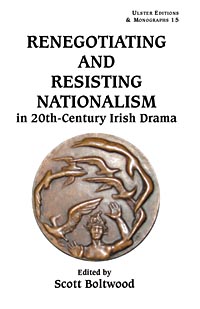
Renegotiating and Resisting Nationalism in 20th-Century Irish Drama
21.6 x 13.8 cm xiv, 211 pp. 2009 Ulster Editions & Monographs series (ISSN 0954-3392) volume 15
The essays in this collection seek to refine our understanding of the often polyvalent and conflicted engagement that Irish dramatists have entered into with nationalism, a cultural and political movement that they have often attempted to simultaneously resist and renegotiate.
These nine essays construct a genealogy of dissent, of loyal opposition, revealing the apprehension and dissatisfaction with which the twentieth century’s most influential playwrights have sometimes viewed the Irish state, from its emergence in the early 1900s to its maturity at the century’s end. The articles on W.B. Yeats, Augusta Gregory, J.M. Synge, and Sean O’Casey reveal the early Abbey Theatre’s struggle to critique the failures of and influence the development of the early state and its proscriptive brand of nationalist Irishness. The essays exploring the later plays of Samuel Beckett, Brian Friel, Frank McGuinness, Anne Devlin, Christina Reid, Marie Jones, and Marina Carr expose both the conceptual and political failures of mainstream Irishness in the second half of the twentieth century to satisfy the material or political aspirations of people on either side of the Irish border. While many of this collection’s essays share a common postcolonial interpretive strategy, individual articles also employ the strategies of ecocriticism, social anthropology, structuralism, feminism, and nationalist theory. The fifteenth volume in the Ulster Editions and Monographs series
CONTENTS
Scott Boltwood. Introduction
Colonialism and the Free State:
Hyangsoon Yi. The Traveller in Irish Drama and the Works of J.M.Synge and Seamus O’Kelly
Barbara Suess. Individualism and the Acceptance of Other: Yeats and Where There is Nothing
Scott Boltwood. ‘I keep silence for good or evil’: Lady Gregory’s Cloon plays and Home Rule
Paul Cantor. O’Casey’s Juno and the Paycock and the Problematic Freedom of the Irish Free State
The Republic and the North
Paul Davies. Earthing the Void: Beckett, Bio-regionalism, and Eco-poetics
Shaun Richards. Brian Friel: Seizing the Moment of Flux – Ros Dixon. Chekhov Bogged Down? Tom Kilroy’s version of The Seagull
Susan Cannon Harris. Her Blood and Her Brother: Gender and Sacrifice in Frank McGuinness’s Carthaginians
Rebecca Pelan. Two’s Company, Three’s a Community: Women’s Drama from Northern Ireland
Maria-Elena Doyle. ‘What Sort of Monsters Must We Have Been’: Irishness and the Gothic in McDonagh, Carr and McPherson
Notes – Bibliography – Contributors – Index
Front cover illustration. The Irish Academy of Letters' Gregory Medal, designed by Maurice Lambert (1901-1964) who called it 'Aengus and the Birds', although Yeats preferred the title 'Inspiration'. About seventeen copies were cast in bronze in 1934, and the mould destroyed. As originator of the project, W. B. Yeats was given one copy by Lambert. Yeats later presented one to Patrick McCartan, the major contributor to its cost, one was bought by the Royal Mint, and fifteen were for presentation by the Academy. These were lodged in a box in the Bank of Ireland, College Green. The actual recipients of the Medal were W. B. Yeats, George W. Russell ('AE'), and Bernard Shaw (all of whom were awarded it in 1935), Douglas Hyde (1937), E. Å’. Somerville (1941), Eoin MacNeill (1944), Stephen Gwynn (1949), Padraic Colum (1953), Seumas O'Sullivan (1957), Micheál mac Liammóir(1960), Austin Clarke (1968), Mary Lavin (1974), Arland Ussher (1975), and John Hewitt (1984). Yeats's intention was that once the medals had all been used, the Academy would commission a new design for future presentations of the Medal. The Academy unanimously agreed on 11 July 1974 that Peadar O'Donnell and Mary Lavin should both be awarded the Medal, but there is no record that O'Donnell ever received it. It is possible that he refused the honour. After Sean J. White removed the medal for Hewitt from the Academy's box at the Bank in 1984, he noted that only one remained. The Academy's archives are now in the National Library of Ireland (MSS 33,745-33,746).
More info →
Joyce, the Artist Manqué, and Indeterminacy
ISBN: 978-0-86140-320-2
21.0 x 14.8 cm. 34pp. 1989 Princess Grace Irish Library Lectures series (ISSN 0269-2619) volume 6
James Joyce's world is filled with characters who have artistic ambitions or temperaments – or pretensions. The 'artist' is a central figure in that world – yet it is peopled with characters who, individually and collectively, present us with Joyce's 'poor trait of the artless', his portrait of the artist manqué.
In the first, encompassing essay in this volume Morris Beja argues that in all Joyce's work there may be only one or two genuinely fulfilled artists – and that we cannot be certain even about them. A major question is how we regard Stephen Dedalus in this light: for he seems to be an unfulfilled artist on Bloomsday, yet perhaps one with the promise of future accomplishment.
Stephen is examined here in the context of the many other artists manqué in Joyce's works: in Dubliners (notably Little Chandler, James Duffy, and Gabriel Conroy), Ulysses (Leopold Bloom, and Molly as well), and Finnegans Wake (Shem and Shaun, notoriously, but also ALP) – and numerous minor figures in all those works and others.
The second essay returns Beja (the author of Epiphany in the Modern Novel) to the concept of epiphany, with new perspectives informed by recent critical theory, as he explores the role of uncertainty – indeterminacy – in the world of James Joyce.
More info →
Charles Lever: New Evaluations
21.6 x 13.8 cm. xvi, 131 pp. + 16 pp illus. 1991
Ulster Editions & Monographs series (ISSN 0954-3392) volume 3
These essays comprise the first extensive re-appraisal of Charles Lever for over fifty years. Once regarded as the equal of Dickens, Thackeray and Trollope, Lever’s public turned their backs upon him when he changed style and genre after making his name with comic military tales. He never recaptured his early popularity, but his later novels in fact manifest a much more serious and crafted approach to fiction, and richly deserve revival.
Lever’s own turbulent and often unhappy life of social and cultural exile in Europe provides the hidden theme of many of his better novels. Continental and Irish settings and preoccupations are juxtaposed, making his contribution to the Anglo-Irish novel per se an unusual and challenging one.
Lever is a shrewd observer of character – particularly of female character; few of his better-remembered contemporaries write with more insight about women; old, young, rich, poor; loving, hating, dominating, subjected. His eye for place is acute; Scott is his model, but Lever’s ability to correlate character with environment is finely developed. His political observations, always well-integrated into the fabric of his plot, are shrewd and balanced.
The current neglect of this accomplished and cosmopolitan Irishman is entirely unwarranted. Though he wrote too much, too hastily, and under pressures sometimes too much dominated by the intransigent necessities of serial publication, the contributors to this volume seek to show that Lever deserves a re-appraisal, and a revival of attention to his extensive and often original output. Thus, hopefully, the revival of interest in Charles Lever, commencing with this volume, should attract readers of the novel well beyond the specialist range of Anglo-Irish scholars.
Contents
Introduction: 'The Famous Irish Lever'. Tony Bareham
'Reading Lever'. A. Norman Jeffares
'A Tale of Love and War: Charles O'Malley'. Lorna Reynolds
'Dr Lever at Portstewart'. Bill Rodgers
'Transitional States in Lever'. Richard Haslam
'Lever's Post-Famine Landscape'. Chris Morash
'Charles Lever and the Outsider'. Tony Bareham
Notes
Index
More info →

Builders of my Soul: Greek and Roman Themes in Yeats
21.6 x 13.8 cm. xvi, 241 pp. + 4pp. illus 1990 Irish Literary Studies series (ISSN 0140-895X) volume 32
Builders of My Soul: Greek and Roman Themes in Yeats, fills a long-felt gap in a neglected area of Yeats studies. It begins with an account of Yeats’s knowledge of the Classics, and then deals with the topics of Philosophy, mainly Platonism; a full, new reading of ‘Under Ben Bulben’; Greek myth, used to validate both personal experience – Maud Gonne as Helen – and a cyclical theory of history; Literature, the two Oedipus plays; Visual art, including an elaborate reading of 'The Statues’, and ‘Byzantium’, the famous passage in A Vision, and the two great poems, in their historical context.

Critical Approaches to Anglo Irish Literature
21.6 x 138. cm. x, 193 pp. 1989
Irish Literary Studies series (ISSN 0140-895X) volume 29
Critical Approaches to Anglo-Irish Literature contains a selection of the papers given at the fifth triennial conference of the International Association for the Study of Anglo-Irish Literature held in Belfast in 1985, chaired by Professor John Cronin. It includes essays on Brian Friel, Seamus Heaney, James Joyce, Patrick Kavanagh, J. S. Le Fanu, J. M. Synge, and W. B. Yeats, as well as papers on more general themes, such as the critical condition of Ulster, English political writers on Ireland, national character and national audience, autobiographical imagination and Irish literary autobiographies. The contributors to this volume, the twenty-ninth in the Irish Literary Studies Series, are Catherine Belsey, Patricia Coughlan, Seamus Deane, Gerald FitzGibbon, Ruth Fleischmann, Margaret Fogarty, John Wilson Foster, Eamonn Hughes, Michael Kenneally, Tom Paulin, Walter T. Rix, and Nicholas Roe. The editors are Michael Allen and Angela Wilcox.

W.B. Yeats and the Tribes of Danu. Three Visions of Ireland’s Fairies
21.6 x 13.8 cm 350 pp. 1987
Irish Literary Studies series (ISSN 0140-895X) volume 27
W. B. Yeats and the Tribes of Danu is a study of the Irish fairy faith in its ancient and traditional forms, and of Yeats’s response to that faith.
The first part concerns the ancient beliefs, chiefly as they are expressed in mythology, and describes the origins and characteristics of the Tuatha De Danann. Peter Alderson Smith shows how they are a folk memory of an ancient people who have to some degree acquired divine and ghostly characteristics.
Part two describes the fairies of modern folklore, the various types, their characteristics, and differences from ghosts, in being a separate and supernatural race of people, homogeneous but unpredictable and notorious for their capriciousness.
Part three finds in Yeats's work between the writing of The Countess Cathleen (1891-92) and the poems of Responsibilities (1914) a desire to know more about the Otherworld that resulted in a relationship that fluctuated between the poles of frustration and despair on the one hand, and morbid enthusiasm on the other. That the process was ultimately therapeutic is shown by Yeats’s move away from the Celtic Twilight to the poems of his maturity.
More info →

Irish Writers and the Theatre
This collection is the second volume in the IASAIL-JAPAN series, which was set up by the Japanese branch of the International Association for the Study of Anglo-Irish Literature.
Many major Irish authors have been dramatists as well as poets and novelists, and perhaps the most famous have gained their fame because of their dramatic output. Over the past three centuries many of the dramatists whose names are remembered have Irish connections - Farquhar, Steele, Goldsmith, Sheridan, Boucicault, Wilde, Synge, Shaw, Yeats, O'Casey, Behan, Beckett, Friel, and Leonard come to mind.
The essays in this collection deal primarily with dramatists of this century, particularly Shaw, Yeats, O'Casey, Behan, Robinson, Beckett and Stewart Parker, but there are more wide-ranging essays – on contemporary fashions in Irish theatre, on O’Casey's influence on modern drama, on the humour of deprivation, and on dramatisations of the life of Jonathan Swift.
The contributors are Eugene Benson, Richard Allen Cave, Emelie Fitzgibbon, Nicholas Grene, Heinz Kosok, Desmond Maxwell, Vivian Mercier, Christopher Murray, Andrew Parkin, Masaru Sekine, James Simmons, Sumiko Sugiyama, Robert Welch and Katherine Worth.

Ze-Ami and his Theories of Noh Drama
ISBN 978-0-86140-214-4 21.6 x 13.8 cm.
For over five centuries the essays of Ze-Ami – considered, with his father Kan-Ami, to be the founder of Noh, the classical dance-drama of Japan – were kept secret. They were not shown to more than one Noh actor in each generation until recently. Though they contain a large number of paradoxes and contradictory statements as well as a great deal of repetition, they were regarded as a Bible by actors in the Noh technique. As repetition was a constant feature in training and in techniques in many arts in Japan, and as paradox had often been used in the search for the truth in Zen, so Ze-Ami's essays were accepted, despite their repetitions, paradoxes and contradictions. They were not. however, easily translatable, and they benefit from being edited.
In this work therefore, Ze-Ami's ideas are dealt with in eight chapters: The History of Noh: Five Groups of Noh Plays: Training: Acting: Writing a Play: Public Tachiai Competitions and Grades of Acting: The Audience: and Hana. This arrangement presents Ze-Ami's ideas with some order and consistency. Relevant sections of eighteen essays by Ze-Ami are translated and discussed. These include Fushi-kaden, Kashū, Ongyoku-Kowadashi-kuden, Kukyō, Shikadō, Nikyoku-Santai-Ningyōzu, Sandō, Fushizuke-shidai Fukyokushū, Yūgaku-Shūdō-Fūcken, Goi, Kyūi, Rikugi, Shūgy-okutokuka, Goonkyoku-Jōjō, Goon, Shūdosho, Kyakurui-ku, and Zeshi-Roku-juigo-Sarugaku-Dangi.
This volume is a most useful introduction to an understanding of Noh history, practice, and technique, for all readers in the West, written as it is by a trained Noh actor..

Yeats and the Noh: A Comparative Study
21.6 x 13.8cm. Irish Literary Studies series 38
W.B. Yeats wrote the plays in Four Plays for Dancers (1921) when he was strongly influenced by Japanese Noh theatre, and was searching for some breakthrough in his efforts to promote poetic drama.
Since then, various books have been published on this topic but, with the notable exception of Richard Taylor, no scholar has been able to cope with both Yeats and Noh. Yeats and the Noh started in a small seminar room in University College Dublin, when both authors took part in productions of The Dreaming of the Bones and Nishikigi with their students. Masaru Sekine directed both plays and Christopher Murray performed in them: they were therefore equipped with live experience as well as their personal expertise in Irish literature and Noh drama.
Professor Augustine Martin introduces the volume, and apart from the main section of the book, Colleen Hanrahan, one of the students who took part in both UCD productions, writes about acting in Yeats’s play; Peter Davidson writes about Yeats, Pound, Rummel and Dulac; and Katharine Worth provides an essay on Yeats, Beckett and Noh. There are 16 pages of illustrations.
This volume is unique in providing detailed analysis of contrasts in theatrical aims, as well as examining why man seeks to explore tragic drama as a means of extending the limits of reality.

‘Since O’Casey’ and other essays on Irish Drama
In this collection of lucid essays that cover the entire eighty years of modern Irish drama, Robert Hogan writes about the major Irish dramatists of the 20th century and their impact on audiences, and on other playwrights, as well as considering the works themselves. In them he uses a variety of critical techniques, ranging from biography to studies of influence, structure and dialogue, to history and anecdote, and the ill-treatment of several sacred cows.
In addition to essays on such giants as Synge, O'Casey, and Beckett, the book deals with more neglected figures such as W. J. Lawrence and the still insufficiently appreciated George Fitzmaurice and Denis Johnston. It also presents a full critical survey of the years 1963-83 in which exciting writers like Brian Friel, Hugh Leonard and John B. Keane made their mark. The author's style and varied ways of dealing with the subjects make this volume particularly enjoyable, as well as informative, reading.
CONTENTS<br
Preface<br
YEATS CREATES A CRITIC<br
THE INFLUENCE OF SYNGE<br
THERE IS REALISM AND REALISM<br
O'CASEY, THE STYLE AND THE ARTIST<br
O'CASEY, THE STYLE AND THE MAN<br
THE INFLUENCE OF O'CASEY<br
DENIS JOHNSTON'S HORSE LAUGH<br
TRYING TO LIKE BECKETT<br
SINCE O'CASEY<br
A Factual Appendix<br
A Critical Appendix, by W. J. Lawrence, containing his reviews of Birthright by T. C. Murray (1910), The Magic Glasses by George Fitzmaurice (1913), Shanwalla by Lady Gregory (1915), and Juno and the Paycock by Sean O'Casey (1924)<br
Notes<br
Index