
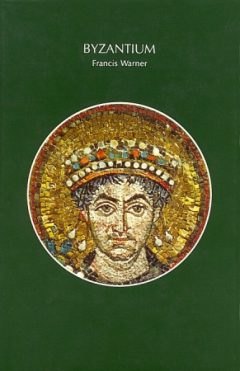
Byzantium
21.6 x 13.8 cm. Oxford Theatre Texts 10
‘Oxford University Dramatic Society (OUDS) gave the première of Francis Warner’s new play Byzantium in King’s College Chapel, Cambridge, followed by two performances in the University Church, Oxford, and another in Winchester Cathedral.
‘Byzantium is a play in two acts. It opens in 527 A.D. with the service in which Justinian is crowned Emperor in succession to his uncle Justin. In Act One Justinian is full of zeal and optimism for the tasks which his vision sets before him. Act Two is altogether more sombre, with unrest at home, news of a catastrophic earthquake in Beirut, and even Byzantium itself plague-stricken and the Empress herself dying. Moreover, the Emperor is plotted against by wily Cappadocian, who is trapped by the spirited Antonina, only to be spared from death by the Christian magnanimity of Justinian.
‘This complex background is sketched lightly yet comprehensively by Warner in elegant and beautiful verse, which was delivered with clarity and fluency by an admirable young cast directed by Tim Prentki
‘Warner did not choose an easy subject with Byzantium. He chose a challenge and he rose to that challenge and surmounted it magnificently. He is a master of plot and characterisation, and, indeed, of the English language, which he commands with a benign authority and loving finesse.’ The Stage
More info →
Agora : In Two Volumes
ISBN: Volume 2 :0-86140-373-8 £17.50
ISBN: The pair : 0-86140--374-6 £40.00
Written over the past twenty-two years Agora contains Francis Warner’s plays originally published in the Oxford Theatre Texts series, the theme of which is the West’s odyssey in discovery of its own values, and – in the second half of the work – what the Twentieth Century has done with them.
The first half of the epic (Volume 1) meets the classical tradition on its own grounds. It opens with Healing Nature, a play about Periclean Athens, and this is followed by a trilogy of Roman plays – Virgil and Caesar, Moving Reflections and Light Shadows – then Byzantium, and concludes with Living Creation, a dramatisation of Renaissance Florence under Lorenzo de’ Medici.
The second half (Volume II), opening with A Conception of Love, a comedy of love to mark the half-way point, is set in the Twentieth Century, and uses Twentieth Century techniques. It contains Maquettes for the Requiem Trilogy and the plays themselves, Lying Figures, Killing Time and Meeting Ends. Added as an appendix is Tim Prentki’s Introduction to the one volume edition of Requiem, published in 1980.
Comments on the plays in Volume I
‘Common to all these plays is a focusing on a moment in history when the attempt was made to ennoble the life of man, to produce that great society, radiant in arts and civilised in politics, which is the mirage that haunts the traveller through the dusty plains of human history. Choice spirits struggle to unite beauty, justice, peace. Of course the struggle is always lost in the end. . . . Detailed. . . accurate . . . moving, with convincing dramatic power, Warner’s verse filled the ear satisfyingly, and echoes in the memory.’ Jasper Griffin, in Oxford Magazine
‘He is a master of plot and characterization, and, indeed, of the English language, which he commands with a benign authority and loving finesse.' The Stage
A ‘contemporary classic’ Oxford Mail
Comments on the plays in Volume II
‘The remarkable series of dramas written by our most adventurous experimental playwright.’ The Times
‘Francis Warner is the most remarkable of those dramatists of our time who have striven to push the limits of theatre beyond their age-old limits. His plays have, by daring appeal to the realms of music and physiology, considerably widened the area of sensibility of those properly responsive to them. They are unique, possibly the only truly unique drama of our time.’ Sir Harold Hobson in The Sunday Times
‘The sort of illuminated shorthand of his style, allied to his arresting visual images, is clearly capable of making a very direct contact - and an electrically shocking one at that. He is a considerable writer.’ Plays and Players

The Well of the Saints
Edited, with an Introduction and Notes, by Nicholas Grene
J.M. Synge’s The Well of the Saints, to some extent overshadowed by his better-known plays Riders to the Sea and The Playboy of the Western World, well deserves an individual edition. A rich and complex tragicomic study of the conflict between imagination and reality, The Well centers on an old, blind couple, disillusioned by a miraculous cure, who finally prefer blindness to sight.
Nicholas Grene’s full introduction provides the historical background to the play and the reasons its first audiences, at Dublin’s Abbey Theatre, received it with a hostility prefiguring the Playboy riots a few years later. He shows how Synge embeds his parable-like story in the reality of the Irish countryside, and how the theme of the play is developed through a skilful dramatic control of audience response. The Well of the Saints, with its striking affinities to Beckett, can thus be recognized as a play before its time.
The play is fully annotated, with an explanatory note on the language and a glossary for those unfamiliar with Synge’s poetic-peasant dialect. And with access (denied previous editors) to the Abbey Theatre prompt-book in which Synge made important theatrical alterations, Prof. Grene has been able to supply an edition with new textual authority.

Selected Plays of George Shiels
Chosen and Introduced by Christopher Murray
The fifteenth volume of the Irish Drama Selections series (ISSN 0260-7962), General Editors: Joseph Ronsley and Ann Saddlemyer.
21.6 x 13.8cm.
Contains The Retrievers (hitherto unpublished), Professor Tim, The New Gossoon, The Passing Day, The Rugged Path, and The Summit, bibliographical checklist.
George Shiels (1886-1949) was one of the most prolific and most successful playwrights in the history of the Abbey Theatre. Before his debut at the Abbey, Shiels's early work was staged by the Ulster Literary Theatre in Belfast and later on his work was taken up by the dynamic Group Theatre, also in Belfast. As a Northerner, Shiels embraced the whole island in his work, his use of dialect and his characterisation. Moreover, while his plays were broadly popular and wonderfully well suited to the acting talents of theatre companies North and South, his all-Ireland perspective lent his work a keen critical edge masked by easy realism and hilarious comedy. Nowadays, we turn to the dark comedy of a play like The Passing Day to re-adjust our view of Shiels and to see his plays as seriously concerned with the land question and issues of identity, gender and the law in post-colonial Ireland. From that perspective, The New Gossoon and in particular The Rugged Path (which in 1940 broke all previous box-office receipts at the Abbey, when the production played for an unprecedented twelve weeks, all previous plays having been limited to two) challenge us to look again at Shiels and see him as public commentator as well as consummate entertainer.
The present collection attempts to facilitate this needed redefinition of Shiels's place in the Irish dramatic canon. To that end it includes The Retrievers (1924), his first full-length political play, never before published, together with Professor Tim (1925), The New Gossoon (1930), The Passing Day (1936), The Rugged Path (1940) and its sequel The Summit (1941), together with a Bibliographical Checklist.
Christopher Murray is Professor Emeritus in the School of English and Drama at University College Dublin. He is former editor of Irish University Review and former chair of the International Association for the Study of Irish Literatures (IASIL). Among his publications are Twentieth-Century Irish Drama: Mirror up to Nation and Sean O'Casey, Writer at Work: A Biography.
More info →

Selected Plays of Lennox Robinson
Chosen and Introduced by Christopher Murray
The first volume of the Irish Drama Selections series (ISSN 0260-7962), General Editors: Joseph Ronsley and Ann Saddlemyer.
ISBN: 0-86140-087-9 / 978-0-86140-087-4 £25.00
Paperback ISBN: 0-86140-088-7 / 978-0-86140-088-1 £9.95
Contains: Patriots, The Whiteheaded Boy, Crabbed Youth and Age, The Big House, Drama at Inish, Church Street, bibliographical checklist.
Lennox Robinson was one of the leading playwrights of Dublin's Abbey Theatre as well as being its general manager and a director for many years. As with many other playwrights of the twentieth century, his work has been unjustly neglected, this volume, published in 1982, being the first of his plays to have appeared for over a quarter of a century. It is fitting, therefore, that this selection should be the first of a new series, Irish Drama Selections, which has sought to remedy the shortage of texts of the work of Ireland's dramatists, which with the exception of perhaps ten authors, are virtually unobtainable except in rare editions, long out of print.
Christopher Murray is Emeritus Professor of Drama and Theatre History, School of English, Drama and Film, University College Dublin. He is former editor of Irish University Review and former chair of the International Association for the Study of Irish Literatures (IASIL). Among his publications are Twentieth Century Irish Drama: Mirror up to Nation and Sean O'Casey, Writer at Work: A Biography. He also chose and introduced the fifteenth volume in the Irish Drama Selections series, Selected Plays of George Shiels.
More info →

The Harvest Festival
ISBN: 978-0-86140-045-4
22.9 x 14.5 cm. xvi, 91 pp. 1979
The Harvest Festival is Sean O’Casey’s earliest extant play. Written in about 1918 or 1919, it was the second play that O’Casey offered the Abbey Theatre. It was turned down, but he kept the manuscript and it now forms part of the extensive O’Casey archive in the Berg Collection of the New York Public Library. It has never been performed, and this is its first publication in the U.K. and Ireland, following on its U.S. publication by only a few months.
The plot focuses on the turmoil of an outside world of strikes and riots converging on a Dublin city church in the midst of its preparations for a harvest festival. Set in 1913, it deals with Irish workers’ battles against economic oppression and religious hypocrisy, with that vital combination of passion, humour and pathos that distinguishes O’Casey’s later plays. It is a rich melodrama of class struggle, with ironically pointed clashes involving representatives of Church, Employers and Labour.
An incomplete revision of the first act, which O’Casey kept with the original manuscript, is included as an Appendix to show the direction the playwright might have gone had he chosen to revise the entire play: as it is, students of drama will see in The Harvest Festival the seeds of O’Casey’s later works, and the lineal descendants of its characters appear in Red Roses for Me, The Drums of Father Ned, and The Bishop’s Bonfire.
Eileen O’Casey has contributed a foreword entitled ‘Clench Your Teeth’, and John O’Riordan has written an Introduction.
A three-quarter leather edition with wood veneer panels, marbled endpapers, top edges gilt, intended to be limited to 50 copies, ISBN 0-86140-052-6, signed by the writers of the Foreword and Introduction, Eileen O'Casey and John O'Riordan, was also published, but of the 50 copies only 30 were actually bound.
More info →
Cock-A-Doodle Dandy
Edited, with an introduction and Notes, by David Krause
ISBN: 978-0-86140-342-4
21.6 x 13.8 cm. xxiv, 119 pp. 1991 Irish Dramatic Texts 5
Regarded by O'Casey as his best play, this dark comedy about Irish rural life at mid-century symbolises the struggle between repression and liberty. Although the final victory is to the forces of oppression (in the shape of Father Domineer and his gombeen men) the play is highly amusing. Initially it was regarded as anti-Catholic and suppressed in Ireland and New York. This publication is the only definitive edition available, having been compared with the original manuscript (in the New York Public Library). Professor Krause is the official biographer of O'Casey.
Co-published with the Catholic University of America Press, Washington, D.C.
More info →

Selected Plays of T.C. Murray
Chosen and Introduced by Richard Allen Cave
The tenth volume of the Irish Drama Selections series (ISSN 0260-7962), General Editors: Joseph Ronsley and Ann Saddlemyer.
Hardback ISBN: 0-86140-142-5 / 978-0-86140-142-0 £30.00
Paperback ISBN: 0-86140-143-3 / 978-0-86140-143-7 £ 10.95
21.6 x 13.8 cm.
Contains: Sovereign Love, Birthright, Maurice Harte, The Briery Gap, Autumn Fire, The Pipe in the Fields, the essay ‘George Shiels, Brinsley MacNamara, Etc.’, and the previously unpublished Illumination , bibliographical checklist.
The playwriting career of Thomas Cornelius Murray (1873-1959) started in 1909 with the production of his first play, Wheel of Fortune (which he revised in 1913 and renamed Sovereign Love), at the Cork Little Theatre, but it was his Birthright, produced at the Abbey Theatre in the following year that established him as a writer of stark and tragic realism. His most enduring plays were all written during the next two decades, but none of the plays written after 1930 can be compared for quality with his earlier work.
The present selection contains Sovereign Love (1909, revised 1913), Birthright (1911), Maurice Harte (1912), The Briery Gap (1917), Autumn Fire (1925), and The Pipe in the Fields (1927), together with Appendices containing Murray's essay 'George Shiels, Brinsley MacNamara, Etc.' (1939), which not only discusses these authors' work but sheds considerable light on his own views about playwriting, and Illumination (1939) which despite its evident weaknesses is still the best of his later dramas. There is a bibliographical checklist of his writings.
More info →