

Four Plays by The Charabanc Theatre Company: ‘Inventing Women’s Work’
Chosen, edited and introduced by Claudia Harris
ISBN: 978-0-86140-438-4
21.6 x 13.8 cm. liv, 258pp. + 8pp. with 16 illus. hardback November 2005
>
The Charabanc Theatre Company played a major role in Northern Ireland’s theatrical renaissance during the 1980s. Charabanc was formed by five out-of-work Belfast actresses (Marie Jones, Maureen Macauly, Eleanor Methven, Carol Moore, Brenda Winter) who first collected stories and then collaborated in writing and performing highly original plays for enthusiastic audiences. From 1983 to 1995, the company toured twenty-tour productions extensively throughout Ireland and the world, spreading their own particular brand of exuberant, dark humour.
The four plays in this collection – Now You’re Talking (1985), Gold in the Streets (1986), The Girls in the Big Picture (1986), and Somewhere Over the Balcony (1987) – represent the creative high point of the company. These entertaining plays show the broad range of the company’s work: portraits of urban and rural women; early, mid-, and late twentieth century settings, and various social, religious, historical political, or personal relations.
Marie Jones, Eleanor Methven, and Carol Moore were the remaining company principals during the mid-1980s when these four plays were created and performed. Marie Jones became the main writer for Charabanc and after leaving the company in 1990 has continued to write, notably the award-winning Stones in His Pockets. Eleanor Methven and Carol Moore continued on as artistic directors until they disbanded the company in 1995. Eleanor Methven now lives in Dublin and is a sought-after actress for stage and screen, and her first screenplay is in development with Journeyman Films. Carol Moore obtained an MA from Queen’s University, Belfast, and still acts for stage and film, but is now primarily an accomplished stage and screen director; in May 2005 she received a NESTA (National Endowment for Science Technology and the Arts) Fellowship.
More info →


Selected Plays of Dion Boucicault
Chosen and Introduced by Andrew Parkin
The fourth volume of the Irish Drama Selections series (ISSN 0260-7962), General Editors: Joseph Ronsley and Ann Saddlemyer.
21.6 x 13.8 cm. 416 pp. 2009 2nd, enlarged edition
Contains: London Assurance, The Corsican Brothers, The Octoroon, The Colleen Bawn, The Shaughraun, Robert Emmet, bibliographical checklist. plus Boucicault's "'Canterin' Jack' - A Sketch from Life. How The Shaughraun was originated'.
Dion Boucicault was a prominent playwright and prolific adapter of foreign plays and novels. He is known and loved especially for his high melodrama. Extremely popular on the Victorian commercial theatre for over forty years, his plays today still provide enjoyment to all audiences Born in Dublin, he achieved his first West End success with London Assurance in 1841. His work frankly catered to contemporary taste and fell rapidly into neglect after his death in 1890, but his lively observation of humanity in many moods, and his unerring sense of what works on the stage, have led his plays in recent years to successful revivals in Dublin, Belfast, Chichester and London, perhaps the most notable being the National Theatre's production of The Shaughraun starring Stephen Rea in the title role.
The works chosen for this volume illuminate Boucicault's consummate craft as a writer for the theatre in the age of actor-managers and melodrama. They also remind us of that Irish verve, charm and adroitness which made him the most popular playwright of his generation on both sides of the Atlantic. Arguably the father of both the Irish and American drama, his characteristic plotting and taste for sensation suggest that another of his heirs was the early movie industry.
This volume includes the great success of Boucicault's youth, London Assurance, together with his preface to the first edition; his durable version of the melodrama The Corsican Brothers; the exciting American plantation play The Octoroon, with both its endings; and three of his Irish plays, The Colleen Bawn, Robert Emmet, and The Shaughraun, to which has now been added his article on Cantherin' Jack, his inspiration for that play's title role. A selected bibliographical checklist, dates of first performances and cast lists are given, as are the songs, music and a glossary for the Irish plays.
The present selection from Boucicault's vast opus is chosen and introduced by Andrew Parkin. Andrew Parkin is Professor Emeritus of the Chinese University of Hong Kong and Honorary Senior Tutor of Shaw College. An Honorary Life Member of the Canadian Association for Irish Studies and Adviser to the Chinese Academy of Social Sciences in Beijing, he belongs to a number of other international scholarly organisations. A member of the Canadian Writers’ Union, he is also adviser to the Canadian Chinese Writers’ Association. Residing now in France, he is President of the Paris Decorative and Fine Arts Society. He publishes scholarly books, mainly on drama, as well as original poetry, and short fiction.
More info →

Ze-Ami and his Theories of Noh Drama
ISBN 978-0-86140-214-4 21.6 x 13.8 cm.
For over five centuries the essays of Ze-Ami – considered, with his father Kan-Ami, to be the founder of Noh, the classical dance-drama of Japan – were kept secret. They were not shown to more than one Noh actor in each generation until recently. Though they contain a large number of paradoxes and contradictory statements as well as a great deal of repetition, they were regarded as a Bible by actors in the Noh technique. As repetition was a constant feature in training and in techniques in many arts in Japan, and as paradox had often been used in the search for the truth in Zen, so Ze-Ami's essays were accepted, despite their repetitions, paradoxes and contradictions. They were not. however, easily translatable, and they benefit from being edited.
In this work therefore, Ze-Ami's ideas are dealt with in eight chapters: The History of Noh: Five Groups of Noh Plays: Training: Acting: Writing a Play: Public Tachiai Competitions and Grades of Acting: The Audience: and Hana. This arrangement presents Ze-Ami's ideas with some order and consistency. Relevant sections of eighteen essays by Ze-Ami are translated and discussed. These include Fushi-kaden, Kashū, Ongyoku-Kowadashi-kuden, Kukyō, Shikadō, Nikyoku-Santai-Ningyōzu, Sandō, Fushizuke-shidai Fukyokushū, Yūgaku-Shūdō-Fūcken, Goi, Kyūi, Rikugi, Shūgy-okutokuka, Goonkyoku-Jōjō, Goon, Shūdosho, Kyakurui-ku, and Zeshi-Roku-juigo-Sarugaku-Dangi.
This volume is a most useful introduction to an understanding of Noh history, practice, and technique, for all readers in the West, written as it is by a trained Noh actor..

Yeats and the Noh: A Comparative Study
21.6 x 13.8cm. Irish Literary Studies series 38
W.B. Yeats wrote the plays in Four Plays for Dancers (1921) when he was strongly influenced by Japanese Noh theatre, and was searching for some breakthrough in his efforts to promote poetic drama.
Since then, various books have been published on this topic but, with the notable exception of Richard Taylor, no scholar has been able to cope with both Yeats and Noh. Yeats and the Noh started in a small seminar room in University College Dublin, when both authors took part in productions of The Dreaming of the Bones and Nishikigi with their students. Masaru Sekine directed both plays and Christopher Murray performed in them: they were therefore equipped with live experience as well as their personal expertise in Irish literature and Noh drama.
Professor Augustine Martin introduces the volume, and apart from the main section of the book, Colleen Hanrahan, one of the students who took part in both UCD productions, writes about acting in Yeats’s play; Peter Davidson writes about Yeats, Pound, Rummel and Dulac; and Katharine Worth provides an essay on Yeats, Beckett and Noh. There are 16 pages of illustrations.
This volume is unique in providing detailed analysis of contrasts in theatrical aims, as well as examining why man seeks to explore tragic drama as a means of extending the limits of reality.

Killing Time
Killing Time, the centrepiece of Francis Warner’s Requiem trilogy, is a study of war and of its roots in each one of us. The play was performed at the 1975 Edinburgh Festival, where it won high acclaim.
'The plays of Francis Warner have, by daring appeal to the realms of music and physiology, considerably widened the area of sensibility of those properly responsive to them. . . . Killing Time is not for all markets, but where it is appreciated it will fetch a high price.’ Harold Hobson, The Sunday Times
‘Dramatic and provoking. . . . Excellent acting by an experienced cast.’ The Scotsman
'Killing Time completes a remarkable trilogy by one of Britain’s leading playwrights. Warner is not an “easy” playwright. His works bristle with intellect and although his characters are genuinely human the situations in which they find themselves are often dramatically bizarre.’ Cambridge Evening News
'Killing Time is a difficult play to assess in conventional terms. Nevertheless this is a truly intellectual play. . . a diverse but consciously poetic vision of war as a “fever in the brain”.’ Edinburgh Festival Times
'Killing Time is an important philosophical and moral work. Set in the human brain, it is a series of vignettes on the subject of war, all carefully counterpointed to reflect the biological working patterns of the brain. Not so much a play as a theatrical poem or mathematical theorem, it is unashamedly intellectual, frequently provoking and always demanding.’ The Stage
More info →

The Plays – Book 2
Edited by Ann Saddlemyer
ISBN: 978-0-86140-061-4
xxxvi, 304 pp. 21.4cm
J.M.Synge died in 1909 and The Works of John M. Synge were published in four volumes by Maunsel & Co., Dublin, in 1910. Since that time, with the exception of a few minor verses and one or two fragments of prose, the canon of his work has remained unaltered. Nevertheless, much unpublished material exists, for the most part of great interest and significance for the understanding of Synge's methods of work and development. This material, including early drafts of the plays, notebooks, poems, and fragments of poetic drama, has now been thoroughly explored in order to create this definitive edition, first published by Oxford University Press 1962-68, which not only collects together all that is of significance in his printed and in his unprinted work, but also, by a careful use of worksheets and early drafts, indicates much of the process of creation.
The Collected Works is under the general editorship of the late Professor Robin Skelton, of the University of Victoria, British Columbia. The first volume contains his edition of Synge's poems and translations; the second assembles all Synge's prose writings of any merit or interest, edited by the late Dr Alan Price, of The Queen's University, Belfast.
The third and fourth volumes are devoted to Synge's plays, edited by Professor Ann Saddlemyer, then of Victoria College, University of Toronto, now retired. The first of these volumes contains texts of Riders to the Sea, The Shadow of the Glen, and The Well of the Saints, and of the originally little known When the Moon has Set, with appendices analysing the drafts of each play and giving details of first productions. In addition the volume contains much unpublished material, scenarios, dialogues, and fragments, discovered among Synge's notebooks.
This volume provides definitive texts of The Tinker's Wedding, The Playboy of the Western World, and Deirdre of the Sorrows. For all these three plays recently discovered manuscript and notebook material has involved a certain amount of textual alteration; an examination of the long-lost final typescript of The Playboy of the Western World has provided many clues to the author's intentions, while comparison of the various drafts of Deirdre of the Sorrows with the typescript given by the executors to Yeats and Lady Gregory has enabled Dr Saddlemyer to determine the extent of posthumous collaboration.
Synge rewrote his plays many times; one act of The Playboy ran to at least fifteen full drafts, not counting numerous alterations. By examining each available draft of every play, the editor has been able to provide not only a final text of each play as close as possible to the dramatist's version, but in her accompanying notes almost a variorum study of significant passages. Appendixes record the growth of each play from the original scenario through many drafts to the final text, and include discarded scenes which throw new light on the playwright's creative process. Details of first productions and a comprehensive description of all the manuscript sources are also included. The introduction traces the history of each play, quoting extensively from Synge's unpublished correspondence and notebooks to record the dramatist's attitude to his own work in the making, and to set each play against the broader background of the Abbey Theatre. In searching out the material for this edition, Dr Saddlemyer has made use of public and private collections in both Ireland and the United States, and has also included a glossary and guide to pronunciation.
These volumes were published by arrangement with Oxford University Press.
More info →

The Plays – Book 1
Edited by Ann Saddlemyer
ISBN: 978-0-86140-060-7
J.M.Synge died in 1909 and The Works of John M. Synge were published in four volumes by Maunsel & Co., Dublin, in 1910. Since that time, with the exception of a few minor verses and one or two fragments of prose, the canon of his work has remained unaltered. Nevertheless, much unpublished material exists, for the most part of great interest and significance for the understanding of Synge's methods of work and development. This material, including early drafts of the plays, notebooks, poems, and fragments of poetic drama, has now been thoroughly explored in order to create this definitive edition, first published by Oxford University Press 1962-68, which not only collects together all that is of significance in his printed and in his unprinted work, but also, by a careful use of worksheets and early drafts, indicates much of the process of creation which occurred before the production of the printed page.
The Collected Works is in four volumes, under the general editorship of the late Professor Robin Skelton, of the University of Victoria, British Columbia. The first volume contains edition of Synge's poems and translations, the second assembles all Synge's prose writings of ant merit or interest, edited by the late Dr Alan Price, of The Queen's University, Belfast.
The third and fourth volumes are devoted to Synge's plays, edited by Professor Ann Saddlemyer, then of Victoria College, University of Toronto, now retired. Only five of the plays were published during Synge's lifetime. One emptied the Abbey Theatre, yet was the first of its productions to be translated and performed on the Continent; one caused riots in both Britain and America; one was considered 'too dangerous' to be performed in Ireland. All were written during the last seven years of Synge's life, for the Abbey Theatre, of which he was co-director with W. B. Yeats and Lady Gregory. But although his output was comparatively slight, Synge's contribution to the development of modern drama is immeasurable.
In the first volume of the plays we see the development of the playwright's craft. Definitive texts, based on Synge's own notebooks and typewritten drafts, are provided of Riders to the Sea, The Shadow of the Glen, and The Well of the Saints. Included is his controversial first play, When the Moon Has Set, rejected three times by his co-directors, yet carefully preserved by Synge among his papers. Other material discovered among his notebooks, scenarios, dialogues, and fragments, written between 1894 and 1908, indicates not only the scrupulousness with which Synge studied his art, but his rich and fertile imagination. A comprehensive introduction records the history of each play in the making, from genesis to finished product, at the same time setting Synge's work within the larger context of his experience as director and producer and quoting from his own letters documenting his progress. Appendices analysing the drafts of each play and giving details of first productions provide further bibliographical information and describe the numerous manuscript sources tracked down by the editor in public and private collections in both Ireland and the United States.
The second volume of plays contains texts of The Tinker's Wedding, The Playboy of the Western World, and Deirdre of the Sorrows, with similar notes and appendices.
These volumes were published by arrangement with Oxford University Press.
More info →

The Unicorn from the Stars
Edited, with an Introduction and Notes, by Katharine B. Worth
First published in 1903, Where There Is Nothing was never reprinted in the author’s lifetime. It lost its place in collected editions of Yeats’s plays to a new version, The Unicorn from the Stars, in which Lady Gregory had a major share. There has long been a need for an edition of Where There Is Nothing to restore to general view an interesting play which, unusually for Yeats, has a modern setting, a middle-class hero, and a predominantly naturalistic technique.
Yeats gave various reasons for abandoning the original play. Perhaps one he did not mention was his doubt whether its open and direct style and modem Irish background might not identify the author too closely with the visionary central character, Paul Ruttledge. Many of Yeats’s deepest preoccupations are reflected in Paul’s pursuit of his apocalyptic vision: he abandons a life of bourgeois comfort for hard freedom among the tinkers, follows a religious life in a monastery, and finally dies a martyr at the hands of a mob who cannot understand his ecstatic message: “Where there is nothing, there is God.”
The drastically revised version, The Unicorn from the Stars, changes the period and social milieu and introduces new characters and plot complications which bear the marks of Lady Gregory’s distinctive style. Both plays are included in this volume to allow comparison of the plays themselves and to throw light on the characteristic methods of these two preeminent playwrights.
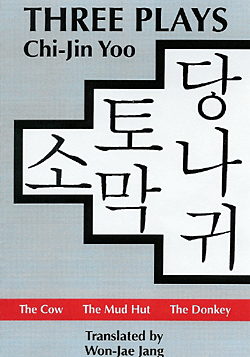
Three Plays
Translated by Won-Jae Jang
In his study Irish Influences on Korean Theatre during the 1920s and 1930s, Won-Jae Jang alerted scholars to a previously unexamined example of intercultural exchange in which Korean scholars looked to Irish writers and especially Irish dramatists to help them find a way of freeing themselves from the cultural imperialism of Japan. They studied the stated aims of Yeats, Lady Gregory and Synge in founding an Irish National Theatre Movement to gain independence from the dominance of English drama, read translations of their plays as well as some by O’Casey and T. C. Murray, and decided to follow that example, first by adaptations, then imitations and finally with original dramas that nonetheless reveal a profound debt to distinct Irish models.
The three plays by Chi-Jin Yoo (the centenary of whose birth is celebrated in 2005) that are contained in this volume belong to this last group. He focuses on the lives of the deprived and the impoverished, country people struggling to maintain a degree of security if only to retain some vestige of human dignity. In this he follows the Irish realist tradition rather than the Yeatsian preoccupation with the legendary and the heroic. Wan-Jae Jang offers the reader literal translations from the Korean, the better to respect the raw energy of the original dramas, into which Chi-Jin Yoo welded a surprising variety of influences from Irish playwrights. As well as the three plays, The Cow, The Mud Hut and The Donkey, also published here is an article by Yoo, ‘Sean O’Casey and I’, which shows the major influence that O’Casey in particular had on his work.
Won-Jae Jang was born in Seoul, graduated from Korea University (BA), and Goldsmiths College, University of London (MA), and was granted his PhD from Royal Holloway, University of London in 2000. He is now working for Soongsil University as a Junior Professor. His Irish Influences on Korean Theatre during the 1920s and 1930s was published in 2003.
Where There is Nothing
Edited, with an Introduction and Notes, by Katharine B. Worth
First published in 1903, Where There Is Nothing was never reprinted in the author’s lifetime. It lost its place in collected editions of Yeats’s plays to a new version, The Unicorn from the Stars, in which Lady Gregory had a major share. There has long been a need for an edition of Where There Is Nothing to restore to general view an interesting play which, unusually for Yeats, has a modern setting, a middle-class hero, and a predominantly naturalistic technique.
Yeats gave various reasons for abandoning the original play. Perhaps one he did not mention was his doubt whether its open and direct style and modem Irish background might not identify the author too closely with the visionary central character, Paul Ruttledge. Many of Yeats’s deepest preoccupations are reflected in Paul’s pursuit of his apocalyptic vision: he abandons a life of bourgeois comfort for hard freedom among the tinkers, follows a religious life in a monastery, and finally dies a martyr at the hands of a mob who cannot understand his ecstatic message: “Where there is nothing, there is God.”
The drastically revised version, The Unicorn from the Stars, changes the period and social milieu and introduces new characters and plot complications which bear the marks of Lady Gregory’s distinctive style. Both plays are included in this volume to allow comparison of the plays themselves and to throw light on the characteristic methods of these two preeminent playwrights.

The Herne’s Egg
Edited, with an introduction and notes, by Andrew Parkin.
This play has long been attacked as repugnant in subject – for example, the brutal gang rape of a woman by seven men – and confused in tone. Yet despite its bloodshed, murder, rape, and suicide, Yeats still imbues the play with farcical, ironic humour, and compared to his last two plays, Purgatory (1939) and The Death of Cuchulain (1939), this tragic farce is the lightest in mood and tone.
Professor Parkin draws on the clash of values – between Christian and Pagan – and maintains that this central theme justifies the violence, sacrilege, sensuality and ferocious energy. Yeats imbues the play with farcical and ironic humour and his action is never tasteless or merely sensational. The Herne's Egg is an exuberant and crucial landmark in Yeatsian drama.
This, the first critical edition, will be of very real interest to the modern reader or actor.
More info →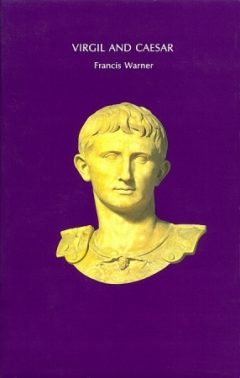
Virgil & Caesar
21.6 x 13.8 cm. Oxford Theatre Texts 11
‘In his new play, Virgil and Caesar, the completion of a serial epic entitled AGORA, Francis Warner explores the dramatic tension between worldly rule, the pragmatism of politics, and the vision of the poet as idealist.<br
‘Staged in the uniquely fitting setting of Oxford University’s Convocation House, the production by Tim Prentki and Dominic Shellard exploited the limited space of fan-vaulted beauty to fine advantage.<br
‘The play, as it explored the relationships between the machinations of worldly power, the wooing of the army, the detecting of subterfuge from the judiciary, the temptation of tyrannical power, the duties of family life, and the seductive disasters of succumbing to lust, unfolded in masterly fashion against the background of the philosophical and other views of the poets.<br
‘Warner brings to our attention the perennial conflicts that are as timeless as they are timely. The command of English through poetic imagery must rank as the very best. Here we have laid before us the perennial crises of humanity dressed in classical clothes yet intensely of today.<br
‘How valuable such rare and important plays are, being written in times when not only biological species are under threat around the world, but also cultural continuity itself.’ The Stage 'Detailed. . . accurate . . . moving, with convincing dramatic power, Warner’s verse filled the ear satisfyingly, and echoes in the memory.’ Jasper Griffin, in Oxford Magazine
Requiem and its maquettes
'Mr Warner’s talent is remarkable, original, and is not content with achieving easy things. He sees theatre in terms of musical and pictorial construction. His visual sense is extraordinarily vivid. His verbal mastery too, is undeniable. The permissive theatre is both employed and transcended by the force and beauty of Francis Warner’s brooding and baroque imagination. . . The text is one of the richest encountered in the theatre for a long time.’ Harold Hobson, The Sunday Times
Maquettes was called by a reviewer in The Sunday Times ‘one of the triumphs of this year’s Edinburgh Festival’.
'This remarkable trilogy achieves its effects through a combination of musical, theatrical, and pictorial techniques.' Elizabeth Kilburn on CBC Radio said of the Canadian performance, ‘Warner creates rôles for women that are absolutely brilliant.'Plays and Players
'The sort of illuminated shorthand of his style, allied to his arresting visual images, is clearly capable of making a very direct contact – and an electrically shocking one at that. He is a considerable writer.’ Time Out
More info →
Rembrandt’s Mirror
Volume 14 of Oxford Theatre Texts series
viii, 138pp. plus 32pp colour illus.
'This new play by Francis Warner followed the life of Rembrandt from his arrival in Amsterdam in 1625 until his death some fifty years later. By tracing his friendships with the great figures of the day, the play explored the interactions of art and life in the Dutch Republic during a period of political turmoil and religious intolerance.
"Central to this cultural milieu was the Speelhouse, essentially a highly refined brothel, whose patrons included Prince Frederik Hendrik, the poet Joost van den Vondel, the royal advisor Constantijn Huygens, and of course Rembrandt...
Such liberated more conflicted directly with the prevalent Dutch Calvinism, whose moral severities were personified by the Reverends Smout and Trigland, a ludicrous duo of preachers... They brought about the suppression of the speelhouse, thus causing the dissolution of Rembrandt's circle and initiating his decline.
"The language, while stylised, came to sound entirely natural, thanks to the skill of the actors, at times achieving a lyrical beauty; and its cadences gave a suitable distance to seventeenth century Holland.
"Rembrandt (Simon Kane) had a commanding stage presence, and his defences of art were some of the most convincing I have heard from a fictionalised artist.
"The play's emotional involvement was very strong, and there were moments when the audience's identification with the characters became almost palpable. This was exemplified by the shocked silence that greeted the deaths of Rembrandt's first wife and child. Death was the overarching theme of this play, and its impact on Rembrandt's work became pronounced towards the end, especially in his final self-portrait where the experience of the years was etched in his face." Oxford Magazine
‘The play is fabulously detailed and interweaves the joy and tragedy of individuals with the background of political and religious change. The language is rich, with sparks of humour and pertinent observations on love, sensuality, grief, morality and art. This depth is sustained by immaculate and engaging acting and lavish costumes. A few hundred words cannot do this play justice. Go and see it." Eva Spain in Theatre Review (Daily Information, Oxford)
More info →
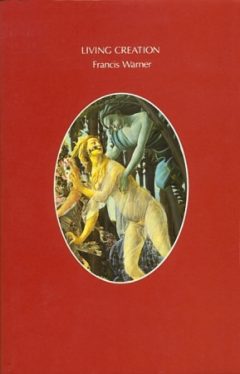
Living Creation
21.6 x 13.8 cm. Oxford Theatre Texts 8
Highly praised by the critics, Living Creation is Francis Warner’s tenth successful play. It tells the story of Lorenzo de’ Medici’s dominance over Florence, of his patronage of the poets and artists, and particularly of his relationship with Botticelli (whose life unifies the action), and covers the death first of Lorenzo’s brother, then of himself against the background of Savonarola’s rise to power, fall, and execution.
Francis Warner, the Oxford poet and dramatist, has given vivid expression to the civic and religious conflicts of the Medicis, Savonarola, and their contemporaries in renaissance Florence.
Much of the action concerns Botticelli’s creation of some of his masterpieces - shown in colour slide projections - [and] their impact on his fellow Florentines. . . .
Mr Warner, in language that is invariably compulsive and heightened by the richness of sensitive, forceful imagery, has brought to the stage the intrigue, the religious sourness, the savage cruelty and also the beauty of the Florence of the Medicis.’ The Stage
Francis Warner has done Oxford a real service by choosing to stage his latest play at the Examination Schools.
His verse takes on a new muscularity and sensitivity. The large and able cast respond. And Greta Verdin’s beautifully staged and orchestrated production has the same hypnotic appeal as a Botticelli painting.’ Oxford Mail</b
More info →
King Francis I
21.6 x 13.8 cm.
‘Francis Warner’s play in celebration of the quincentenary of François I’s birth in 1494 is an act of courage. . . . It opens in 1515, on the king’s return from fighting the Swiss, and takes us to his death in 1547.
'Along the way, we meet not only the king himself, but also figures at least equal in prestige: Charles V, King of Spain and Holy Roman Emperor, Clément Marot, Leonardo da Vinci, Marguerite de Navarre. . . . The play maintains a consistently coherent line. Tim Prentki, as director, deserves his share of the credit for carrying forward this complex tale.
'We hear of François as king, warrior, husband, lover/philanderer, patron of the arts, huntsman, opponent of the Sorbonne, creator of institutions free from the domination of the Church, religious bigot, and many things more>. . . The whole is constructed on the basis of serious research into the period and the characters concerned.’ Oxford Magazine
‘It is a substantial play, in verse, which presents an intriguing picture of the Renaissance court. Francis’s patronage of the arts appears to spring as much from interests of state and princely one-upmanship as from his much-vaunted love of beauty. But it also provokes one of the play’s most poignant scenes, the death of Leonardo da Vinci. King Frances I deserves to be widely performed.’ Church Times
'King Francis I takes its place in an enterprise aimed at producing a vast historical vision.’ Oxford Magazine

Selected Plays of Paul Vincent Carroll
Chosen and introduced by George Cusack
The sixteenth volume of the Irish Drama Selections series (ISSN 0260-7962), General Editors: Joseph Ronsley and Ann Saddlemyer.
21.6 x 13.8cm.
Contains: The Things That Are Caesar’s, Shadow and Substance, The Conspirators, The White Steed, The Devil Came from Dublin, and Goodbye to the Summer, articles about his and others' plays – 'The Substance of Paul Vincent Carroll', 'On Legend and the Arts', 'The White Steed', 'Scottish Drama', 'Can the Abbey be Restored?', 'Reforming a Reformer, 'The Rebel Mind' – and a bibliographical checklist.
Paul Vincent Carroll was the first Irish Catholic to write for the Irish National Theatre after Irish independence. As such, his work offers a unique perspective on Irish life in the early years of the Irish Free State and Irish Republic, particularly the influence of the Catholic Church in rural Ireland. He is particularly known for his depictions of the Catholic clergy, which are simultaneously critical, hopeful, and, above all, human.
Although Carroll was lauded in both Dublin and New York as a major new theatrical voice, virtually none of his work has been in print since his death in 1968.
George Cusack is the author of The Politics of Identity in Irish Drama: W. B. Yeats, Augusta Gregory, and J. M. Synge, and the co-editor of Hungry Words: Images of Famine in the Irish Canon. He received his PhD from the University of Oregon in 2003. He is currently the Director of the Edith Kinney Gaylord Expository Writing Program at the University of Oklahoma.
More info →

Healing Nature
21.6 x 13.8 cm. Oxford Theatre Texts 9
'Francis Warner has shown once more he is a masterful poet and dramatist. Healing Nature, his eleventh play, is his best work to date. The action centres round Pericles, the aristocratic general, commandingly played by Rob Smith, as he creates "an Athens all the world will imitate", only to see the tide of fortune turn and the empire fall into decay. Its exploration of the dilemmas facing empire-builders and empire- losers is original, thought-provoking, and relevant.
‘It is a compelling play which combines the grand, heroic drama of Marlowe's Tamburlaine with moments of exquisitely delicate lyric poetry and unexpected dashes of humour.' The Stage
'A real treat in poetry was to be had in the Sheldonian last night. This was the première performance of Healing Nature, by Francis Warner. . . The play is about the turmoil that the birth pangs of democracy bring to a city, and the revolution and hostilities that accompany it.
‘Francis Warner's play was safe in the hands of the Oxford University Dramatic Society, who, under the direction of Mark Payton, put on a classically Greek production. All brought out the Shakespearian quality of the play's verse and depth of meaning. And there could have been no better setting than the magnificent amphitheatre that is the Sheldonian.' Oxford Mail.
A ‘contemporary classic’ Oxford Mail
More info →
Goethe’s Weimar
21.6 x 13.8 cm. Oxford Theatre Texts 13
‘This is a study in “Weimar as a mode of spiritual life’, as Thomas Mann might have called it: the spirit of the place reflected in a swift series of sparkling encounters, bewildering in its variety, stirring in its epic scope.
'The vision was conveyed though some splendid acting. . . . Here they are, the secular saints of German Kulturreligion; all conjured up with perfect ease and conviction. This play is about people, some more, some less noble, but all noble in their efforts and, in Faustian fashion, “ever striving”. . .
'In the end, what counts is language, the language of poetry (as Herder would have been the first to insist). The verse is effortless and pure, and rises on occasion to noble resonance.
'For readers of German literature, this language holds special delights. In addition to the poems and the plays, the novels and the essays, contemporary letters, diaries, reported conversations are continually present. Much learning, lightly worn, has gone into this play.
'An example. At the end of the play, the audience is left with a masterly translation of the most celebrated of Goethe’s, perhaps of all German poems (“Über allen Gipfeln/ist Ruh”).
'The end is sombre, indeed. This mystery play promises no salvation. The sound of cannons is a moving and fitting end to Goethe’s Weimar.' Oxford Magazine
'The scale is Shakespearean, with a huge cast (thirty speaking parts) sweeping through time and place in flowing blank verse. . . . Warner is excellently served by his actors; Daniel Cassiel brings gravitas to Goethe, and Ian Drysdale achieves an astonishing double as Schiller and Napoleon. Tim Prentki produces smoothly as always.' Oxford Times
More info →
A Conception of Love
hbk 21.6 x 13.8 cm. Oxford Theatre Texts 5
In an empty circle, and without props, Francis Warner recreated for the 1978 Observer Oxford Festival of Theatre the world of late adolescence, of boys and girls caught in the process of becoming men and women.
‘Superbly and masterfully played’ (Oxford Mail), this beautifully balanced, minutely complex play examines the familiar Warnerian preoccupations, this time in a comedy of love, rich in poetry and generous in spirit
More info →