

Representative Irish Tales
With a foreword by Mary Helen Thuente
This anthology of Irish fiction edited by W.B. Yeats was first published in 1891, but despite its significance in his early career, was out of print for nearly eighty years. Representative Irish Tales is a fine selection of Irish fiction – as representative of Yeats himself as it is of Irish novelists. His introductory commentary and his editorial emendations provide an interesting perspective on an influential, but relatively unknown phase of his early work. Novelists represented are: Maria Edgeworth, John & Michael Banim, William Carleton, Samuel Lover, William Maginn, T. Crofton Croker, Gerald Griffin, Charles Lever, Charles Kickham, and Miss Rosa Mulholland.
Representative Irish Tales was first published in 1891 but was soon out of print - until the present edition in 1979. This printing (1991) marks the centenary of the work. Mary Helen Thuente provides a fascinating and useful foreword setting the tales in the context of Yeats's own writing.
More info →


The Collector’s Bag
(short stories)
A fascinating collection of stories based on the author's experiences as an Indian Civil Services Deputy Commissioner, or `Collector' in the Himalayan district of Garhwal, in which actual fact stands beside fiction, and where, if the story is not true, in whole or in part, it still gives a true insight into the life and mores of the people in that part of the subcontinent. Love, murder, rogues, humour, revenges, trial by ordeal, blood feuds, and Chinese-Tibetan plans for the invasion of India are featured, as well as an account of the author's meeting with Jawarhal Nehru.
The author has splendidly evoked a way of life of half a century ago, but much of it could still exist today: the world changes very little in the depths of the Indian hill country.
More info →
Goodnight, Morning
Jo Rippier was born in Plymouth in 1935, and educated at King’s School Worcester and Emmanuel College Cambridge. He gained his Ph.D. in English Literature at the Johann Wolfgang Goethe Universitatät, where he was a lecturer in the English Department until retiring in 1998. His previous publications include The Short Stories of Sean O’Faolain: A Study in Descriptive Techniques,and Some Postwar English Novelists, a volume of short stories, Goodnight, Morning, and collections of poetry, Seasons and Remembrance (1981), Beginnings, Endings (1991), Past Present (1996), Against the Stream (1999, with aquarelles by Gerhard Elsner), Late Motley (2001), Something Old, Something New (2007), Echoes and Reflections (2009), Footsteps (2011), The Silence of Snow (2013), Darkness and Light (2014), Shadows (2015) and Sights and Sounds (2017).
More info →
Moments in Time
ISBN 978-0-86140-454-4
These short stories are in general an attempt to recapture and encapsulate aspects of a distant past that will soon have faded for ever. Tiny scenes, events and memories are brought back in the form of a reality that has, through the workings of time, become fictionalised. Who now knows what the reality actually was?
Jo Rippier was born in Plymouth in 1935, and educated at King’s School Worcester and Emmanuel College Cambridge. He gained his Ph.D. in English Literature at the Johann Wolfgang Goethe Universitatät, where he was a lecturer in the English Department until retiring in 1998. His previous publications include The Short Stories of Sean O’Faolain: A Study in Descriptive Techniques (1976), Some Post-war English Novelists, a volume of short stories, Goodnight, Morning, and collections of poetry, Seasons and Remembrance (1981), Beginnings, Endings (1991), Past Present (1996), Against the Stream (1999, with aquarelles by Gerhard Elsner), Late Motley (2001), Something Old, Something New (2007), Echoes and Reflections (2009), Footsteps (2011), The Silence of Snow (2013), Darkness and Light (2014), and Shadows (2015).
More info →
The Untilled Field
With an Introduction by Richard Allen Cave
21.6 x 13.8 cm. xxxiv, 225 pp. 1903, and revised by Moore in 1926, and 1931.
This edition first published in 2000
Bubbling with enthusiasm for the revival of Gaelic in Ireland, George Moore suggested to the Gaelic League that it should publish a translation of a modern work that children might study in school and that artists might imitate and so begin a new tradition of Gaelic Literature. It was a sensible idea that was delayed at first for want of agreement within the League over a suitable text. Spurred on by his friends, Moore himself then set about writing some tales of Irish life for this end. They were translated by Taidgh O’Donohue and published in 1902 in the New Ireland Review. Later a collection of these and more stories appeared under the title An T-Úr-Gort, Sgéalta; a version of this, reworked by Moore in English as The Untilled Field, followed in 1903. It proved subsequently the one of his works that pleased Moore best for its affectionate portraits of Irish rural life.
Though modelled initially on Turgenev’s Tales of a Sportsman, the stories soon became original inspirations woven out of Moore’s memories of the peasants who lived and worked on his family estate in Mayo. Moore took as his theme the pathos of their existence: the bleakness; the imaginative, cultural and emotional austerity that compelled many, often whole parishes, to emigrate and leave their homes in ruins; the indefatigable resilience of those who stayed and endured; and the fragile consolations offered by their religion. The painfulness of his subjects he offset by the gentle humour of his treatment. Moore’s antipathy to the Catholic clergy was soon to become notorious but the tragi-comic plight of the parish priest who finds his power and moral authority undermined by the poverty of his parishioners and the cunning they develop in order to survive provokes in these tales some barbed satire but much compassion and amusement. The delicacy of discrimination, the emotional control that reveals Moore’s understanding and pity through a technique of powerful understatement is unusual in his work and unusual too in the tradition of Irish fiction.
Moore once wrote of The Untilled Field: ‘It is a dry book and does not claim the affections at once.’ But Moore was wrong: level and dispassionate in tone it may be, but the book is one of the richest and most perfectly written of his works and the depth of feeling that went into its composition is evident throughout.
This new printing of the text of the 1931 edition also contains the texts of ‘In the Clay’ and ‘The Way Back’ which Moore omitted from that edition. It has an Introduction by Richard Allen Cave.
More info → 
The Lake
With an Afterword by Richard Allen Cave
ISBN: 978-0-901072-82-5
21.6 x 13.8 cm. xii, 274 pp. 1980
The Lake is George Moore’s most poetic and perfectly crafted novel. It tells of a priest’s loss not of faith, but of commitment to the principles fostered in him during his training and his discovery of a more fulfilling religion that celebrates instinct as being, if rightly understood, man’s true mode of communion with his soul. Father Gogarty’s parish is in a remote district of Mayo beside Lough Carra and his new philosophy is worked out during his long walks and rides round the lake where he learns how the changing quality of his perceptions of the landscape about him can reveal the fluctuating moods of that ‘underlife’ of his psyche that shapes his being.
The Lake is a novel about self-discovery through guilt (Gogarty fears he has brought about the death of a parishioner through vigorously denouncing her way of life from the altar) and atonement in renouncing a creed which demands that a man continually repress his capacity for joy. But it is also a novel about the satisfactions of living close to nature in Ireland; the atmosphere of the Mayo countryside, the play of light on mountain, wood and lake, the rich historical associations in every church, castle or abbey ruin and farmstead are evoked with a rare skill, subtly illuminating the relationship that Moore takes as his theme between place and the Irish personality. If in studying the motives that compel his priest to the decision, ‘Non Serviam’, Moore is establishing a pattern in Irish fiction that Joyce will elaborate with his Portrait of an Artist, then in his poetic rendering of consciousness as the sum of a character’s perceptions, Moore is anticipating the technique of Virginia Woolf and Elizabeth Bowen.
Published in 1905, The Lake underwent considerable revision in two further editions before Moore was satisfied with its complex form and the disciplined style that form exacted. (The present edition reprints the last revised text of 1921.) In an Afterword, Professor Richard Allen Cave of Royal Holloway, University of London, examines the nature of this discipline, the influence of Zola and of Dujardin on Moore’s choice of a structure: and the ways first the composition and later the revision of The Lake were made easier by the writing of the stories in The Untilled Field (1903) and the autobiography, Hail and Farewell! (1911-1914). Significantly, all three works – each a masterpiece of its kind and, viewed together, the triumph of Moore’s career – were the product of the novelist’s return to his native land to champion the cause of the Irish renaissance. With them Moore gave to Irish fiction a new method and a new voice and, before Joyce and Beckett, set exacting standards of scruple and dedication in the pursuit of a finished artistry in prose.
Richard Allen Cave, Emeritus Professor of Drama and Theatre Arts at Royal Holloway in the University of London, has published extensively in the fields of renaissance drama (Jonson, Webster, Brome), modern English and Irish theatre (Wilde, Yeats, Pinter, Beckett, Friel, Mc Guinness), dance (Ninette de Valois, Robert Helpmann), stage design (Charles Ricketts, Robert Gregory) and direction (Terence Gray). Most recently, he devised and was General Editor of an AHRC-funded project to create an online edition of The Collected Plays of Richard Brome (2010), and published the monograph, Collaborations: Ninette de Valois and William Butler Yeats (2011). The Collected Brome is soon to be published in a more traditional book-format by Oxford University Press (2020). He has also edited the plays of Wilde, Yeats and T.C. Murray; and the manuscript versions of Yeats’s The King of the Great Clock Tower and A Full Moon in March. Professor Cave is a trained Feldenkrais practitioner who works on vocal techniques with professional actors and on extending movement skills with performers in physical theatre.
More info → 
The Cock and Anchor, Being a Chronicle of Old Dublin City
Edited by Jan Jędrzejewski
21.6 x 13.8 cm. xxviii, 489 pp. Ulster Editions & Monographs series (ISSN 0954-3392) volume 9
First published in 1845, Joseph Sheridan Le Fanu's The Cock and Anchor is one of the most interesting historical novels written in Ireland in the nineteenth century. It is many things: a record of the mores and manners of early eighteenth-century Ireland, a story of love struggling against the prejudices of class and religion, a penetrating moral study of crime and punishment, an engaging thriller. But first of all it is a full-bodied, energetic, lively picture of Dublin - its palaces and its inns, its streets, its people, its way of life. Written in the early years of Le Fanu's career as a novelist, it provides an exciting introduction to the work of one the most intriguing novelists of Victorian Ireland.
The Editor has provided notes, notes on the text and appendices which give the major and minor textual variants of the tale, and nearly thirty pages of contemporary reviews published in Ireland, England and Scotland.
Educated at the University of Łódź, Poland, and Worcester College, Oxford, Professor Jan Jędrzejewski is Dean of the Faculty of Arts at the University of Ulster. He wrote Thomas Hardy and the Church (1996), edited a selection of Thomas Hardy's short fiction Outside the Gates of the World (1996), and published numerous papers on Victorian fiction, modern Irish literature, and Anglo-Polish literary relations.
Front cover illustration (continuing onto the front flap): 'A Prospect of the City of Dublin from the Magazine Hill, in his Majesty's Phoenix Park' by Joseph Tudor, issued in 1753.
More info →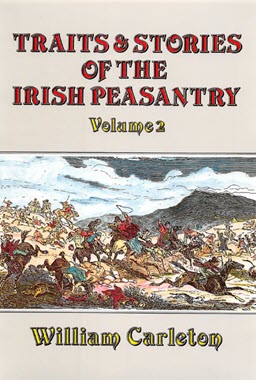
Traits and Stories of the Irish Peasantry, Vol.2
21.6 x 13.8 cm. with all the original illustrative etchings
Traits and Stories of the Irish Peasantry can be considered to be Carleton’s greatest work. It went through a number of transformations before the ‘definitive edition’ was published in 1842-44. This edition was the last that Carleton actually oversaw; thus it is the culmination of his own work on the collection, and for this reason is the edition we publish.
Traits and Stories contains a wealth of illustrations by famous illustrators of the time. They give a good impression of the tales themselves, being crowded with laughing, weeping, fighting, working, playing, dying, and praying peasants in sublime scenery, poverty-stricken cottages, cosy public houses, trim farms, broken-down barns, hillside chapels, hedge schools, and hovels. The inhabitants of Carleton’s world are villains, scholars, horse-thieves, pig-drivers, priests, farmers and shopkeepers. He aimed to show the Irish peasant honestly to the world, choosing simple, strong plots. Contemporary critics praised Carleton most for the ‘light and shade’ of his depictions of Irish character, and much of his power lies in the combination and contracts of light and shade, good and evil, fun and tragedy. He is a writer of great comic genius, as well as being able to convey the horrors of poverty and the peasant life.
He conveys, too, a sense of urgency. What he was describing was an Ireland of his youth that was passing or had already passed, hence his often lengthy annotations about the traditions, tales, customs and pastimes that he even then considered necessary for his readership.
A fine ability to tell a story distinguishes Carleton from many contemporary purveyors of folklore and folk life, and this contributed to his immense popularity in Ireland, England and across the Atlantic in the United States and Canada. There appeared over 50 editions of Traits and Stories, containing some or all the stories of the ‘Definitive Edition’, in the 19th Century alone. No other work of the first half of the 19th Century conveys so well the rural life of the period. Apart from being immensely entertaining, these stories are essential reading for the literary and history student of that period. This is the only complete printing of the ‘Definitive Edition’ presently available.
Volume 2 contains 'Geography of an Irish Oath' – 'The Lianhan Shee' – 'Going to Maynooth' – 'Phelim O'Toole's Courtship' – 'The Poor Scholar' – 'Wildgoose Lodge' – 'Tubber Derg'; or 'The Red Well' – 'Neal Malone'
Barbara Hayley died in a road accident at the time she was Professor of English at St Patrick’s College, Maynooth. Her publications include Carleton’s Traits and Stories and the 19th Century Anglo-Irish Tradition (1983), and A Bibliography of the Writings of William Carleton (1985). Her Carleton’s Alterations to ‘Traits & Stories of the Irish Peasantry’ is not yet published.
More info →

Traits and Stories of the Irish Peasantry, Vol.1
With an Introduction by Barbara Hayley
21.6 x 13.8 cm. with all the original illustrative etchings
Traits and Stories of the Irish Peasantry can be considered to be Carleton’s greatest work. It went through a number of transformations before the ‘definitive edition’ was published in 1842-44. This edition was the last that Carleton actually oversaw; thus it is the culmination of his own work on the collection, and for this reason is the edition we publish.
Traits and Stories contains a wealth of illustrations by famous illustrators of the time. They give a good impression of the tales themselves, being crowded with laughing, weeping, fighting, working, playing, dying, and praying peasants in sublime scenery, poverty-stricken cottages, cosy public houses, trim farms, broken-down barns, hillside chapels, hedge schools, and hovels. The inhabitants of Carleton’s world are villains, scholars, horse-thieves, pig-drivers, priests, farmers and shopkeepers. He aimed to show the Irish peasant honestly to the world, choosing simple, strong plots. Contemporary critics praised Carleton most for the ‘light and shade’ of his depictions of Irish character, and much of his power lies in the combination and contracts of light and shade, good and evil, fun and tragedy. He is a writer of great comic genius, as well as being able to convey the horrors of poverty and the peasant life.
He conveys, too, a sense of urgency. What he was describing was an Ireland of his youth that was passing or had already passed, hence his often lengthy annotations about the traditions, tales, customs and pastimes that he even then considered necessary for his readership.
A fine ability to tell a story distinguishes Carleton from many contemporary purveyors of folklore and folk life, and this contributed to his immense popularity in Ireland, England and across the Atlantic in the United States and Canada. There appeared over 50 editions of Traits and Stories, containing some or all the stories of the ‘Definitive Edition’, in the 19th Century alone. No other work of the first half of the 19th Century conveys so well the rural life of the period. Apart from being immensely entertaining, these stories are essential reading for the literary and history student of that period. This is the only complete printing of the ‘Definitive Edition’ presently available.
Volume 1 contains Professor Hayley’s foreword Carleton’s Auto-biographical Introduction – 'Ned M'Keown' – 'The Three Tasks' – 'Shane Fadh's Wedding – 'Larry M'Farland's Wake' – 'The Battle of the Factions' – 'The Station' – 'The Party Fight and Funeral' – 'The Lough Derg Pilgrim' – 'The Hedge School' – 'The Midnight Mass' – 'The Donagh', or 'The Horse-stealers' – 'Phil Purcel the Pig-Driver'.
Barbara Hayley died in a road accident at the time she was Professor of English at St Patrick’s College, Maynooth. Her publications include Carleton’s Traits and Stories and the 19th Century Anglo-Irish Tradition (1983), and A Bibliography of the Writings of William Carleton (1985). Her Carleton’s Alterations to ‘Traits & Stories of the Irish Peasantry’ is not yet published.
More info →

Vertue Rewarded, or The Irish Princess, ‘A New Novel’ (1693)
21.6 x 13.8 cm. Princess Grace Irish Library series (ISSN 0269-2619) volume 7
Published for the first, and (until now) only, time in 1693, this novel is set in Ireland immediately after the Battle of the Boyne, and describes the courtship of a young lady of Clonmel by a prince, who is on his way to take up a post in Limerick. The story is humorous and engaging. As the editor points out, its interest lies not only in it calling itself `A Novel', but that it may well have been known to Samuel Richardson, and influenced his Pamela (itself subtitled Virtue Rewarded), published fifty years later. This work can lay claim to being the first Irish novel ever published – certainly the earliest that is extant, and as such will be of interest to all students of literature in the English language.
More info →

Walter Pater, ‘Gaston de Latour’: The Revised Text
Scarcely two years after Walter Pater's death, Macmillan & Company published Gaston de Latour; An Unfinished Romance. The author of works critical to the formation of the Transition and Modernist periods set his last novel in the turbulent years following the Reformation. Selected chapters first appeared serially in Macmillan's Magazine and Fortnightly Review, but the posthumous volume edited by Charles L. Shadwell, Pater's long-time friend, remains controversial. For a century readers have seen only a portion of what Pater wrote for Gaston de Latour. Shadwell withheld six manuscript chapters.
Pater's prominence and widening influence in late-nineteenth and early twentieth-century studies makes those unpublished chapters more intriguing than ever. Edited from the holographs and based on definitive material incorporating all known fragments, The Revised Text includes the crucial suppressed chapters. Professor Gerald Monsman's edition, meticulously edited and researched, is surely closer to Pater's own latest version. This comprehensive Gaston de Latour offers what many will see as a work closer to Pater's intention than the book Macmillan printed in 1896.
The Revised Text is notable in other ways, Pater's study of eroticism in his portrait of Queen Marguerite is a significant contribution to gender studies in the late-Victorian period. The Pater of the 1890s is revealed here too. As Monsman says, the “later Pater is in many ways the most interesting of all the successive Paters – certainly wearier, but also more candid, consummately polished artistically, self-consciously aware of a dawning modernism."
Gerald Monsman (University of Arizona) has worked for nearly a decade to bring this authoritative edition to print. His contributions to the field are well known: Pater’s Portraits (Johns Hopkins University Press, 1967), Walter Pater (G. K. Hall, 1977), Walter Pater’s Art of Autobiography (Yale University Press, 1980). Gaston de Latour: The Revised Text is a significant achievement. Scholars and students will find Monsman's Introduction, Explanatory Notes, Diplomatic Transcriptions, Emendations and Variants invaluable.

Lady Gregory’s Early Irish Writings 1883-1893
General Editors of the Coole Edition: T.R.Henn CBE and Colin Smythe
Edited and Introduced by James Pethica
23.4 x 15.5 cm. x, 248 pp. + 32 illus.
This sixteenth volume of the Coole Edition contains Lady Gregory’s first writings on Ireland. They include the two surviving versions of her unpublished first attempt at autobiography, 'An Emigrant's Note Book' (1883); three short stories she wrote under the pseudonym ‘Angus Grey’ —'A Philanthropist', 'A Gentleman' and 'Peeler Astore' (1890-91); and her anonymously-issued anti-Home Rule pamphlet A Phantom's Pilgrimage, or Home Ruin (1893). Appendices contain her lyric 'Alas, a woman may not love' (1886) and the poems she sent to Wilfrid Scawen Blunt following his imprisonment in Galway in 1888 for participating in a banned tenant protest against evictions. Also included is the newly-rediscovered text of Sir William Gregory’s prescient 1881 pamphlet on the Land League.
James Pethica’s Introduction sets these works within their biographical, political and creative contexts, charting the imperatives and aspirations driving Lady Gregory’s first sustained efforts as a writer. This remarkable collection throws an entirely new light on the years of her marriage and early widowhood, revealing the foundational influence of Sir William Gregory on her political views and self-conception as a landowner, and detailing the course of her turn to Irish themes and to the life of the Galway world she had grown up in for subject matter. Lady Gregory's Early Irish Writings shows her already finding core elements of her creative voice long before she met W.B. Yeats and emerged to later prominence as a folklore collector, dramatist, and cultural nationalist.
James Pethica teaches Irish Studies, Modern literature, and drama at Williams College in Massachussetts. He is preparing the authorized biography of Lady Gregory for Oxford University Press.
More info →
Lady Gregory’s Shorter Writings Volume 1; 1882-1900
General Editors of the Coole Edition: T.R. Henn CBE and Colin Smythe
Edited and Introduced by James Pethica
23.4 x 15.5 cm. x, 298 pp.
This first volume of Lady Gregory’s Shorter Writings covers the years 1882-1900. Edited and introduced by James Pethica, whose authorized biography of Gregory is in preparation for Oxford University Press, it makes available all the previously uncollected work she wrote for publication during the period, including newly-discovered articles, material that was never printed, and items that appeared anonymously or pseudonymously.
The volume begins with her first independent publication, Arabi and His Household (1882), written in support of the deposed leader of the Egyptian Nationalist rebellion, who faced likely execution by the British. Gregory's travel journalism and other occasional writings of the 1880s were sufficient to catch the attention of Oscar Wilde, who praised her "clever pen" and invited her to contribute to The Woman’s World, the periodical he edited. Also included here are more than a dozen unpublished poems, often highly personal, written during her travels to India and Ceylon, along with the sequence of twelve sonnets she gave Wilfrid Scawen Blunt in 1883 as they ended their clandestine affair. Writings from the early 1890s include one short story set in Italy, and another with a plot her friend Henry James briefly considered using as the basis for a novel.
Gregory’s publications from the mid-1890s offer sharp new insight into her growing interest in Irish folklore, her emergence as an Irish nationalist, and her enthusiasm for the Irish language and the Gaelic League. Key works include a previously unpublished pamphlet on the inequities of Irish taxation, and Gregory’s first substantial folklore essays. The last writings in the volume register her increasing centrality in the emergence of the Irish Literary Theatre, her developing friendship and collaborations with W.B.Yeats, and her growing confidence in her creative voice as she began her rise to prominence.
James Pethica teaches Irish Studies, Modern literature, and drama at Williams College in Massachusetts. He is preparing the authorized biography of Lady Gregory for Oxford University Press.
More info → 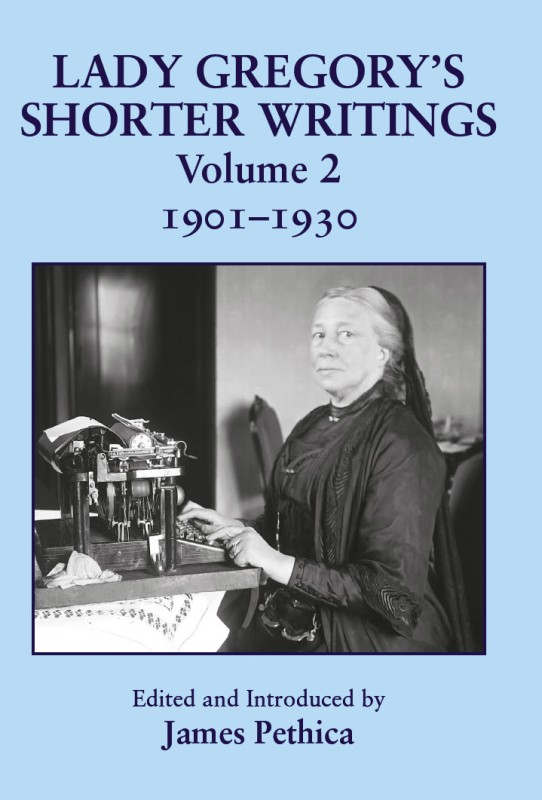
Lady Gregory’s Shorter Writings Volume 2; 1901-1930
General Editors of the Coole Edition: T.R.Henn CBE
and Colin Smythe
Edited and introduced by James Pethica
23.4 x 15.5 cm. pp. xvi, 434.
This second volume of Lady Gregory’s Shorter Writings, covering the years 1901–1930, makes available all the previously uncollected work she published during the period. The texts collected here range from folklore essays, reviews, responses to political events, and writings in support of the Irish language movement to book prefaces, letters and articles from her campaign for the return of the Lane pictures, publications relating to the Abbey Theatre, and, latterly, essays written primarily to earn money. All reflect the wide range of commitments and enthusiasms Gregory maintained amidst the considerable regular demands of her work as a dramatist and theatre director. The volume includes various newly-uncovered items; writings that appeared anonymously or pseudonymously; letters published in newspapers over others’ names, but written by her; and a few works which she wrote for the press but did not in the end submit, or which were declined by publishers.
James Pethica teaches Irish Studies, Modern literature and drama at Williams College in Massachusetts. He is preparing the authorised biography of Lady Gregory for Oxford University Press.
More info →