

The Prose of J. M. Synge
Edited by Alan Price
paperback 21.4 cm.
J.M.Synge died in 1909 and The Works of John M. Synge were published in four volumes by Maunsel & Co., Dublin, in 1910. Since that time, with the exception of a few minor verses and one or two fragments of prose, the canon of his work has remained unaltered. Nevertheless, much unpublished material exists, for the most part of great interest and significance for the understanding of Synge's methods of work and development. This material, including early drafts of the plays, notebooks, poems, and fragments of poetic drama, has now been thoroughly explored in order to create this definitive edition, first published by Oxford University Press 1962-68, which not only collects together all that is of significance in his printed and in his unprinted work, but also, by a careful use of worksheets and early drafts, indicates much of the process of creation which occurred before the production of the printed page. The Collected Works is in four volumes, under the general editorship of the late Professor Robin Skelton, of the University of Victoria, British Columbia, who began the series with his edition of the poems and translations.
The second volume, edited by the late Dr Alan Price, of The Queen's University, Belfast, author of Synge and Anglo-Irish Drama, assembles all Synge's prose writings of any merit or interest. Over half of it consists of a reprint of The Aran Islands, and In Wicklow, West Kerry and Connemara, checked and supplemented where necessary by collation with Synge's own manuscripts and proofs. About a quarter consists of articles and reviews not previously collected, and the rest, including most of Part One, was never published before. Thus the prose of Synge can here be seen as a whole and should lead to a deeper understanding of both the writer and the Anglo-Irish literary revival. Thirty-five drawings by Jack B. Yeats are included.
These volumes were published in 1982 by arrangement with Oxford University Press.
More info →

A Servant of the Queen
Edited by A. Norman Jeffares and Anna MacBride White
21.6 x 13.8 cm. paperback
Maud Gonne MaeBride is part of Irish history: her foundation of the women's group Inghinidhe na hEireann. the Daughters of Ireland, in 1900, was the key that effectively opened the door of politics in the twentieth century to Irishwomen. Still remembered in Ireland for the fiery, emotive public speeches she made on behalf of the suffering – those evicted from their homes in the West of Ireland, the Treason-Felony prisoners on the Isle of Wight, indeed all those whom she saw as victims of the imperialism she constantly opposed – she is known, too, within and outside Ireland as the woman W. B. Yeats loved and celebrated in his poems.
He wrote poems to and about her after they first met in 18S9, and he continued to do so in his middle age and up to his seventies. when he remembered her ‘straight back and arrogant head’, her gentleness, and her wildness. And something of those extremes in her character becomes clear in her autobiography, A Servant of the Queen, which brings her life up to her marriage to John MaeBride in 1903.
This is no orthodox autobiography: it selects episodes – many of them highly dramatic – in her life rather than providing a more pedestrian progress through all its events. The book conveys her romanticism and suggests how wide a range of activities she pursued as a fervent nationalist, persuasive propagandist, and successful journalist. Her sheer courage emerges clearly but though she held mere convention in contempt she had to exercise some discretion in writing these memoirs. The editors have identified some hitherto unnamed characters and established the identity of persons given other names in earlier editions: they have indicated some of the episodes in Maud Gonne's life – notably her liaison with the French politician Lucien Millevoye – that she was obliged to omit in the first edition (1937). A Servant of the Queen is written in a characteristically dashing conversational style and reveals the complexity of Maud Gonne's character: it is a most readable account of aspects of a vital, exciting life which has maintained its interest to historians and students. In this new edition, the editors, who compiled The Gonne-Yeats Letters 1893-1938, have corrected the order of the chapters so that they are now arranged according to the sequence of events, and have added a chronology, notes on the principal figures, and an index.
More info →

Representative Irish Tales
With a foreword by Mary Helen Thuente
This anthology of Irish fiction edited by W.B. Yeats was first published in 1891, but despite its significance in his early career, was out of print for nearly eighty years. Representative Irish Tales is a fine selection of Irish fiction – as representative of Yeats himself as it is of Irish novelists. His introductory commentary and his editorial emendations provide an interesting perspective on an influential, but relatively unknown phase of his early work. Novelists represented are: Maria Edgeworth, John & Michael Banim, William Carleton, Samuel Lover, William Maginn, T. Crofton Croker, Gerald Griffin, Charles Lever, Charles Kickham, and Miss Rosa Mulholland.
Representative Irish Tales was first published in 1891 but was soon out of print - until the present edition in 1979. This printing (1991) marks the centenary of the work. Mary Helen Thuente provides a fascinating and useful foreword setting the tales in the context of Yeats's own writing.
More info →

The Voyage of St. Brendan
Written in about AD800, Navigato Sancti Brendani Abbatis is one of the most famous and enduring stories of western Christendom. While the question whether Saint Brendan reached America remains a subject of controversy, the tale itself is of great interest – a strongly integrated text which derives from several centuries of Irish literary tradition. The text is illustrated by the relevant woodcuts from a German version of the tale which was printed in Augsburg in 1476.
John J. O’Meara has here translated one of the most famous and enduring stories of western Christendom, the Navigatio Sancti Brendani Abbatis, written in Ireland perhaps as early as the year 800. While the routes of Saint Brendan’s journeys remain a subject of controversy, the tale itself is of great interest – a strongly integrated text which derives from several centuries of Irish literary tradition.
The Voyage of Saint Brendan presents Professor O’Meara’s translation of the only scientific edition of the original Latin text, with his introduction, and is illustrated by the relevant woodcuts from a German version of the tale, Sankt Brandans Seefahrt, printed in Augsburg in 1476. When this version was published By the Dolmen Press in 1975 it was acclaimed by critics on both sides of the Atlantic:
‘It’s a fascinating book’ (Quidnunc, The Irish Times); ‘has the simplicity, the joyous naiveté, the suspension of reality which captivate the most sceptical reader of the Franciscan Fioretti and the same pervasive innocence and fiery spirituality’ (The Irish Independent); ‘valuable both as scholarship and literature’ (The Malahat Review); ‘A worthwhile book in every respect‘ (Choice, U.S.A.).
It was designed by Liam Miller.
More info →

Limerick Lace: A Social History and a Maker’s Manual
ISBN: 978-0-86140-368-4
29.6 x 21.0 cm. 91 pp. with 115 illus.
Limerick is probably the most famous of all Irish laces. When President Kennedy came to Limerick in 1963 the Lord Mayor presented him with a Christening robe of the lace, and other important visitors have been delighted to receive gifts of this prestigious material.
The making of this form of lace became possible when machine-made net became readily available, as it is a form of embroidery on net, being either chain-stitch (tambour) or darned net (also called run-lace), or a combination of both techniques.
This volume is produced in the same format as Carrickmacross Lace and Mountmellick Work, and is in three sections. The first deals with the invention of Limerick lace and its history, the second with Mrs Florence Vere O'Brien and her contribution to Limerick and its lace-workers, while the third deals with the techniques used in making Limerick Lace, the materials and designs, preparation and sewing, and filling and embroidery stitches.
The book contains many illustrations of fine piece of lacework from the authors' collections, as well as pictures of prizewinning examples from photos in the possession of the Royal Dublin Society.
About the authors
Nellie O Cléirigh was born in Clonmel, County Tipperary, and is a graduate of University College Dublin, in History and Irish, but she also attended embroidery classes at the Dublin School of Art. She formed a collection of old Irish lace which has been exhibited in Ireland and abroad, and this led to her study of the history of lace making in Ireland and of the people who contributed to it development. Publication of her Carrickmacross Lace in 1985 has led to lectures, publications and broadcasts in Ireland and abroad. She worked as a civil servant in Dublin until her marriage to Cormac, when she established a handicraft business in Dublin, and later a craft shop in Knightstown, Valentia Island, Co.Kerry. Her Valentia, A Different Irish Island was published in 1992.
Veronica Rowe (née Hardy) grew up at Walterstown, Crusheen, Co. Clare, not far from the home of her maternal grandmother, Florence Vere O'Brien (whose work for the Limerick lace industry is told in Section Two of this book). She trained as a textile designer in Scotland and worked with several handweaving firms in Ireland. She gained an Arts Council scholarship to France and Italy, and a Diploma in the History of European Painting. She is a past chairman of the Irish Guild of Spinners, Weavers and Dyers, and was its representative on the Crafts Council of Ireland. She is a member of the Arts Committee of the Royal Dublin Society, of its Crafts Sub-committee, and of the committee that in 1988 organised an important lace exhibition in Dublin (later displayed in Lisburn Museum, Co.Down), at which her collection of Florence Vere O'Brien's lace was shown. She organised an exhibition of Clare Embroidery in County Clare and County Down, and has written articles and a booklet on the subject.
More info →

The Middle Kingdom: The Faerie World of Ireland
ISBN: 978.0.900675.82.9
21.6 x 13.0 cm. 191 pp. + 8 pp. illus.
"[Among the books I read at the Beaconsfield Public Library] I remember being impressed by Dermot MacManus' The Middle Kingdom, which had a great effect on me, and is probably one of the most influential books I've ever read", Terry Pratchett (in his 1999 talk to the Folklore Society)
'No matter what one doubts,' wrote W.B.Yeats, 'one never doubts the faeries for . . . they stand to reason.' The author, an intimate friend of Yeats and a friend too of the great folklorist Douglas Hyde and the myriad-minded mystic G.W.Russell ('A.E.'), was a staunch believer in 'the ancient and continuing spirit life of the countryside'.
Writing not as a folklorist but as a historian, Diarmuid MacManus records in factual detail many manifestations of the Irish faery world early in the twentieth century. He tells how the Thornhill fairy appeared to two sisters in their room, and the Mount Leinster fairy to a young woman as she was taking the cows home, and a young girl tried to pat the Wicklow pooka as it walked beside her, but her hand went right through it.
This is a strikingly persuasive book, tackling in a serious and intelligent manner a subject that has a strong romantic appeal. The author set out to write the book with certain principles in mind: first, that a central character in each incident was still alive at the time the book was first published (in 1959); second, that he could vouch for their reliability; and third, that each agreed to stand up, if asked, and vouch for the truth of the experience. Except in a few instances, those telling the stories had been friends of the author for many years.
Since its publication forty years ago it has retained its uniqueness as the only collection of true Irish fairy tales.
More info → 
The Importance of Being Oscar
An Entertainment on the Life and Works of Oscar Wilde
21.6 x 13.8 cm. 71pp. 1995
Facsimile of the 1978 2nd Dolmen edition
ISBN: 978-0-85105-510-7
Originally created by the author as a one man show that was first produced at the Gate Theatre in Dublin in 1960 to rapturous reviews, and over the next fifteen years performed by him all over the world, the most recent production was performed by Simon Callow at the Savoy Theatre in 1998. Originally published by the Dolmen Press in 1963, critics acclaimed the text as 'an outstandingly skilful and memorable tribute from one Irish artist to another' (Micheal O hAodha, The Irish Press), and 'every bit as Wildeanly witty as Oscar at his best' (Quidnunc in The Irish Times). The present printing uses the designs mac Liammóir produced for the record sleeves for his recording of the work.
More info → 
A Little History of Ireland
21.6 x 13.8 cm. 63 pp. 1991
ISBN: 978-0-85105-433-9
First published by Dolmen Press in 1973, 2nd enlarged Dolmen edition 1982.
Seamus MacCall wanted to show that, as a nation, the Irish have much to be proud of and this resolve fired him with a contagious enthusiasm which the reader of A Little History of Ireland cannot help but share. It is a bird's-eye view of the Irish past which is at once lucid and expert and presents a vivid and lively view of its subject. This new edition of A Little History of Ireland has a final section by Catherine MacCall and Börje Thilman which brings the story up to our time.
'It is not very often that one gets the chance to see the whole course of Irish history outlined in sixty pages . . . Because there is no room for unnecessary detail, the facts are simply given to the reader’ Ireland of-the Welcomes
‘MacCall has managed to be at once concise and comprehensive in his coverage and the little book should be a valuable reference work’ The Irish Times
The cover shows the. meeting of Dermot MacMurrough and the Earl of Gloucester from the French metrical history of Richard II (British Museum) after the colour lithograph in Gilbert's Facsimiles of National Manuscripts by kind permission of the Royal Irish Academy.
More info →

The Holy Wells of Ireland
21.6 x 13.8 pp. 170 pp. 1992 pbk repr. of 1980 edition
Holy wells have been a feature of the religion of the Irish people for longer than records have existed, and while pilgrimages to them are not as common as in the last centuries, many wells are still visited, particularly on the Saints’ or ‘Pattern’ Days, and even now new wells occasionally appear.
In this survey Dr Patrick Logan, author of The Old Gods, Irish Country Cures and Fair Day: The Story of Irish Fairs and Markets, describes many of those wells that are still visited, detailing the features of the pilgrimage and the benefits obtained, together with the legends attached to the wells, the saints they are dedicated to and their Pattern Days, the sites, trees and stones associated with them, and fish that some of them have; he also gives information about the holy islands that have wells.
This collection does not attempt to describe every holy well in Ireland – an impossible task with so many – but Dr Logan has gathered together a collection of the most representative and interesting ones that visitors, pilgrims, and historians, as well as the local people will find it fascinating to read about.
‘What the author has done is to collect . . . a huge amount of important material about the wells, their history, the saints to whom they are dedicated, and their accessories, so to speak, such as the sites, the fish that some still nurture, and even such fascinating things as "swearing stones" and "cursing stones" . . . . A volume that is much needed and that will be a source of fascination to scholars and local historians alike for many years to come.’ Cork Examiner
'Dr Logan has succeeded in packing a great volume of interesting and useful information into this book.' Irish Independent
More info →
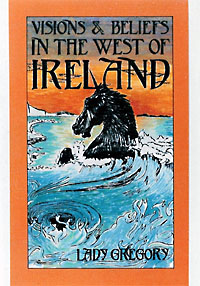
Visions and Beliefs in the West of Ireland
General Editors of the Coole Edition: T.R.Henn CBE and Colin Smythe
With an introduction by Elizabeth Coxhead
21.6 x 13.8 cm. ISBN: 978-0-901072-36-8
Visions & Beliefs in the West of Ireland has been a classic among folklore collections since its first publication in 1920. Lady Gregory started collecting the stories from local people in Clare and West Galway in the 1890s, and in the early years was often accompanied on her trips by W.B.Yeats. Both found the tales a valuable source for their work. Originally intended as a joint project, the two volume collection (here published as a single book) finally appeared under Lady Gregory's name, but Yeats provided notes and two essays, `Witches and Wizards and Irish Folk-Lore' and `Swedenborg, Mediums & the Desolate Places', both of which appear here.
Many aspects of the supernatural are presented, and there are stories about seers, healers, charms, banshees, fairy forts, the evil eye – this is a treasure trove of west Irish folk-beliefs from the late 19th and early 20th centuries.
Elizabeth Coxhead, who died in 1979, was a journalist, critic, broadcaster and novelist. She was also the author of Lady Gregory, A Literary Portrait (1961, revised 1966), the first book to be published exclusively about Lady Gregory, and Daughters of Erin (1965, republished 1979). which contains biographies of five leading women of the Irish Literary Revival period, Maude Gonne, Constance Markievicz, Sarah Purser, and Sally (Sarah) and Molly Allgood.

Cuchulain of Muirthemne: The Story of the Men of the Red Branch of Ulster
General Editors of the Coole Edition: T.R.Henn CBE and Colin Smythe
With a Foreword by Daniel Murphy
ISBN: 978-0-900675-85-0
21.6 x 13.8 cm
Here are the myths and legends of early Ireland as translated and written down by Lady Gregory, and published in 1902. This volume has a Preface by W.B. Yeats, who described it as `the best book that has ever come out of Ireland', and `the chief part of Ireland's gift of the imagination of the world'. Legends include: the Hound of Cuchulain and the Men of the Red Branch of Ulster.
Contents
Dedication of the Irish Edition to the People of Kiltartan
Foreword by Daniel Murphy
Preface. Signed W. B. Yeats, March 1902.
Birth of Cuchulain
Boy Deeds of Cuchulain
The Courting of Emer
Bricriu’s Feast, and the War of the Words of the Women of Ulster
The Championship of Ulster
The High King of Ireland
Fate of the Children of Usnach
The Dream of Angus
Cruachan
The Wedding of Maine Morgor
The War for the Bull of Cuailgne
The Awakening of Ulster
The Two Bulls
The Only Jealousy of Emer
Advice to a Prince
The Sons of Doel Dermai
Battle of Rosnaree
The Only Son of Aoife
Death of Cuchulain
Note by W. B. Yeats on The Conversation of Cuchulain and Emer. (Pages 32-34)
Notes. Signed A.G.
More info →

Me & Nu, Childhood at Coole
Illustrated by Joyce Dennys.
With a prefatory note by Maurice Collis
ISBN: 978-0-86140-010-2
19.0 x 13.5 cm. 128 pp. 1978 (reduced facsimile of first 1970 hardcover edition)
Lady Gregory was the cornerstone of the Irish Literary Revival in the first quarter of the century. At Coole Park in Co. Galway she was host to many literary figures and painters of the time: W. B. Yeats of course, J. M. Synge, Bernard Shaw, Douglas Hyde, A. E. (George W. Russell), Sean O'Casey, John Masefield, George Moore, and among the painters, J. B. Yeats the elder, Jack B. Yeats and Augustus John.
As well as spending a large part of her time as hostess of Coole, being a prolific author and playwright, a Director of the Abbey Theatre, the chief campaigner for the return of the Lane Pictures to Dublin, and an excellent landlord, she is remembered as a great personality.
This book is written by one of her grandchildren, Anne, who, with her brother and sister, was born and brought up at Coole, and in it she gives a new dimension to what we know of Lady Gregory and her guests.
As Maurice Collis writes in his Prefatory Note, ‘The narrative is Anne Gregory's recollection of what living at Coole with her grandmother was like. Her account is very cleverly constructed. The stature of Lady Gregory is subtly increased. She was a wonderful woman and a wonderful grandmother.’
'One of the most delightful books I have ever read ... a truly lovable book.' Gabriel Fallon in The Evening Press
'A charming book and Joyce Dennys's pictures are a delight.’ The Spectator
‘a MUST for children of ALL ages.' Sunday Independent
‘The book shows us the great through a child's eyes, skilfully, wittily, and sometimes surprisingly.' British Book News
More info →

The Easter Proclamation of The Irish Republic 1916
ISBN: 978-0-85105-289-2
18.4 x 13.0 cm 10 pp. set in Uncial type, with reproduction of the original Proclamation, the pivotal document of the Easter Rising
More info →