

Contributions to the Irish Homestead
Vol.1 ISBN: 0-901072-41-9 £40.00
Vol.2 ISBN: 0-901072-42-7 £40.00
Both v.1 &v.2 ISBN: 0-901072-96-6 £80.00
Edited by Henry Summerfield
During its existence, A.E. contributed, often anonymously chiefly while he was its editor, to well over 1,000 issues of the Homestead and 400 of the Statesman. Professor Summerfield has made a selection covering the entire period, dividing it into general articles and book reviews, and adding indexes to themes, books reviewed and of footnotes. In two volumes, sold separately or as a pair, totalling 1,037 pages.
More info →
Erskine H. Childers, President of Ireland. A Biography
21.6 x 13.8 cm. with 24 illus.
Hurriedly summoned from his English public school in November 1922, Erskine Childers was permitted by the Free State authorities to make one brief, final visit to his condemned father in the cells of Portobello Barracks, Dublin, at the height of the Civil War. Not surprisingly, such an emotional ordeal had a profound and lasting impact on the sixteen-year-old boy, who had promised his father in the death-cell to shake hands with and forgive every Minister in the Provisional Government who were responsible for his death, and that if he entered Irish politics himself he would never mention the execution in public, and do everything possible to ensure that the Childers name would become a healing memory.
A little over half a century later when that same schoolboy became President of Ireland he was universally regarded as a man of peace. His sudden death after only eighteen months in office brought the largest gathering of monarchs and rulers ever to assemble on Irish soil, to pay tribute to Erskine Childers in St. Patrick’s Cathedral, while people wept openly in the streets outside.
This work tells of the patient determination that nothing and no one would divert Erskine Childers from the exacting task he had promised to undertake, and of the very considerable contributions to Ireland that he was able to make in the process, in the various ministeries that he headed, and finally as the country’s first citizen, the fourth President of the Republic of Ireland.
Mr. Jack Lynch, Ireland’s premier from 1966-73, and 1977-79, has written a foreword for this biography.
More info →
Universal Theology and Life In The Other Worlds
In the third and final volume of The Meaning of Life, Professor Whiteman, a mathematician and mystic (who will be celebrating his 100th birthday in November 2006) has completed the mammoth task he set himself, namely to incorporate his own mystical experiences into a world view. As he writes in the Preface, ‘What we are to consider here is the experience of the divine Reason (Logos) in everything of life, always working for the advancement of the good. The experience which gives or leads to this is today described as mystical. So here we study what has been said or depicted regarding the mystical, also the way to proceed for its attainment and development, and what the most notable teachers in the past have seen fit to declare.
‘This third volume on the “meaning of life” deals accordingly with the fruits of spiritual development in three chief ways. Firstly, every conclusion reached is based on and in accord with the mystical and psychical experience granted to me over the course of about eighty years (some even earlier). . . . Secondly, there is need an intensive study of ancient scriptures, which I have felt obliged to study in the original languages: Vedic, Sanskrit, Pali, Hebrew and Greek [as] translations of these scriptures have almost invariably been made by scholars lacking mystical experience. . . . Knowledge of quite another kind is also needed, philosophical and indeed mathematical in character, if the consistent rational development of objective phenomena in other-world states of life (and even in the physical world) is to be understood. . . . In the Historical Survey, Part III, I have restricted the enquiry to writings reasonably taken to refer to first-hand mystical experience in history up to about 120 C.E. . . . there is good reason to believe that, after that date, the earlier and genuine accounts of mystical experience have been built on by theologians and others who had not been granted that experience.’
Professor J.H.M.Whiteman (who also wrote as Michael Whiteman) published more than fifty contributions relating to spiritual development, psychological, mystical, or otherwise scientific matters. He taught in the Department of Applied Mathematics at the University of Cape Town for twenty-nine years (principally Relativity, Quantum Theory, and related subjects). He has conducted classes in Sanskrit at various times, served as Editor of The South African Music Teacher for over fifty-five years, and has appeared as an expert witness in court or as a consultant on psychological or other scientific matters. His previous books – The Mystical Life (1961), Philosophy of Space and Time (1967), The Meaning of Life, Vol.1 (1986) and Vol.2 (2000), and Aphorisms on Spiritual Method (1993) – have all been highly praised.
CONTENTS
Preface
List of Diagrams and Charts
Abbreviation Code
Acknowledgements
Prologue: The ‘World Illusion’ (Māyā), Universal Reason, Consciousness, and Individual Life
PART I
introductory studies
- The Scientific Validation and Reality Rating of Reports of Non-Physical Experience
- The Fallacies of Modern Materialism and the Correction
- Survival of Death: A Clarification of Ideas, on the Basis of Evidence
- The Angelic Choirs
PART II
an outlining of universal theology, with first-hand evidence
- Part I: Divinity, Creation, and the Purpose of Suffering
- Part II: Individual, Society, and the System of the Worlds
PART III
a selected historical survey
- Mystical Religion in the Late Bronze Age
- Mystical Teachings in the Rig Veda: Four Hymns in New Translation
- Two Classical Upanishads in New Translation, with Commentary
- The Psychical and Mystical Experience of Gotama Buddha
- The Mystical Experience and Teachings of the First Isaiah
- Four ‘Messianic’ Psalms, in New Translation, with Commentary
- Mystical Teachings of St Paul
- Mystical Evidence in the Johannine Gospel and Letters
PART IV
life in the other worlds
- ‘Naturalistic’ Experiences ‘Out of the Physical Body’
- Meetings after Death
- The Intermediate world
- The Clothing of the Spiritual Body
- The Higher Worlds
- The Lower Worlds, and their Inhabitants
SUPPLEMENTS
- The Mystical Derivation of Quantum Theory and Physical Laws in General
- Six Parables
- The Transliteration System used her for Biblical Hebrew
References
Names Index
Subject Index
More info →
Aphorisms on Spiritual Method
In the present period of soul-searching, conflict and reconciliation, many people are turning to the ancient Indian classics of spiritual development and psychology for illumination and guidance. Prominent among these classics is the collection of aphorisms called the Yoga Sutras of Patanjali, which offer a systematic exposition of principles and practices successfully followed over the course of 1000 years before the Christian era.
This comprehensive and up-to-date study, with its preliminary mystical explanations of themes in the Rig Veda, Upanishads and early Buddhism, will hopefully make the substance of this ancient guide to spirituality more immediately accessible and illuminating for our modern times.
Contents: eleven chapters on the mystical and historical background - an idiomatic translation - an interlinear translation and detailed commentary - and three supplements to assist teachers who are unfamiliar with Sanskrit.
Previous books by the author (who also writes under the name of Michael Whiteman) - The Mystical Life (1961), Philosophy of Space and Time (1967), and The Meaning of Life vol.1, An Introduction to Scientific Mysticism (1986) - have all been highly praised.
More info →

Horace Plunkett: Co-operation and Politics, An Irish Biography
Horace Plunkett is remembered for his efforts to transform Irish agricultural practice, through the Co-operative Movement which he founded in 1889, and its administration via the Department of Agriculture, which he established ten years later.
From a protestant ascendancy background, Plunkett was one of those ‘fenian unionists' who were always able to see both sides of the Irish Question, and whose reforming zeal, and frank expression of opinion, during the period in which Ireland moved from benevolent Tory rule by Westminster, to independence for the south and partition of the island, brought him into conflict with all shades of political opinion.
This biography traces the development and interplay of his social and political philosophies, establishing Plunkett as the pioneer of modernisation of Ireland's principal industry, and as a political figure whose ideals and experience are of abiding interest.
More info →

Literature and the Art of Creation
ISBN 978-0-86140-252-6
This volume of critical essays and of creative writings brings together work by distinguished authors in many fields in honour of Alexander Norman Jeffares: English literature, Irish and Anglo-Irish Literature and Commonwealth literature, all fields which gained his interest throughout his life and to which he has contributed much, both through the spoken and printed word – as can be’ seen from the bibliography of his writings at the end of this volume.
Scholarship and criticism are deployed by the essayists to show how literature, by virtue of its creativity, offers a human and vivid insight into the individual in his or her society.
Poets and imaginative writers of many traditions deepen and extend our understanding of the creative impulse and its immediacy through their own work.

Nightingales: Poems 1985 – 1996
xii, 108pp., 28.5 x 18.7 cm. 1997
To mark the first twenty years as Francis Warner's publisher, years which included our publication of thirteen books by him (as well as a number of books about his work), and to mark his sixtieth birthday Colin Smythe Ltd. published this volume containing poems written since those published in Collected Poems 1960-1984, together with lyrics from his recent plays.
This book, Nightingales: Poems 1985-1996, is designed by Michael Mitchell, set in Lutetia Italic type, and printed in three colours throughout and embellished with real gold-leaf motifs in a limited edition of 500 signed and numbered copies on mould-made Velin Arches rag paper by the Libanus Press, Marlborough. It is bound by Brian Settle of Smith Settle, Otley, in quarter vellum with boards covered by paste paper made by Victoria Hall of Norwich.
The Libanus Press was founded by designer and printer Michael Mitchell thirty years ago. Working together with two highly-skilled journeymen, compositor and printer, the Press reflects all the splendid qualities of such presses as William Morris's Kelmscott Press and St John Hornby's Ashendene Press. It uses three relief presses and has maintained one of the few remaining type foundries in the country allowing it to produce high quality type for each individual work. Its range and knowledge of the world's best handmade papers gives it the broadest experience of print on the most interesting and beautiful materials, and has persevered with nearly lost techniques, such as the printed application of gold leaf used in the present volume. Numbered amongst the books produced by the Press in the past have been a series of dual text publications - a new translation of Plato's Symposium that is now the contemporary benchmark, Voltaire's Candide, The Letters of Pietro Bembo to Lucrezia Borgia and Extracts from War and Peace - Greek, French, Italian and Russian, giving it unparalleled editorial and design expertise with texts.
‘What a triumphant harvest!’
Dr George Rylands, King’s College,Cambridge
‘A sumptuous treat. It is good to have an unashamedly lyric poet of such talent.’
The Bishop of Oxford

Collected Poems 1960-1984
ISBN: 978-0-86140-206-9
This volume, the first full collection of Francis Warner’s poems for more than twenty years, confirmed his position as a master of lyric form, and also made possible a deeper awareness of the consistency of his development, and the range of his poetic achievement.
Collected Poems contains sonnets in every classical form – also sonnets reversed, inside-out, upside-down, ends-to-middle, with centre-rhyme, boot-lace rhyme, in two voices, acrostic, double acrostic. . . . Far from being merely a cascade of virtuosity, they are filled with deep emotion and rich experience, as well as being precisely made: modifications of the form grown from the pressure and directions of the emotions. The ‘dark’ sonnets are here (this time along with more than fifty others), but these now can be seen set in their original context, the sequence Experimental Sonnets – a book about which much has been written, on account of its technical innovations and its range of feeling, but the full text of which had been unavailable for twenty years.
In addition to such longer poems as his classical evocation Perennia, and over one hundred lyrics brought together for the first time, there are songs from ten plays.
‘Some of the most rewarding and individual poetry of the last quarter century.’ Glyn Pursglove in Francis Warner’s Poetry (1988)
More info →
Medieval and Modern Ireland
ISBN 978-0-86140-289-2
All the papers in Medieval and Modern Ireland were presented at the eighteenth annual international conference of the Canadian Association for Irish Studies, held at Calgary, Alberta, in February 1985. The conference theme, Medieval and Modern Ireland, was chosen by the organising committee for its intrinsic merits, and as a reasonable extension of the theme of the previous conference which focused on the nineteenth and twentieth centuries.
Readers of this volume will be struck by the pervasiveness of the connections between the medieval and the modern in Ireland and the Irish, artists in particular, and realise why James Joyce could hardly avoid linking the modern Irish artist with the medieval Irish monk, as he does in the bitter musings of Stephen Dedalus, who walks alone into eternity along Sandymount Strand: ‘You were going to do wonders, what? Missionary to Europe after fiery Columbanus.’
The contributors are Hallvard Dahlie, Ann Dooley, John Wilson Foster, Brian John, Toni O’Brien Johnson, Heinz Kosok, F. X. Martin O.S.A., and Wolfgang Zach.
More info →

An Irish Literary Dictionary & Glossary
ISBN: 978-0-86140-442-1
Approximately 800 years have passed since the introduction of the English language to Ireland and 400 since the establishment of an Irish Literature in English. However, for complex socio-political reasons there is, as yet, no comprehensive dictionary of the English of Ireland to which readers of Irish Literature – and indeed, of any aspect of Irish studies – can turn to for assistance when they encounter completely unfamiliar words and phrases, or apparently familiar words used unconventionally by Irish writers.
This work is designed to provide the general reader, as well as the specialist, with direct and easy access to this important but elusive and often-overlooked element of Irish Literature. Quotations from writers ranging from AE to Zozimus (including all four Nobel Laureates in literature: Yeats, Shaw, Beckett and Heaney) are used to illustrate vocabulary and idioms. Also are included are illustrative quotations from English writers, such as Spenser and Thackeray, who wrote about Ireland.
From archaeology (crannog) to zoology (graunogue), almost every aspect of Ireland and Irish life is reflected here in the mirror of art.
More info → 
Irish Poetry after Feminism
These essays are revised versions of lectures given at the Princess Grace Irish Library in Monaco, and address some of the most exciting developments in Irish poetry over the last thirty years, concentrating especially on the work of Derek Mahon, Medbh McGuckian, Vona Groarke and Sinéad Morrissey. Irish Poetry after Feminism also includes forthright debate between the contributors about the relations between ideology and poetics. Gathering some of the finest critics, the volume makes an important contribution to one of the central debates about Irish literature.
'Feminism and Irish poetry are . . . natural allies, not antagonists; to posit them otherwise is to declare the redundancy of art in its capacity to change lives on its own terms. With such an understanding, students of the topic of Irish poetry after feminism are released to seek out its neglected aspect in an investigation of Irish feminism after poetry, in confidence that relations of hospitality and exchange, rather than those of absolutism and hierarchy, can be expected to prevail between the art form and the intellectual, social and political tradition concerned.' Catriona Clutterbuck
CONTENTS<br
Justin Quinn: Introduction<br
Moynagh Sullivan. Irish Poetry after Feminism: In Search of 'Male Poets' <br
Peter McDonald. The Touch of a Blind Man: Forms, Origins and 'Hermeneutics' in Poetry <br
Catriona Clutterbuck. An Unapproved Alliance: Feminism and Form in the Irish Poetry Debate <br
Derek Mahon: First Principles <br
Fran Brearton. On Derek Mahon's 'First Principles' <br
Lucy Collins. Northeast of Nowhere: Vona Groarke, Sinéad Morrissey and Post-Feminist Spaces <br
Selina Guinness. The Annotated House: Feminism and Form <br
Leontia Flynn. On the Sofa: Parody & McGuckian <br
David Wheatley. That They May Be Damned: Samuel Beckett and the Poetry of Misogyny</i

An Anglo-Irish Dialect Glossary for Joyce’s Works
This work is intended to provide the general reader as well as the specialist with access to an important but neglected element of Joyce's style: the Anglo-Irish (Hiberno-English) dialect.
Although some commentaries and editions of individual works include glossaries on a few terms, this is the first full scale reference work of its kind. It will be of use to others besides Joyceans also because Joyce's use of the dialect is so extensive that most examples a reader is likely to encounter elsewhere are identified and explained here.
More info →

Words Apart, A Dictionary of Northern Ireland English
Words Apart is a study of the rich linguistic heritage of the people of Northern Ireland, providing an invaluable introduction to this remarkable and eloquent variety of English. The book is not simply a dictionary: it is a record of the unique interaction of three peoples, the Irish, the English and the Scots, and reflects a history of courage, humour and stoicism.
This study is in four sections. The first provides a brief account of the growth and development of the English language in Northern Ireland. Section Two offers a lexicon which includes pronunciations, etymologies and illustrative sentences from live recordings made in both rural and urban areas in all six counties. Section Three is an alphabetically-arranged list of English words followed by their equivalents in the dialect. The final section includes extended examples of verse, prose and recorded speech.
This book will be of value to the general reader as well as to those with a special interest in Irish studies, in variations in English and in the spread of English throughout the world.
More info →
A Guide to the Books of William Blake for Innocent and Experienced Readers
With notes on interpretive criticism 1910 to 1984
ISBN 978-0-86140-408-7 874pp.
The writings of William Blake were not understood by his contemporaries or the Victorians, and it was only in 1910, with the publication of Joseph Wicksteed's Blake's Vision of the Book of Job, that the long process of comprehending Blake's works seriously began.
Part 1 of the present work consists of twelve chapters that are primarily intended to lead the reader who has little or no acquaintance with Blake's more difficult works through all his books. These consist of Poetical Sketches, Songs of Innocence and of Experience, three early prose tractates, the eleven shorter prophetic books (including The Marriage of Heaven and Hell), the lyrics of the Pickering Manuscript, The Four Zoas, Milton, Jerusalem, The Gates of Paradise, The Ghost of Abel and Illustrations of The Book of Job.
The reader who wishes to explore a work more fully can proceed to Part II, where a headnote outlines the main scholarly views of its structure and meaning. The headnote for each book is followed by a survey, laid out line by line, of how such details as proper names, Blakean symbols, political allusions, and obscure phrases have been interpreted. Where there are engraved designs, these are covered in a comparable fashion. Part II will also be useful to those who want an overview of the interpretations of a particular work or passage and to readers interested in the evolution of twentieth-century understanding of Blake.
There are two indexes providing ready access to explanations of terms and proper names.
'Its nearly 900 pages comprise the most helpful overview of Blake's works and of Blake criticism I have ever come across... Highly recommended.' Bill Goldman in The Journal of the Blake Society
HENRY SUMMERFIELD teaches in the Department of English at the University of Victoria, British Columbia. He is author of That Myriad-Minded Man, A Biography of G.W.Russell - 'AE', is General Editor of the Collected Works of G.W.Russell, and editor of A Selection from the Contributions to 'The Irish Homestead' by Russell. He is also author of An Introductory Guide to The Anathemata and the Sleeping Lord Sequence of David Jones.

The Poetry of Austin Clarke
Late in his career, the Irish poet Austin Clarke was asked by Robert Frost what kind of poetry he wrote. ‘I load myself with chains,’ Clarke replied, ‘and try to get out of them.’ ‘Good Lord!’ Frost said. ‘You can’t have many readers.’ Despite a distinguished career spanning almost sixty years, Austin Clarke has not had many readers outside Ireland. Inside Ireland, many critics ranked Clarke as the most important Irish poet writing after Yeats, but his work has not received extensive critical attention — partly because it is often difficult and complex, and partly because Clarke was committed to writing not just about the Irish, but also for the Irish.
In The Poetry of Austin Clarke, the first published book-length study of Clarke’s poetry, Gregory Schirmer argues against seeing Clarke as a provincial writer. Rather, he sees Clarke’s large and varied canon as informed by a broad humanistic vision that enables it to transcend Clarke's commitment to the local.
Clarke once said that in reading Joyce’s A Portrait of the Artist as a Young Man he had difficulty distinguishing between Stephen Dedalus and himself. Like Joyce, Clarke (1896-1974) came to see Irish Catholicism as a powerful and complex threat to his freedom and artistic vocation. In The Poetry of Austin Clarke, Schirmer asserts that almost all of Clarke’s poetry moves between two poles: his view of Irish Catholicism as a repressive, life-denying force, and his humanistic faith in man’s inherent goodness and right to moral, intellectual, and spiritual freedom.
This argument is advanced through a detailed reading of Clarke’s poetry, beginning with the early narrative poems, which are based on the same pre-Christian Irish legends that inspired Yeats and the Irish Literary Revival, and then turning to Pilgrimage (1929) and Night and Morning (1938), two volumes of lyrics that are central to understanding Clarke’s poetry as a whole. In these books, Clarke sets forth the terms that govern all his art – the struggle between humanism and religion, flesh and spirit, reason and faith. Clarke’s satirical poems and epigrams of the 1950s and 1960s are then examined in terms of this tension. Finally the book discusses Clarke’s later poetry, including the long, semi-autobiographical Mnemosene Lay in Dust (1966), the late erotic poetry, and Clarke’s free translations of Gaelic verse.
Throughout all this varied writing, Schirmer argues, Clarke is celebrating the human in the face of the forces that he sees ranged against it. It is this vision that makes Clarke’s poetry an important part, not just of Irish literature, but of all literature attempting to express man’s condition in the twentieth century.

The Descent of the Gods, being the Mystical Writings
Edited and annotated by Raghavan and Nandini Iyer
This volume contains A.E.'s known mystical writings, including his four major works, The Avatars (1933), The Candle of Vision (1918), The Interpreters (1922), and Song and its Fountains (1932), together with his letters and other prose contributions to Dana, Ethical Echo, The Internationalist, The Irish Theosophist, Lucifer, and Ourselves, W.Y.Evans Wentz's interview with A.E. in The Fairy-Faith in Celtic Countries, A.E.'s first independent publication, To the Fellows of the Theosophical Society, his introduction to City Without Walls, and many other spiritual books, reviews and his hitherto unpublished story ‘The Return’.
Although Russell, known as A.E., was a poet, painter, newspaper editor, and a political writer, working for three decades in the Irish cooperative movement, it is probably as a mystic that he attracts contemporary attention. His writings on mystical and mythological topics, reflecting his study of Hindu and Theosophical teachings as well as his own visionary experience, offer a unique and inspiring exploration of unseen worlds.
Interpretation of the context and significance of A.E.’s thinking is facilitated for the reader of this collection by the extensive introduction and copious notes offered by Professors Raghavan Iyer and Nandini Iyer.
.
More info →
Yeats the Initiate. Essays on certain themes in the writings of W.B.Yeats
For many years Kathleen Raine has been known as the leading exponent of what she herself calls ‘the learning of the imagination’ in the work of Blake, Yeats and other poets and scholars within (using the word in its broadest sense) the Platonic tradition. Yeats the Initiate contains all Dr Raine’s essays on Yeats, covering many aspects of the traditions and influences that informed his great poetry. Several of her essays in this field are already regarded as definitive evaluations of their subjects and these, with other hitherto uncollected studies and some new papers here printed for the first time, all fully illustrated and annotated, make Yeats the Initiate one of the most important publications of recent years in the field of Yeats studies.
The essays collected in Yeats the Initiate include ‘Hades Wrapped in Cloud’, a study of Yeats and the occult, Dr Raine’s introduction to Yeats’s collections published as Fairy and Folk Tales of Ireland, and three major studies previously published separately – Yeats, the Tarot and the Golden Dawn; From Blake to ‘A Vision’ and ‘Death-in-Life’ and ‘Life-in-Death’. A major paper on ‘Yeats on Kabir’ is printed for the first time, as is a topographical paper on the Sligo area in the West of Ireland. A long essay on Yeats’s debt to Blake has been extensively revised, and other topics discussed include the play Purgatory, Yeats’s contemporary, Æ (G.W.Russell, the visionary), and Kathleen Raine’s own poetic debt to Yeats.
The essays that make up this volume reflect a lifetime’s knowledge presented with the fine perception of a great poet. The many illustrations form a graphic accompaniment to the text. It is essential reading for all students of the life and work of William Butler Yeats.

Irish Literature in English, The Romantic Period
Vol 1 ISBN: 0-86140-272-3 / 978-0-901072-272-4 £30.00 <br
Vol 2 ISBN:0-86140-273-1 / 978-0-901072-273-1 £30.00 <br
The Pair ISBN: 0-901072-40-0 / 978-0-901072-40-5 £60.00 Originally advertised as Ireland and Romanticism, Patrick Rafroidi’s work is a revised and updated translation of his much acclaimed L’Irlande et le romantisme (1972). It is now published for the first time in English in two volumes, the first a study of the period and its authors, and the second an important work of reference on all the Irish literary figures of the time. The study is divided into three sections, ‘Prelude to Romanticism’, ‘Nationalist Romanticism’, and ‘The Impact of Irish Romanticism’, with extensive notes and an index. Professor Rafroidi studies the causes of the movement, how it was influenced by political and literary landmarks of the time, and how the authors themselves influenced others, not only in England but also in the United States, in France and in Germany, and their rediscovery and use of Ireland’s early history and myths. The reference section contains a general bibliography, bio-bibliographies of the Irish authors whose work was published between 1789 and 1850, information as to the performances of their plays in the most important theatres in the British Isles, and a list of the principal Irish periodicals of the time. This is therefore a most useful work for all those interested in the period, and the bibliographies make it an essential work of reference which all libraries and students of Anglo-Irish Literature will need on their shelves, for continuous referral.

The Dramatic Works, Volume 1
ISBN: 978-0-901072-52-8
12.6 x 13.8 cm. iv, 395 pp. 1977 Volume 1 of the Dramatic Works of Denis Johnston
Containing: General Introduction, The Old Lady Says `No!' and 'A Note on what happened', The Scythe and the Sunset, Storm Song, The Dreaming Dust, 'Strange Occurrence on Ireland's Eye' and accompanying prose writings about these plays.
More info →
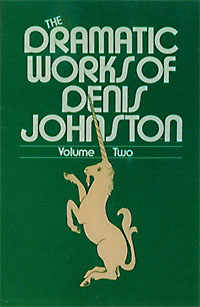
The Dramatic Works, Volume 2
ISBN: 978-0-901072-53-5
21.6 x 13.8 cm. iv, 404 pp. 1979 Volume 2 of the Dramatic Works of Denis Johnston
Contains: A Bride for the Unicorn, The Moon in the Yellow River, A Fourth for Bridge, The Golden Cuckoo, Nine Rivers from Jordan, The Tain (a pageant), and 'Introducing the enigmatic Dean Swift'.
More info →