

Rural Ireland, Real Ireland?
21.6 x 13.8 cm. 245pp. 1996
The aim of the present collection, which is edited by Jacqueline Genet, is to draw a picture of rural Ireland through Irish literature, from the 18th century, through the numerous rich productions of the nineteenth century, up to the present time. Starting with studies of the background to the subject by Catherine Maignant and Paul Brennan, the remaining essays, by Bernard Escarbelt, Claude Fierobe, Jean Brihault, Colin Meir, Godeleine Carpentier, Caroline MacDonogh, Declan Kiberd, Jacqueline Genet, Rene Agostini, Martin Croghan, the late Augustine Martin, Colbert Kearney, Maurice Harmon, and Danielle Jacquin, cover aspects of rural Ireland in the work of William Chaigneau, Maria Edgeworth, Lady Morgan, William Carleton, Charles J. Kickham, Lady Gregory, Douglas Hyde, W.B. Yeats, J.M. Synge, Tomas O’Crohan, Daniel Corkery, Seamus O’Kelly, Patrick Kavanagh and Flann O’Brien.
CONTENTS
The Background
Catherine Maignant: "Rural Ireland in the 19th Century and the advent of the modern world"
Paul Brennan: "Ireland's Rural Population"
Rural Ireland in Literature
Bernard Escarbelt: "William Chaigneau's Jack Connor: a literary image of the Irish peasant"
Claude Fierobe: "The peasantry in the Irish novels of Maria Edgeworth"
Jean Brihault: "Lady Morgan: Deep Furrows"
Colin Meir: "Status and style in Carleton's Traits and Stories of the Irish Peasantry"
Godeline Carpentier: "The peasantry in Kickham's tales and novels: an epitome mof the writer's realism, idealism and ideology"
Caroline MacDonogh: "Augusta Gregory: A Portrait of a Lady"
Declan Kiberd: " Decolonizing the mind: Douglas Hyde and Irish Ireland"
Jacqueline Genet: "Yeats and the myth of rural Ireland"
Ren‚ Agostini: "J.M.Synge's 'celestial peasants'"
Martin Craghan: "'...the great and good... the worthless and insignificant'. A case study of Tomas O'Crohan: The Island Man"
Augustine Martin: "The Past and the peasant in the stories of Seumas O'Kelly"
Colbert Kearney: "Daniel Corkery: a priest and his people"
Maurice Harmon: "Kavanagh's Old Peasant"
Danielle Jacquin: "'Cerveaux lucides is good begob': Flann O'Brien and the world of peasants"
More info →
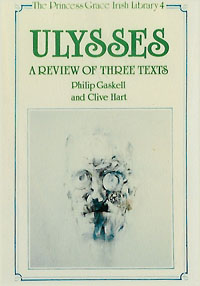
‘Ulysses’, a Review of Three Texts
21.6 x 13.8 cm. xviii, 232 pp. 1989 The Prince Grace Irish Library series (ISSN 0269-2619) volume 4
ISBN: 976-0-86140-314-1
Feeling that none of the existing editions of Ulysses adequately represented the text of the novel, Philip Gaskell and Clive Hart looked again at the evidence of Joyce's manuscripts, typescripts, and proofs, and have produced lists of suggested alterations for the three most important editions of the book: the first edition of 1922, the standard American edition of 1961, and the so-called 'corrected' edition of 1984. They believe that a copy of any of these editions, marked up with the alterations they propose, will result in a text closer to what Joyce intended in 1922 than any that has yet been achieved. What is offered here, in fact, is not a new edition of Ulysses, but a kit for repairing the major faults of existing editions.
More info →
International Aspects of Irish Literature
ISBN: 978-0-86140-363-9
21.6 x 13.8 cm. xii, 450 pp. 1996 Irish Literary Studies series (ISSN 0140-895X) volume 44, IASAIL Japan series volume 5
This is a selection of the papers read at the International Association for the Study of Anglo-Irish Literature’s 1990 conference, held in Kyoto, with the theme ‘Irish Literature as an International Literature’, at which Seamus Heaney was the keynote speaker.
The collection is divided into sections: ‘Time Out of Mind’, ‘Regional Responses’, and ‘Chronological Responses’, with panels on ‘Interdiction of an Artist: Samuel Beckett’ and ‘Women in Irish Writing’, the essayists being Marie Arndt, Joseph Chadwick, Joan Coldwell, Steven Connor, Richard Corballis, Martin J. Croghan, Adele M. Dalsimer, Ganesh Devy, Theo D’Haen, Eilis Dillon Mercier, Seamus Heaney, Werner Huber, Clair Hughes, Michael Kenneally, Masaki Kondo, Heinz Kosok, Junko Matoba, Peter MCMillan, Leon McNamara, Naoya Mori, Kristin Morrison, Maureen Murphy, Ciaran Murphy, Seán O h-Eidirsceoil, Mitsuko Ohno, Britta Olinder, Peter Robinson, Joseph Ronsley, Ann Saddlemyer, Tetsuro Sano, Bonnie Kime Scott, Fuyiji Tanigawa, Stanley Weintraub, Robert Welch, and summaries of papers not published in full in this volume.
There are essays on folk memory as history, folklore, place names in early Irish and Japanese literature, Irish novels in an early 19th century German court library, echoes of Ireland in New Zealand literature, Irish regionalism, magic realism, four essays on aspects of W. B. Yeats, four on Joyce, with others featuring Jonathan Swift, Oscar Wilde, Bernard Shaw, Lafcadio Hearn, Sean O’Casey, Jack B. Yeats, Denis Johnston, Samuel Beckett, Seamus Heaney, John Hewitt, Toni Morrison, Maria Edgeworth, Sean O’Faolain and John Butler Yeats.
More info →

Rediscovering Herbert Horne: Poet, Architect, Typographer, Art Historian
22.5 x 14.8 cm.
Herbert Horne (1864-1916) was a figure of alarming versatility: poet, architect, editor, essayist, typographer, designer of books, and the first scientific historian of art from the British Isles. His great book on Botticelli has been called by John Pope-Hennessy "the best monograph in English on an Italian painter." Horne's splendid editorship of the Century Guild Hobby Horse led Bernard Berenson and others to hail him as the successor of William Morris. Horne the connoisseur also gathered a choice selection of drawings and paintings which await closer appreciation. They are housed in his residence, now the Museo Horne, Florence, Italy.
In spite of his achievements he passes unmentioned in the Dictionary of National Biography, and aside from distinguished but brief discussions of his art activities by Fritz Sax and Frank Kermode, no book-length study has been devoted to him: until now.
Rediscovering Herbert Horne is Ian Fletcher's last book. Well known in the United States and Europe for his highly original scholarship, Fletcher provides an engaging account of the work of one of the more fascinating though elusive personages of the time. In his foreword, Peter Stansky says "Ian Fletcher has now presented us with a rich picture of Horne, in all the multiplicity of his talents and accomplishments."
Reproductions of Horne's designs and typography assist in effecting the re-emergence of this intriguing 1880-1920 figure.
More info →

The Book of Aran: The Aran Islands, Co. Galway
20.6 x 22.1 cm 335 pp. 80 colour and 220 b/w illus. 1994
ISBN: 978-1-873821-03-9
'The Book of Aran is a handsomely produced and generously illustrated update on Aran as seen by the multi-faceted eye of scholarship." Irish Times
'The Book of Aran has managed to convey some of the magic, isolation and cultural richness that island communities often have.' Irish Press
'The book is beautifully produced and the text achieves that happy state of being scholarly while eminently readable. The selection of pictures is superb. At the very least, the book is a minor publishing triumph. Don't even contemplate going to Aran without it." Evening Press
Over the centuries many people have felt the attraction of the landscape of the Aran Islands, with its impressive monuments that go back thousands of years, its distinctive culture that offers glimpses of a rich and distinctive pattern of life and a people whose island isolation forged a sense of independence and endurance. The Book of Aran is the first publication to deal with all the many different aspects of the three islands of Inis Mór, Inis Meáin and Inis Oírr, including the natural environment, archaeology and history and the cultural heritage of the islands. It is aimed at the general reader who wants to gain a deeper understanding of one of the most intriguing landscapes in Europe.
Contributors: John Feehan, Cilian Roden, Michael O'Connell, Gordon D'Arcy, J.W. O'Connell, John Waddell, Paul Walsh, John de Courcy Ireland, Anne O'Dowd, Dara Ó Conoala, Pádraigín Clancy, Lelia Doolan, James Duran, Anne Korff, Joe McMahon, Patrick F. Sheeran and Pádraig Standún.

Selected Plays of St. John Ervine
Chosen and Introduced by John Cronin
The fifth volume of the Irish Drama Selections series (ISSN 0260-7962), General Editors: Joseph Ronsley and Ann Saddlemyer.
ISBN: 0-86140-101-8 / 978-0-86140-101-7 Hbk £35.00
ISBN 978-0-86104-102-6 /978-0-86140-102-4 Pbk £9.95
21.6 x 13.8 cm.
Contains: Mixed Marriage, Jane Clegg, John Ferguson, Boyd's Shop, Friends and Relations, prose extracts, bibliographical checklist.
John Greer Ervine was born in Ballymacarrett, a working-class district of East Belfast, in 1883 (he added the prefix ‘St.’ to his name when he began to write). He was to achieve a considerable reputation as playwright, drama critic, novelist and biographer, working at various times in London and New York. As a young man, he got to know Bernard Shaw and was associated with the Fabian Society. In 1915 he was appointed manager of Dublin’s Abbey Theatre, but his brusque manner and his declared intention of turning the Abbey into a typical British repertory theatre alienated the players, many of whom left to set up a separate company of their own.
Ervine’s real contribution to the Abbey consisted of a number of his vigorous early plays, including Mixed Marriage and John Ferguson. After leaving the Abbey, he joined the British Army and was severely wounded in 1918, necessitating the amputation of a leg. After the War, he wrote drawing-room comedies for the London stage, and his most substantial work of biography was a book on his idol, Shaw. He returned to Irish themes in the 1930s, with plays like Boyd’s Shop, which was to prove one of his most popular and frequently revived works for the stage. A determined realist, Ervine had little sympathy with the work of some his notable contemporaries, and wrote severely about, for example, Synge. Ervine is at his best in those plays in which he depicts characters like John Ferguson, whose rigid moral attitudes are grimly tested by cruel circumstances. He is also impressive in his creation of strong women characters, such as Mrs Rainey in Mixed Marriage and Jane Clegg in the play of that name. In plays like those, he often anticipates his more famous successor, Sean O’Casey, and even looks forward to later Northern Irish writers like Sam Thompson.
This volume was published with assistance from the Arts Council of Northern Ireland.
John Cronin is Emeritus Professor of English at the Queen’s University, Belfast. His publications include Somerville and Ross, Gerald Griffin 1803-1840: A Critical Biography, and The Anglo-Irish Novel, Volume 1: The Nineteenth Century, and Volume 2, 1900-1940. He is general editor of a series of eight Classic Irish Novels of the Nineteenth Century. In addition to his academic activities, Professor Cronin has worked extensively on arts programmes for BBC Northern Ireland and BBC World Service and was for many years a member of the Anglo-Irish Literature Committee of the Royal Irish Academy.
More info →


A History of Chalfont St Peter and Gerrards Cross, and A History of Bulstrode
ISBN: 978-0-86140-319-6
23.4 x 15.5 cm. 189 pp. incl. over 100 illus.
This book contains Revd Geoffrey Edmonds’ work, last published by this company in 1968, and Dr Audrey Baker’s hitherto unpublished history of Bulstrode, past home of Judge Jeffreys, the Dukes of Portland and then the Dukes of Somerset.
While Chalfont St Peter dates back to before the Norman Conquest, and Bulstrode to the time of the Knights Templar, the parish of Gerrards Cross is a newly formed entity, being carved out of five neighbouring parishes, and greatly expanded following the 1906 opening of the London to High Wycombe Great Western & Great Central Joint Railway line which passed through the village.
Through their separate histories both Dr Baker and the Revd Edmonds chart the history of the locality through the centuries, showing how it has evolved from Anglo-Saxon and medieval times, through the Reformation, the Cromwellian period and Restoration, the Hanoverian and Victorian eras to the 20th century, and how the great families who came to live here gained or lost power, rose, fell or moved on, as well as the creation of Gerrards Cross over the past century.
In addition to the hundred or so illustrations within the book (including a number showing the construction of the railway through Gerrards Cross), the cover reproduces a watercolour of Chalfont Park by J.M.W.Turner, that was unknown until 2002.
The index features every person, place and house mentioned by the authors so residents can see what parts of the book relate to their home or the part of the villages in which they live
The Revd Geoffrey Edmonds (1902-75) was born in Rochester, Kent. He obtained an MA degree at Pembroke College, Cambridge, before studying Divinity at Mansfield College, Oxford. He was Congregational Minister at Oxted, Surrey, and in 1950 moved to Gerrards Cross, where he was Minister until his retirement in 1972, and where he continued to live until his death. Apart from being a keen chess player, and a keen historian, he was very interested in the activities of the village, being a Trustee of the Gerrards Cross Memorial Centre, a Governor of the local school and a Rotarian.
After reading Modern History at St Hilda’s College, Oxford, Audrey Baker studied History of Art at the Courtauld Institute and received her doctorate from the University of London. She specialised in medieval art, and published a number of long and detailed articles in major periodicals such Archaeologia, and the Archaeological Journal. She sometimes collaborated with Dr E. Clive Rouse. In the last years of her life she concentrated on local history and published various articles in The Records of Buckinghamshire, the journal of the Buckinghamshire Archaeological Society. Dr Baker and the Revd Geoffrey Edmonds were co-founders of the Chalfont St Peter and Gerrards Cross Local History Society.
More info → 
The Easter Proclamation of The Irish Republic 1916
ISBN: 978-0-85105-289-2
18.4 x 13.0 cm 10 pp. set in Uncial type, with reproduction of the original Proclamation, the pivotal document of the Easter Rising
More info → 
George Moore in Perspective
21.6 x 13.8 cm 174 pp. 1983 Irish literary Studies series (ISSN 0140-895X) volume 16
George Moore was considered during his lifetime to have been one of the supreme masters of prose style in the early years of the 20th century, and he was renowned for rewriting his books as his style developed. His many famous works include Hail and Farewell!, The Lake, A Drama in Muslin (rewritten as Muslin), Evelyn Innes, Esther Waters, The Brook Kerith and A Story Teller's Holiday, though many would immediately call to mind others of his oeuvre.
Moore died in January 1933 and this collection was brought together to celebrate the fiftieth anniversary of his death. The essays (in order of appearance in the book) are
'George Moore, a reappraisal' (Janet Egleson Dunleavy);
'Moore Hall, 1952' (Richard J.Byrne);
'George Moore's Paris' (Jane Crisler);
'George Moore's Dublin' (James Liddy);
'Private Moore, Public Moore' (Robert Stephen Becker);
'George Moore's Medievalism' (Gareth W. Dunleavy);
'The Moore-Joyce Nexus' (Patrick A.McCarthy);
'George Moore and Samuel Beckett' (Melvin J. Friedman);
'Collecting Moore' (Edwin Gilcher).
To these are added a collection of 17 portraits, in life and caricature, of George Moore, and an appendix 'Some Bibliographical Notes' by Edwin Gilcher, in which he adds to the information he published in his 1970 Bibliography.

Oscar Wilde’s The Importance of Being Earnest, The First Production
Edited by Joseph Donohue with Ruth Berggren
21.0 x 27.4 cm 378 pp. with 158 illus. 1995 Princess Grace Irish Library series (ISSN 0269-2619) volume 10
At its première nearly 125 years ago on Saint Valentine's Day 1895, at the St James's Theatre in King Street, London, Oscar Wilde's `trivial comedy for serious people' The Importance of Being Earnest found great and immediate favour with audiences and critics alike. Yet, by early May, the play had disappeared from the stage, its author convicted of immoral offences and condemned to two years' imprisonment with hard labour. A century later, although Wilde's reputation has long since been restored and his last play for the stage become a timeless classic, much of the meaning and significance the work held for its contemporary audience has been lost or diluted.
The present edition fills this gap in understanding by reconstructing the original 1895 St James's Theatre production. The text itself, derived from theatrical typescripts, including the Lord Chamberlain's licensing copy and Charles Frohman's script for the American premiere, is profusely annotated and illustrated from contemporary sources and presented in a format that balances text and context. An extraordinary range of materials is thus combined to show or explain what the first performance of The Importance of Being Earnest was like in the theatre and how its audiences and critics received it.
Based upon a new, reconstructive method for the study of theatrical performance that aims to set the play securely in its historical and cultural moment, the edition offers a wealth of detail about the staging and acting of the play, including numerous first production and early revival photographs. The reconstructed text itself, remarkably close to the 1899 first edition seen through the press by Wilde himself, recaptures the essential comic vitality of the play that is familiar to audiences throughout the world.
This work will therefore appeal to readers, scholars, theatre practitioners, lovers of the theatre and of the writings of Oscar Wilde.
A Reconstructive Critical Edition of the Text of the First Production at St James's Theatre, London, 1895, Annotated and illustrated from contemporary sources, and edited, with introductory essays on the play and its text by Joseph Donohue with Ruth Berggren. This fully annotated edition of the play, with 158 contemporary illustrations, informs the general reader and scholar alike of all those points that are now likely to be missed, while also giving an overall view of the contemporary cultural and political background. It won the 1995 Barnard Hewitt Award for Outstanding Research in Theatre History.
More info →
Modern Irish Writers and the Wars
21.6 x 13.8 cm. Ulster Editions & Monographs series (ISSN 0954-3392) volume 7
In recent years the literature arising out of the Troubles of the last three decades has understandably stimulated widespread and sustained critical comment and debate, but there has been no such intensive examination of the Irish literature of the century’s wars.
The events of 1916, the Anglo-Irish War, the Irish and Spanish Civil Wars and the First and Second World Wars stimulated a literature by Irish writers of cumulative interest and importance. In particular, in its diversity and in the complexities of allegiance, attitude and situation involved, it is in contrast with, for instance, English war writing of this century where the issues are less complex, and where First World War combatant writing with its stress on battlefield experience laid down an influential paradigm for writers of later wars. Much Irish writing relating to the century’s conflicts is the work of non-combatants – most famously Yeats and O’Casey – and the greater variety of types of war experience endured in conflicts of varying degrees of intensity and duration, both on home ground and abroad, gave rise to a war literature that shows a wide spectrum of literary responses. It is precisely this diversity in its various political and social contexts that the present volume seeks to address.
The essays collected here, a number of which were delivered at the first session of the Ulster Symposium at the University of Ulster in 1992, comprise an examination of a range of Irish war-related writing by specialists in various fields. Some attention is given to the literature of the recent Troubles, but the main focus of the book is on the century’s wars in Irish literary experience.
CONTENTS
Introduction. Kathleen Devine
'The Secret Scripture: Irish Poets in the European War'. Bruce Stewart
'1916: the Idea and the Action'. Declan Kiberd
'Yeats and War'. Jacqueline Genet
'Maud Gonne: Romantic Republican'. A.Norman Jeffares
'O'Casey at War'. Christopher Murray
'Sean O'Faolain's Midsummer Night Madness and Other Stories: Contexts for Revisionism'. Patrick Walsh
'Frank O'Connor's ‘War Book’: Guests of the Nation'. Elmer Andrews
'Louis MacNeice and the Second World War'. Terence Brown
'Beckett and World War II'. John Fletcher
'Elizabeth Bowen: the War's ‘Awful Illumination’ in The Heat of the Day'. Josette Leray
'Denis Johnston: Neutrality and Buchenwald'. Terence Boyle
'A Question of Guilt - Francis Stuart's War'. Anne McCartney
'Reading Protestant Writing: representations of the Troubles in the Poetry of Derek Mahon and Glen Patterson's Burning Your Own'. John Goodby
'A Necessary Distance? Mythopoeia and Violence in At the Black Pig's Dyke'. Alan J. Peacock and Kathleen Devine

Louis MacNeice and His Influence
21.6 x 13.8 cm. xviii, 184 pp. 1998 Ulster Editions & Monographs series (ISSN 0954-3392) volume 6
Louis MacNeice's status as a major 20th Century literary talent and a key figure in the development of modern Irish Literature in English is now established since the acceleration of critical interest and enterprise from the early 1970s to the present.
It is no accident that MacNeice's critical rehabilitation, after some decades of relative neglect, was effected largely by critics with an awareness of the Irish dimension of his make-up as a poet and who could thus appreciate the full complexity of the social, cultural and historical influences working on and through him; and it is similarly the case that the reassessment of MacNeice from the 1970s onward was consequent on the 'renaissance' in Northern Irish poetry in the 1960s.
MacNeice is no longer inadequately categorised as a 'Thirties' also-ran in the shadow of Auden, or as a writer of 'poetry on the surface'.
It is now more possible to see him whole – as a poet of complex, multiple identities and allegiances, as a writer of manifold talents (poet, critic, dramatist, broadcaster) and as a preternaturally alert, lyric recorder of the social and phenomenal world whose vision is conditioned by a profound philosophical scepticism.
The present volume, which brings together a number of experts on MacNeice's work, continues and extends the exploration of the range and depth of his achievement, with essays on various topics, including his influence on writers such as Michael Longley, Derek Mahon, Seamus Heaney and Paul Muldoon.
The essays were mostly given as papers at the conference held at the University of Ulster, Coleraine in September 1994. It was the first to have been exclusively devoted to the poet's work. It will be the seventh volume in the Ulster Editions and Monographs series.
More info →
Yeats, The Master of Sound
21.6 x 13.8 cm. xvi, 349 pp. 2006 Irish Literary Studies series (ISSN 0140-895X) volume 51
In 1922, James Stephens said: ‘we shall talk like Irishmen, or we are done for – we shall think like Europeans, or we are done for.’ In 1948, a later poet and critic, Robert Farren, recognised that Yeats had achieved at least one of those conditions when he said that he had ‘brought the Irishman’s voice – its inflections, cadences and idioms – into verse.’
The Irish brogue has often been considered as merely an ornamental adjunct to speech without any realisation of its value to poetry written in Ireland. But since poetic forms are based on the usual speech patterns of a country – its everyday talk – then the crucial significance of the patterns of Irish speech to the rhythms of poetry should be identified and explained.
Yeats, the Master of Sound is such a study. The author traces Irish speech rhythms back to Gaelic and, in this context, explains what Irish poets owe to their local accent – Heaney, in particular, has acknowledged such a debt. Using the American poet Robert Frost’s concept of the ‘sound of sense’ as a key, Dr Devine explores the rhythms of Anglo-Irish poetry and their stating of a formalised emotion through such traditions as the amhrán (Irish song metre) and the ancient method of singing known as sean-nós. Yeats was to build on these connected influences, adding a theatrically defiant tone to patterns of assonance and rhyme to attain an ‘elaborate rhythm’ – again a concept and practice derived from the Gaelic.
This book shows how the Irish speaking voice is in thrall to a language which has endured for over 2,000 years and which, by its shaping of the rhythms of that voice, continues to influence those of the island’s poets who write in English today.
Brian Devine received his MA from University College Dublin, and DPhil from the University of Ulster, Coleraine. He is currently working on a Gaelic grammar and a study of the poetry of Patrick Kavanagh, entitled The Awkward Visionary.

Samuel Ferguson, The Literary Achievement
21.6 x 13.8 cm. x, 229 pp. 1990 Irish Literary Studies series (ISSN 0140-895X) volume 39
An awareness of the work of Samuel Ferguson is essential to any understanding of the emergence of modern Irish writing. During a career which spanned more than fifty years of the nineteenth century, he was the initiator of several new literary possibilities for a community which was beginning to identify itself and to seek a distinctive voice. Although he achieved only limited recognition as a poet in his own lifetime, later Irish writers have acknowledged him as being of central literary significance in the perception of the past and the production of the present.
Samuel Ferguson: The Literary Achievement is the first full-length study to trace the range and development of his poetry, translations and fiction, and the changing contexts within which they were written, from the earliest published pieces of the 1830s to the last poems in the 1880s. By offering a comprehensive survey of these writings, Dr Denman evaluates a corpus of work which is at the heart of Irish Victorianism and which underpins much Irish writing during the century since Ferguson's death.
More info →

The Burren Wall
ISBN: 978-1-873821-16-9
15.5 x 23.0 cm, 64 pp. 82 colour illustrations & photographs 2006
Subject: Natural and Social History
The Burren and the Aran Islands have some of the most distinctive stone walls to be found anywhere. Visitors are invariably intrigued while locals, having lived with them for generations, pass little comment. The walls, in their use of local stone and economical design, nevertheless stand as linear monuments to local skill and hard won endeavour. This book deals with their social history, from the earliest prehistoric examples to the most modern, indicating how different styles may be attributed to specific periods of construction.
Celebrating the aesthetic qualities of the Burren wall in photographs, illustrations and quotations, this book also informs about natural history, presenting the wall as a habitat for myriad flora and fauna.
Gordon D'Arcy is a naturalist, environmental educator and artist. He has published several books including the Natural History of the Burren (Immel, 1992) and contributed chapters to The Book of the Burren (Tir Eolas, 1991 & 2001) and the Book of Aran (Tir Eolas, 1994).
This book, the culmination of many years spent investigating this remarkable limestone land, is replete with his photographs and illustrations. He lives with his wife Esther-Mary in south Galway, a few miles from the edge of the Burren.

George Gissing at Work: A Study of His Notebook ‘Extracts from my Reading’
This volume sheds new light on Gissing's intellectual process and methods of work. Over 160 quotations which he recorded in his notebook reveal themes and passions which profoundly interested him. His novels are increasingly valued for their candour about nineteenth century social problems such as the status of women and the condition of the working class.
More info →
An Edwardian’s View of Dickens and His Illustrators: Harry Furniss’s ‘A Sketch of Boz’
25.5 x 17.8 cm. xii, 116 pp. 2005 with 69 illus.
Harry Furniss (1854–1925) was a well-known if somewhat abrasive figure in English literary, artistic and political circles during the half century either side of 1900. In March 1905, at the invitation of the Dickens Fellowship, he delivered in London’s Memorial Hall a platform lecture on Dickens and his illustrators, “A Sketch of Boz,” illuminated by some sixty magic lantern slides. Over the next two years Furniss toured the provinces with an enlarged version of this lecture. An Edwardian’s View of Dickens and His Illustrators is an edited and annotated transcription of the unpublished manuscript of this engaging lecture, together with the original illustrations, some of which are Furniss’s own.
Few complete texts of oral lectures have survived and, coming from the pen (and pencil) of a professional book illustrator and keen Dickensian, “A Sketch of Boz” is an important document in the culture of Edwardian England.
Professor Cordery’s substantial introduction discusses how the lecture sheds light on a number of fields: Dickens’s reputation and that of his illustrators in the early twentieth century; the cultural significance of the platform lecture; the changing style of illustration and caricature; the commercial and ideological exploitation of Dickens at the turn of the century. He summarises the main illustrators surveyed by Furniss and includes more than 170 annotations. The book thus engages a variety of readers interested in nineteenth- and early twentieth-century British literature and culture.
More info → 
No Bland Facility: Selected Writings on Literature, Religion and Censorship
Edited by James H. Murphy
21.6 x 13.8 cm
ISBN: 978-0-86140-315-8
This book presents the reader with a selection of the writings of Peter Connolly (1927-87) who retired as Professor of English Language and Literature at St Patrick's College, Maynooth in 1985.
Divided thematically, the essays cover the major subjects that interested him: apart from Censorship, Literature (his areas of greatest expertise were in the modern novel and modern poetry) and Religion are represented by his essays `The Priest in Modern Irish Fiction', `W.B.Yeats: "the unchristened heart" ', `God in Modern Literature', `Tragedy', and `The Church in Ireland since Vatican II'.
The issue on which Peter Connolly's ideas have had the most influence has undoubtedly been that of censorship, and the role he played in the public debate on censoring books in Ireland. Many of the distinctions he drew then could still have a useful role to play in the renewed contemporary debate, even though its focus has shifted towards the visual media, notably television. Included here are his essays `Censorship', `The Moralists and the Obscene', and `Thoughts after Longford'.
This volume, edited by James H. Murphy, opens with a collection of memories and tributes from friends and colleagues, and ends with a selection of his book reviews.

Literature and the Changing Ireland
21.6 x 13.8 cm. x, 230 pp. 1982
Irish Literary Studies series (ISSN 0140-895X) volume 9
The papers in this collection were, with one exception, given at the triennial conference of the International Association for the Study of Anglo-Irish Literature held in St. Patrick's College, Maynooth, Ireland, in 1979.
The theme of the conference was the place of literature in a changing Ireland, and to this end the speakers' papers covered various aspects of this important subject. The contributors to this volume are in the order they appear here. Declan Kiberd, Klaus Lubbers, Cathal Ó Háinle, Vivian Mercier, Suheil Bushrui, Stan Smith, D. E. S. Maxwell, Thomas Kilroy, Peter Denman, James O'Brien, and Patrick Rafroidi.
CONTENTS<br
Introduction. Peter Connolly<br
Acknowledgements<br
THE PERILS OF NOSTALGIA: A CRITIQUE OF THE REVIVAL. Declan Kiberd<br
AUTHOR AND AUDIENCE IN THE EARLY NINETEENTH CENTURY. Klaus Lubbers<br
TOWARDS THE REVIVAL. SOME TRANSLATIONS OF IRISH POETRY: 1789-1897. Cathal G. Ó Háinle<br
VICTORIAN EVANGELICALISM AND THE ANGLO-IRISH LITERARY REVIVAL. Vivian Mercier<br
IMAGES OF A CHANGING IRELAND IN THE WORKS OF W.B.YEATS. Suheil Badi Bushrui<br
HISTORIANS AND MAGICIANS: IRELAND BETWEEN FANTASY AND HISTORY. Stan Smith<br
SEMANTIC SCRUPLES: A RHETORIC FOR POLITICS IN THE NORTH. D.E.S.Maxwell<br
THE IRISH WRITER: SELF AND SOCIETY, 1950-1980. Thomas Kilroy<br
RHYME IN MODERN ANGLO-IRISH POETRY. Peter Denman<br
THREE IRISH WOMEN STORY WRITERS IN THE 1970s. James O'Brien<br
CHANGE AND THE IRISH IMAGINATION. Patrick Rafroidi<br
Notes on the Contributors<br
Index

Selected Plays of Austin Clarke
Chosen and Introduced by Mary Shine Thompson
The fourteenth volume of the Irish Drama Selections series (ISSN 0260-7962), General Editors: Joseph Ronsley and Ann Saddlemyer.
21.6 x 13.8 cm.
Contains: The Son of Learning, The Flame, Black Fast, The Kiss, As the Crow Flies, The Viscount of Blarney, The Second Kiss, Liberty Lane,and the hitherto unpublished The Frenzy of Sweeney and St Patrick’s Purgatory (a translation of Calderón’s play), ‘Verse Speaking’, ‘Verse Speaking and Verse Drama’, and a bibliographical checklist.
Austin Clarke (1896-1974) is known as a poet, a playwright, a broadcaster and a novelist. In the later part of his life his work became better known principally through the support given by Liam Miller and the Dolmen Press in publishing his Collected Plays (1963) and later single plays, and volumes of poems, culminating in his Collected Poems (1974). His work as a reviewer was ceaseless, and during his life he wrote over 1,500 reviews, assessing over 5,000 books, but it must be as one of twentieth century Ireland’s most important poets that he is best known.
Clarke’s plays are less well known, both perhaps because they are verse plays, and also because they have been out of print for so many years, so the publication of a selection was long overdue.
Mary Shine Thompson is a lecturer in the English Department of St Patrick's College Drumcondra (Dublin City University) and College Coordinator of Research. Her doctoral dissertation is entitled 'Austin Clarke; A Literary Life-Chronology'. She was commissioned to prepare the National Library of Ireland's Catalogue of its Austin Clarke holdings, completed in 2003. Among her publications are Studies in Children Literature 1500-2000 (Four Courts Press, 2004) and Treasure Islands, Real And Imagined, in Children's Literature (2005), both edited with C. Keenan.
Please note. Due to changes in sale patterns since the series was started we have not issued this work in paperback. ISBN 0-86140-209-X is cancelled.
More info →