

Joyce, the Artist Manqué, and Indeterminacy
ISBN: 978-0-86140-320-2
21.0 x 14.8 cm. 34pp. 1989 Princess Grace Irish Library Lectures series (ISSN 0269-2619) volume 6
James Joyce's world is filled with characters who have artistic ambitions or temperaments – or pretensions. The 'artist' is a central figure in that world – yet it is peopled with characters who, individually and collectively, present us with Joyce's 'poor trait of the artless', his portrait of the artist manqué.
In the first, encompassing essay in this volume Morris Beja argues that in all Joyce's work there may be only one or two genuinely fulfilled artists – and that we cannot be certain even about them. A major question is how we regard Stephen Dedalus in this light: for he seems to be an unfulfilled artist on Bloomsday, yet perhaps one with the promise of future accomplishment.
Stephen is examined here in the context of the many other artists manqué in Joyce's works: in Dubliners (notably Little Chandler, James Duffy, and Gabriel Conroy), Ulysses (Leopold Bloom, and Molly as well), and Finnegans Wake (Shem and Shaun, notoriously, but also ALP) – and numerous minor figures in all those works and others.
The second essay returns Beja (the author of Epiphany in the Modern Novel) to the concept of epiphany, with new perspectives informed by recent critical theory, as he explores the role of uncertainty – indeterminacy – in the world of James Joyce.
More info →
Arthur Symons: A Bibliography
Arthur Symons (1865-1945), now widely regarded as the most important critic of the late 19th and early 20th centuries, is best known for his seminal work, The Symbolist Movement in Literature (1900). Shortly after Symons's mental breakdown in 1908, his close friend W. B. Yeats called him ‘the best critic of his generation’ and in 1957, Frank Kermode, in Romantic Image, referred to Symons as a ‘crucial’ figure in the development of Modernism, ‘always at the centre of his period and herald of its successor’.
One of the most prolific writers of his time, Symons produced some 60 volumes and pamphlets of poetry and prose; edited, introduced, or contributed poetry and prose to scores of volumes; wrote over 1300 articles and reviews for periodicals and newspapers; and translated works by such noted writers as Zola, Baudelaire, Verhaeren, Verlaine, Villiers de 1'Isle-Adam, Hugo von Hofmannsthal, Casanova, Alexandre Dumas fils, and d’Annunzio.
Until now, such vast productivity has never been fully accounted for and bibliographically described. Karl Beckson, Ian Fletcher, Lawrence W. Markert, and John Stokes – all specialists in the 1880-1920 period and all having previously published on Arthur Symons – have collaborated on this comprehensive bibliography to produce a scholarly and reliable reference work that will provide little known details of Symons's immense oeuvre. This book will remain an indispensable source of research for decades to come.
ISBN: 978-0-944318-04-1

Charles Lever: New Evaluations
21.6 x 13.8 cm. xvi, 131 pp. + 16 pp illus. 1991
Ulster Editions & Monographs series (ISSN 0954-3392) volume 3
These essays comprise the first extensive re-appraisal of Charles Lever for over fifty years. Once regarded as the equal of Dickens, Thackeray and Trollope, Lever’s public turned their backs upon him when he changed style and genre after making his name with comic military tales. He never recaptured his early popularity, but his later novels in fact manifest a much more serious and crafted approach to fiction, and richly deserve revival.
Lever’s own turbulent and often unhappy life of social and cultural exile in Europe provides the hidden theme of many of his better novels. Continental and Irish settings and preoccupations are juxtaposed, making his contribution to the Anglo-Irish novel per se an unusual and challenging one.
Lever is a shrewd observer of character – particularly of female character; few of his better-remembered contemporaries write with more insight about women; old, young, rich, poor; loving, hating, dominating, subjected. His eye for place is acute; Scott is his model, but Lever’s ability to correlate character with environment is finely developed. His political observations, always well-integrated into the fabric of his plot, are shrewd and balanced.
The current neglect of this accomplished and cosmopolitan Irishman is entirely unwarranted. Though he wrote too much, too hastily, and under pressures sometimes too much dominated by the intransigent necessities of serial publication, the contributors to this volume seek to show that Lever deserves a re-appraisal, and a revival of attention to his extensive and often original output. Thus, hopefully, the revival of interest in Charles Lever, commencing with this volume, should attract readers of the novel well beyond the specialist range of Anglo-Irish scholars.
Contents
Introduction: 'The Famous Irish Lever'. Tony Bareham
'Reading Lever'. A. Norman Jeffares
'A Tale of Love and War: Charles O'Malley'. Lorna Reynolds
'Dr Lever at Portstewart'. Bill Rodgers
'Transitional States in Lever'. Richard Haslam
'Lever's Post-Famine Landscape'. Chris Morash
'Charles Lever and the Outsider'. Tony Bareham
Notes
Index
More info →

Orders of Knighthood and of Merit
The Pontifical, Religious and Secularised Catholic-founded Orders and their relationship to the Apostolic See
Hardcover ISBN: 0-86140-371-1 / 978-0-86140-371-4 £70.00
Limited signed edition, three-quarter morocco, vellum panels, marbled end-papers, in slip-case ISBN: 0-86140-380-0 / 978-0-86140-380-6 £450.00
23.4 x 15.5 cm. xvi, 714 pp. + 48pp colour illustrations and with c.400 b/w illustrations within the text
Since the publication in 1983 of Archbishop Cardinale’s Orders of Knighthood, Awards and the Holy See, and the two later editions (1984 and 1985) edited and revised by Peter Bander van Duren, whose own work The Cross on the Sword appeared in 1987, there have been major changes in the Holy See’s attitude towards Orders of Knighthood. These changes have meant that large sections of both books are now out of date, so it has been necessary for Peter Bander van Duren to completely rewrite and update the work Archbishop Cardinale began, and without which this book could not have been written.
Orders of Knighthood and of Merit presents the many Catholic-founded Orders of Knighthood in a new perspective, and deals not only with the Pontifical Equestrian Orders and the two surviving religious Orders of Knighthood, but with the many Catholic-founded but secularised Orders – dynastic, state and crown – that exist today. He examines their relationship, where one exists, to the Apostolic See and the Papacy in the light of the changes that have taken place, as well as the dichotomy between the different rôles and functions of the Holy See and the Apostolic See, the Mater et Magistra of all Catholic-founded Orders of Knighthood. Having been able to study various source materials hitherto and not since available to others, he exposes the misunderstandings and misinformation that exist in this field, and highlights errors that have been perpetuated, sometimes for centuries, through genuine lack of information, as well as those that, for political expediency, have been deliberately concealed.
The chapter and appendices on the Pontifical Orders of Knighthood are designed to assist papal knights in their rôle and functions that their appointments have given them.
The author places the Catholic-founded Orders of Knighthood in perspective, and shows that the continued existence of many of them is based not only on authoritative ecclesiastical and temporal documents of foundation, Papal Briefs and Bulls, but also on their lay apostolate which has continued without interruption.
Neither the Codex Iuris Canonici in force from 1917 to 1983, nor that governing the Catholic-founded Orders during the pontificate of St. Pius X (who more than any other pope laid the foundations for the Pontifical Orders as we know them today), created the present situation where necessity dictates that one has to distinguish between the rôle and functions of the Apostolic See and the Holy See: this dichotomy was created by the 1983 Codex Iuris Canonici. The author shows the paradox that would arise if those who wish to equate them according to the latter’s rather vague Canons are not challenged to clarify their positions: their rulings would nullify the present enormous value of many of the Catholic-founded Orders to the Apostolic See and, indeed, to the whole Church. The author goes so far as to suggest that if the authority and the supremacy of the Apostolic See were to be further diminished, those mighty armies that once protected our Christian civilisation will have lost their raison d’être.
Special attention is paid to dynastic Orders of Knighthood, especially those that although secularised, in some cases for centuries, still fulfil a lay apostolate. Many state and dynastic Orders were secularised during the Reformation, and while they no longer have any link with the Apostolic See, they retain the character and insignia of their former existence, and now have a reciprocal relationship with the Holy See in its capacity as a sovereign power. Extinct Catholic-founded Orders, as well as those organisations that without justification claim chivalric status, are dealt with in detail. One of the most important matters dealt with by the author, and not hitherto considered elsewhere, is the raison d’être of several Orders, and some aspects of Hospitaller as well as Military Orders are also examined.
For over half the last millennium, from the time of the first Crusade to the latter half of the seventeenth century, members of Catholic-founded Orders of Knighthood were at the forefront of the defence of West European civilization, and the author suggests that they may once again find a rôle. There are also many appendices that give a wealth of information not readily available to those interested in phaleristics – the study of Orders, decorations and honours bestowed on meritorious individuals. Orders of Knighthood and of Merit is therefore one of the most important contributions to the study of phaleristics that has been published in the past decades.
CONTENTS
I. The involvement of the Apostolic See and the Holy See in the field of chivalry – The origin and evolution of Orders of Knighthood.
II. THE PONTIFICAL ORDERS OF KNIGHTHOOD. The origin and evolution of Pontifical Orders of Knighthood and the attitude of individual pontiffs to the Orders – The Supreme Order of Christ – The Order of the Golden Spur, or The Golden Militia – The Golden Collar of the Pian Order – The Order of Pius IX – The Order of St. Gregory the Great – The Order of Pope St. Sylvester – Corollary on non-Catholic Knights of the Order of St. Gregory the Great.
III. PAPAL KNIGHTS. The rôle and function of the Pontifical Equestrian Orders – The procedure for admission – The implications of the Supreme Pontiff being the fons honorum of Pontifical Knighthoods.
IV. PONTIFICAL RELIGIOUS AWARDS OF MERIT. The Golden Rose – The Cross ‘Pro Ecclesia et Pontifice’ – The Medal ‘Benemerenti’.
V. RELIGIOUS BUT NON-PONTIFICAL ORDERS OF KNIGHTHOOD. The Sovereign Military Hospitaller Order of St. John of Jerusalem, of Rhodes and of Malta – The Most Venerable Order of the Hospital of St. John of Jerusalem – The Equestrian Order of the Holy Sepulchre of Jerusalem.
VI: A TRANSFORMED RELIGIOUS ORDER OF KNIGHTHOOD: The Teutonic Order.
VII. CATHOLIC-FOUNDED DYNASTIC ORDERS. Their nature, rôle and function, and their relationship with the Apostolic See
The Noble Order of the Golden Fleece of Burgundy
The Imperial and Royal House of Habsburg-Lorraine – The Noble Order of the Golden Fleece of Austria – The Order of the Dames of the Starry Cross
The Royal House of Bragança of Portugal – The Order of Our Lady of the Conception of Vila Viçosa – The Royal Order of Saint Isabel
The Royal House of Bourbon of the Two Sicilies – The Sacred Military Constantinian Order of St. George – The Royal Order of St. Januarius
The Royal House of Savoy-Italy – The Supreme Order of the Most Holy Annunziata – The Order of SS. Maurice and Lazarus
The Royal House of Bavaria Wittelsbach – The Order of St. George – The Order of St. Hubert – The Order of St. Michael
The Royal House of Bourbon of France – The Royal House of Bourbon Orléans – The Order of the Holy Ghost – The Royal and Military Order of St. Louis – The Order of St. Michael of France
The Ducal House of Habsburg-Tuscany: The Grand Duchy of Tuscany – The Order of St. Stephen – The Order of St. Joseph.
VIII. SECULARISED CATHOLIC-FOUNDED ORDERS OF KNIGHTHOOD STILL BESTOWED AS CROWN OR STATE ORDERS
Denmark: The Order of the Elephant; The Order of the Dannebrog
Great Britain and Northern Ireland: The Most Noble Order of the Garter; The Most Ancient and Most Noble Order of the Thistle; The Most Honourable Order of the Bath; Knights Bachelor
Monaco: The Order of St. Charles
The Republic of Poland: The Order of the White Eagle; The Order of ‘Polonia Restituta’
The Republic of Portugal: The Riband of the Three Orders; The Military Order of the Tower and the Sword, of Valour, Loyalty and Merit (although not a Catholic-founded Order); The Military Order of Christ; The Military Order of Avis; The Military Order of St. James of the Sword
San Marino: The Equestrian Order of St. Marino; The Equestrian Order of St. Agatha
Spain: The Noble Order of the Golden Fleece (Spanish branch); The Monastic Military Orders of Alcantara, of Calatrava, of Montesa & of Santiago; The Most Distinguished Order of Carlos III; The Order of Isabella the Catholic; The Military Order of St. Ferdinand; The Royal & Military Order of St. Hermenegildus; The Orders of Cisneros, & of St. Raymond of Peñafort
Sweden: The Royal Order of the Sword (The Order of the Yellow Ribbon); The Royal Order of the Seraphim
IX. EXTINCT CATHOLIC-FOUNDED ORDERS OF KNIGHTHOOD
X. THE MILITARY AND HOSPITALLER ORDER OF ST. LAZARUS OF JERUSALEM
XI. RECOGNIZED KNIGHTLY ORGANISATIONS. The Association of the Knights of Columbus -
The Knights and Dames of St. Michael of the Wing
XII. THE SPIRIT OF CHRISTIAN CHIVALRY TODAY
XIII. UNRECOGNISED ORGANISATIONS STYLING THEMSELVES ORDERS OF KNIGHTHOOD
APPENDICES
1. Pontifical Equestrian Orders: Papal Letters of Foundation and Decrees
2. Additional Guidelines for Papal Knights and Investitures
3. Conferment of Pontifical Religious Awards
4. The Pontifical Medal
5. The Pontifical Corps of Guards: the Pontifical Noble Guard – The Pontifical Swiss Guard – The Palatine Guard of Honour – The Pontifical Gendarmerie
6. Perrot’s List of Extinct Orders
7. On Chronological Lists of Orders of Knighthood
8. The Prerogatives of the Dukes of Bragança
9. Bull of Foundation of the Portuguese Order of Christ and Royal Brief of Acceptance by King Dom Dinis I
10. Insignia as objets d’art
11. Orders and Decorations of the Republic of Poland
12. Appointment of S.A.R. Don Carlos de Borbón-Dos Sicilias y Borbón-Parma as Infante of Spain
SELECT BIBLIOGRAPHY
Index
More info →


The Cross on the Sword
A Supplement to 'Orders of Knighthood, Awards and the Holy See'
ISBN: 978-0-905715-32-2
23.5 x 15.5 cm. 196 pp. illus. Van Duren 1987
With an Introduction by Archbishop, later Cardinal, Jacques Martin
This book attests to the fact that there is nothing more ancient, more venerable, more diversified than the Orders of Chivalry that have existed or still exist, and more desired, more sought after by certain people, than a papal decoration. It is always necessary to underline the essential differences between temporal decorations and those that are conferred by the sovereign Pontiff. A papal knighthood is not to be viewed solely as an honour, as a reward: it also incorporates a duty and a mission, that of serving and protecting the person of the Vicar of Christ. Papal Knights form a sort of army, on the devotion of which the Pope must be able to rely. To the Knight it is not the honour that matters but his obligations and services. + Jacques Cardinal Martin
Peter Bander van Duren's The Cross on the Sword is a supplement to his edition of the late Archbishop H.E. Cardinale's Orders of Knighthood, Awards and the Holy See (1985), and consolidates his revisions and additions that appeared in that work.
The first part deals with the statutes and regulations concerning the Pontifical Equestrian Orders of Pius IX, St. Gregory the Great and Pope St. Sylvester, the privileges granted to Papal Knights and their juridical position. As His Excellency Archbishop Jacques Martin writes in his introduction the author had to rely, for the information in this section, on ‘the Papal Briefs of the Orders' founders and the provisions made for the Papal Knights by Pope St. Pius X, many of which were contained in personal directives. It was left to Peter Bander van Duren to interpret them in the light of today's need as the Holy Father wrote them over eighty years ago.’
For the first time in the history of the Papal Knights, guidelines have been devised for an investiture ceremony, and the question of precedence has been examined in the light of the privileges granted to Papal Knights by Pope St. Pius X.
Part II deals with general juridical questions arising from Archbishop Cardinale's work, particularly the position of Catholic Orders of Knighthood that he stated were ‘extinct’, ‘abolished’, ‘suppressed’ or ‘in abeyance’. The author also examines the degree of importance that should be attached to the Bullarium Romanum when establishing the status of an Order.
Part III contains addenda to the 1985 edition of Orders of Knighthood, Awards and the Holy See concerning Catholic and Catholic-founded Orders of Knighthood, and Part IV introduces two Christian but not Catholic Orders, each unique in their nature.
The Cross on the Sword is a most useful work, not only for Papal Knights and everyone who may at one time or another be connected with their investiture ceremonies — Parish Priests, Masters of Ceremonies, diocesan and parochial administrations, for example — but also for everyone who is interested in Orders of Chivalry, and their continuing role in the world today. The illustrations not only show insignia — medals and uniforms — of the Orders examined in this book, but also illustrate the ceremonies themselves, adding a further dimension to the help that this work provides for the reader.

Builders of my Soul: Greek and Roman Themes in Yeats
21.6 x 13.8 cm. xvi, 241 pp. + 4pp. illus 1990 Irish Literary Studies series (ISSN 0140-895X) volume 32
Builders of My Soul: Greek and Roman Themes in Yeats, fills a long-felt gap in a neglected area of Yeats studies. It begins with an account of Yeats’s knowledge of the Classics, and then deals with the topics of Philosophy, mainly Platonism; a full, new reading of ‘Under Ben Bulben’; Greek myth, used to validate both personal experience – Maud Gonne as Helen – and a cyclical theory of history; Literature, the two Oedipus plays; Visual art, including an elaborate reading of 'The Statues’, and ‘Byzantium’, the famous passage in A Vision, and the two great poems, in their historical context.

Vertue Rewarded, or The Irish Princess, ‘A New Novel’ (1693)
21.6 x 13.8 cm. Princess Grace Irish Library series (ISSN 0269-2619) volume 7
Published for the first, and (until now) only, time in 1693, this novel is set in Ireland immediately after the Battle of the Boyne, and describes the courtship of a young lady of Clonmel by a prince, who is on his way to take up a post in Limerick. The story is humorous and engaging. As the editor points out, its interest lies not only in it calling itself `A Novel', but that it may well have been known to Samuel Richardson, and influenced his Pamela (itself subtitled Virtue Rewarded), published fifty years later. This work can lay claim to being the first Irish novel ever published – certainly the earliest that is extant, and as such will be of interest to all students of literature in the English language.
More info →

Critical Approaches to Anglo Irish Literature
21.6 x 138. cm. x, 193 pp. 1989
Irish Literary Studies series (ISSN 0140-895X) volume 29
Critical Approaches to Anglo-Irish Literature contains a selection of the papers given at the fifth triennial conference of the International Association for the Study of Anglo-Irish Literature held in Belfast in 1985, chaired by Professor John Cronin. It includes essays on Brian Friel, Seamus Heaney, James Joyce, Patrick Kavanagh, J. S. Le Fanu, J. M. Synge, and W. B. Yeats, as well as papers on more general themes, such as the critical condition of Ulster, English political writers on Ireland, national character and national audience, autobiographical imagination and Irish literary autobiographies. The contributors to this volume, the twenty-ninth in the Irish Literary Studies Series, are Catherine Belsey, Patricia Coughlan, Seamus Deane, Gerald FitzGibbon, Ruth Fleischmann, Margaret Fogarty, John Wilson Foster, Eamonn Hughes, Michael Kenneally, Tom Paulin, Walter T. Rix, and Nicholas Roe. The editors are Michael Allen and Angela Wilcox.

W.B. Yeats and the Tribes of Danu. Three Visions of Ireland’s Fairies
21.6 x 13.8 cm 350 pp. 1987
Irish Literary Studies series (ISSN 0140-895X) volume 27
W. B. Yeats and the Tribes of Danu is a study of the Irish fairy faith in its ancient and traditional forms, and of Yeats’s response to that faith.
The first part concerns the ancient beliefs, chiefly as they are expressed in mythology, and describes the origins and characteristics of the Tuatha De Danann. Peter Alderson Smith shows how they are a folk memory of an ancient people who have to some degree acquired divine and ghostly characteristics.
Part two describes the fairies of modern folklore, the various types, their characteristics, and differences from ghosts, in being a separate and supernatural race of people, homogeneous but unpredictable and notorious for their capriciousness.
Part three finds in Yeats's work between the writing of The Countess Cathleen (1891-92) and the poems of Responsibilities (1914) a desire to know more about the Otherworld that resulted in a relationship that fluctuated between the poles of frustration and despair on the one hand, and morbid enthusiasm on the other. That the process was ultimately therapeutic is shown by Yeats’s move away from the Celtic Twilight to the poems of his maturity.
More info →

Irish Writers and the Theatre
This collection is the second volume in the IASAIL-JAPAN series, which was set up by the Japanese branch of the International Association for the Study of Anglo-Irish Literature.
Many major Irish authors have been dramatists as well as poets and novelists, and perhaps the most famous have gained their fame because of their dramatic output. Over the past three centuries many of the dramatists whose names are remembered have Irish connections - Farquhar, Steele, Goldsmith, Sheridan, Boucicault, Wilde, Synge, Shaw, Yeats, O'Casey, Behan, Beckett, Friel, and Leonard come to mind.
The essays in this collection deal primarily with dramatists of this century, particularly Shaw, Yeats, O'Casey, Behan, Robinson, Beckett and Stewart Parker, but there are more wide-ranging essays – on contemporary fashions in Irish theatre, on O’Casey's influence on modern drama, on the humour of deprivation, and on dramatisations of the life of Jonathan Swift.
The contributors are Eugene Benson, Richard Allen Cave, Emelie Fitzgibbon, Nicholas Grene, Heinz Kosok, Desmond Maxwell, Vivian Mercier, Christopher Murray, Andrew Parkin, Masaru Sekine, James Simmons, Sumiko Sugiyama, Robert Welch and Katherine Worth.

Ze-Ami and his Theories of Noh Drama
ISBN 978-0-86140-214-4 21.6 x 13.8 cm.
For over five centuries the essays of Ze-Ami – considered, with his father Kan-Ami, to be the founder of Noh, the classical dance-drama of Japan – were kept secret. They were not shown to more than one Noh actor in each generation until recently. Though they contain a large number of paradoxes and contradictory statements as well as a great deal of repetition, they were regarded as a Bible by actors in the Noh technique. As repetition was a constant feature in training and in techniques in many arts in Japan, and as paradox had often been used in the search for the truth in Zen, so Ze-Ami's essays were accepted, despite their repetitions, paradoxes and contradictions. They were not. however, easily translatable, and they benefit from being edited.
In this work therefore, Ze-Ami's ideas are dealt with in eight chapters: The History of Noh: Five Groups of Noh Plays: Training: Acting: Writing a Play: Public Tachiai Competitions and Grades of Acting: The Audience: and Hana. This arrangement presents Ze-Ami's ideas with some order and consistency. Relevant sections of eighteen essays by Ze-Ami are translated and discussed. These include Fushi-kaden, Kashū, Ongyoku-Kowadashi-kuden, Kukyō, Shikadō, Nikyoku-Santai-Ningyōzu, Sandō, Fushizuke-shidai Fukyokushū, Yūgaku-Shūdō-Fūcken, Goi, Kyūi, Rikugi, Shūgy-okutokuka, Goonkyoku-Jōjō, Goon, Shūdosho, Kyakurui-ku, and Zeshi-Roku-juigo-Sarugaku-Dangi.
This volume is a most useful introduction to an understanding of Noh history, practice, and technique, for all readers in the West, written as it is by a trained Noh actor..

Yeats and the Noh: A Comparative Study
21.6 x 13.8cm. Irish Literary Studies series 38
W.B. Yeats wrote the plays in Four Plays for Dancers (1921) when he was strongly influenced by Japanese Noh theatre, and was searching for some breakthrough in his efforts to promote poetic drama.
Since then, various books have been published on this topic but, with the notable exception of Richard Taylor, no scholar has been able to cope with both Yeats and Noh. Yeats and the Noh started in a small seminar room in University College Dublin, when both authors took part in productions of The Dreaming of the Bones and Nishikigi with their students. Masaru Sekine directed both plays and Christopher Murray performed in them: they were therefore equipped with live experience as well as their personal expertise in Irish literature and Noh drama.
Professor Augustine Martin introduces the volume, and apart from the main section of the book, Colleen Hanrahan, one of the students who took part in both UCD productions, writes about acting in Yeats’s play; Peter Davidson writes about Yeats, Pound, Rummel and Dulac; and Katharine Worth provides an essay on Yeats, Beckett and Noh. There are 16 pages of illustrations.
This volume is unique in providing detailed analysis of contrasts in theatrical aims, as well as examining why man seeks to explore tragic drama as a means of extending the limits of reality.

My Life and Music
Widely regarded as one of the 20th century’s finest pianists, Artur Schnabel (1882-1951) was especially renowned as an interpreter of Beethoven. In the words of his friend Edward Crankshaw, his performance of the Diabelli Variations in his last years was ‘like looking at the sun without dark glasses’. However, Schnabel also earned high praise for his playing of Schubert, Mozart, and Brahms. Indeed, his later concert repertoire was largely devoted to great composers in the Austro-German tradition. In explanation, Schnabel contended that he wished to play only ‘music that was better than it could be performed’.
His uncompromising, passionate commitment to penetrating the mysteries of the greatest music is clearly revealed in this absorbing, highly readable combination of personal reminiscence and musical manifesto. Not a conventional autobiography, it includes a transcript of 12 autobiographical lectures Schnabel gave to music students at the University of Chicago in 1945. The lectures were followed by informal sessions in which the pianist answered questions from the audience on a wide variety of musical topics. These questions and Schnabel’s revealing, unrehearsed replies comprise the second part of this book, offering rich insight into the pianist’s personality and musical philosophy. The final section, ‘Reflections on Music’, is a talk Schnabel gave on the occasion of receiving an honorary degree from the University of Manchester.
While his approach to music was highly intellectual, and his demeanour on the concert stage formidably serious (he seldom smiled and never played an encore), Schnabel in person was a warm, animated, and stimulating companion. Much of that personal appeal comes across in this book, as the pianist recalls his experiences as a child prodigy in turn-of-the-century Vienna, his family and social background, pianistic training and preferences in the repertoire, his attitude toward the great conductors and composers of the day, thoughts on the teaching of music, and many more topics.
Enhanced by 20 illustrations, including many photographs from the collection of Schnabel’s son, My Life and Music offers an in-depth portrait — in his own words — of one of the twentieth century’s greatest musicians. It will especially appeal to music lovers, but offers a rich reading experience to anyone fascinated by the passion, power and insight of a musician of genius.
Unabridged, this slightly corrected republication of My Life and Music and Reflections on Music was first published by Colin Smythe Ltd in 1970. The present edition has the joint imprint of Dover Publications and Colin Smythe Ltd. It has a Foreword by Sir Robert Mayer and an Introduction by Edward Crankshaw. There are 20 black-and-white illustrations.
More info → 
‘Since O’Casey’ and other essays on Irish Drama
In this collection of lucid essays that cover the entire eighty years of modern Irish drama, Robert Hogan writes about the major Irish dramatists of the 20th century and their impact on audiences, and on other playwrights, as well as considering the works themselves. In them he uses a variety of critical techniques, ranging from biography to studies of influence, structure and dialogue, to history and anecdote, and the ill-treatment of several sacred cows.
In addition to essays on such giants as Synge, O'Casey, and Beckett, the book deals with more neglected figures such as W. J. Lawrence and the still insufficiently appreciated George Fitzmaurice and Denis Johnston. It also presents a full critical survey of the years 1963-83 in which exciting writers like Brian Friel, Hugh Leonard and John B. Keane made their mark. The author's style and varied ways of dealing with the subjects make this volume particularly enjoyable, as well as informative, reading.
CONTENTS<br
Preface<br
YEATS CREATES A CRITIC<br
THE INFLUENCE OF SYNGE<br
THERE IS REALISM AND REALISM<br
O'CASEY, THE STYLE AND THE ARTIST<br
O'CASEY, THE STYLE AND THE MAN<br
THE INFLUENCE OF O'CASEY<br
DENIS JOHNSTON'S HORSE LAUGH<br
TRYING TO LIKE BECKETT<br
SINCE O'CASEY<br
A Factual Appendix<br
A Critical Appendix, by W. J. Lawrence, containing his reviews of Birthright by T. C. Murray (1910), The Magic Glasses by George Fitzmaurice (1913), Shanwalla by Lady Gregory (1915), and Juno and the Paycock by Sean O'Casey (1924)<br
Notes<br
Index

Farewell, Victoria! English Literature 1880-1900
Although the Victorian era closed, literally, with the death of the Queen in January 1901, the post-Victorian transition had begun decades earlier. Farewell, Victoria! presents Stanley Weintraub’s engaging perspectives on late-Victorian literature, primarily but not exclusively its fiction, which looked backward to popular antecedents and forward to the societal and technological future.
The early 1880s saw the close of iconic Victorian literary careers—Disraeli, Rossetti, Eliot, Meredith, and Trollope among others. It was also the decade of new reputations that would continue in some cases into the middle of the next century. The 1890s witnessed a plethora of experiments in modernity. The Yellow Book and The Savoy, graphic realism and a redefinition of morals, futuristic prophecy and exotic fantasy would expand taste, enlarge the market for books, and write a finis to leftovers from the past.
Stanley Weintraub (Evan Pugh Professor Emeritus of Arts and Humanities at Pennsylvania State University and Adjunct Professor of English at the University of Delaware) offers more than a dozen critiques of the literature of these two decades, essays from many years collected, revised, and updated in this important addition to the 1880–1920 British Authors series. He is one of the most well-known and respected scholars in the field, author or editor of more than fifty books, many dealing with the Victorians and early moderns, including biographies of Victoria, Albert, Disraeli, Whistler, Shaw, and the Rossettis.
More info →
Walter Pater, ‘Gaston de Latour’: The Revised Text
Scarcely two years after Walter Pater's death, Macmillan & Company published Gaston de Latour; An Unfinished Romance. The author of works critical to the formation of the Transition and Modernist periods set his last novel in the turbulent years following the Reformation. Selected chapters first appeared serially in Macmillan's Magazine and Fortnightly Review, but the posthumous volume edited by Charles L. Shadwell, Pater's long-time friend, remains controversial. For a century readers have seen only a portion of what Pater wrote for Gaston de Latour. Shadwell withheld six manuscript chapters.
Pater's prominence and widening influence in late-nineteenth and early twentieth-century studies makes those unpublished chapters more intriguing than ever. Edited from the holographs and based on definitive material incorporating all known fragments, The Revised Text includes the crucial suppressed chapters. Professor Gerald Monsman's edition, meticulously edited and researched, is surely closer to Pater's own latest version. This comprehensive Gaston de Latour offers what many will see as a work closer to Pater's intention than the book Macmillan printed in 1896.
The Revised Text is notable in other ways, Pater's study of eroticism in his portrait of Queen Marguerite is a significant contribution to gender studies in the late-Victorian period. The Pater of the 1890s is revealed here too. As Monsman says, the “later Pater is in many ways the most interesting of all the successive Paters – certainly wearier, but also more candid, consummately polished artistically, self-consciously aware of a dawning modernism."
Gerald Monsman (University of Arizona) has worked for nearly a decade to bring this authoritative edition to print. His contributions to the field are well known: Pater’s Portraits (Johns Hopkins University Press, 1967), Walter Pater (G. K. Hall, 1977), Walter Pater’s Art of Autobiography (Yale University Press, 1980). Gaston de Latour: The Revised Text is a significant achievement. Scholars and students will find Monsman's Introduction, Explanatory Notes, Diplomatic Transcriptions, Emendations and Variants invaluable.

Fly-fishing, Fact vs. Fiction
This collection brings together Jo Rippier’s writings about fishing, fact and fiction, and in one case ‘dramatic’. He has recorded memorable experiences that occurred during his life in his pursuit of fish, and meeting unusual personalities, such as Mr Justice T. C. Kingsmill Moore (‘Saracen’), and Hugh Falkus, as well letting his imagination provide a number of fictional tales. Together they provide the reader with a variety of enjoyable stories and articles, and some historical illustrations, mostly from Punch, ideal for fishermen with time on their hands.
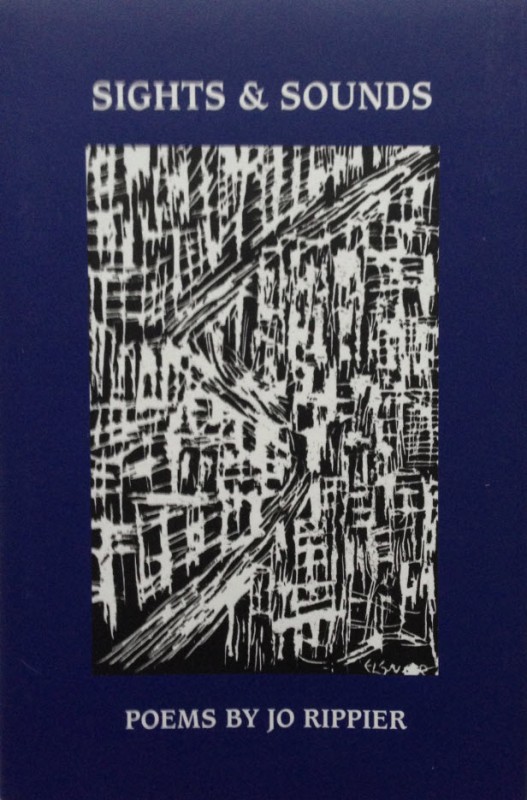
Sights and Sounds
38pp. 20.4cm hbk
The poems in the present collection are largely an attempt to put into words what is registered either in the mind, or when physically encountering the world around. But there are also reflections on what one experiences when looking back on the past.
.
More info →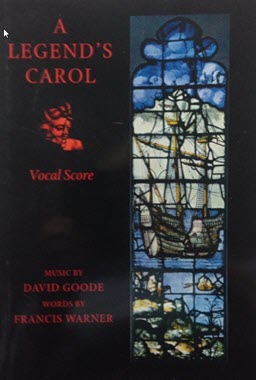
A Legend’s Carol
Vocal Score: 27.0 x 19.0 cm. 72 pages. Paper covers (978-0-86140-498-8) £10.00
Full score: 30.8 x 20.8 cm. 88 pages. Paper covers (987-0-86140-497-1) £15.00
With 11 colour illustrations from the 16th-century windows of King's College Chapel, Cambridge
Score of David Goode's setting of Francis Warner's 1962 Nativity poem, "A Legend's Carol", with a Note on the Poem by Glyn Pursglove.
With a free CD recording, which can be bought separately at https://www.oxrecs.com/ALegendsCarol.html
More info → 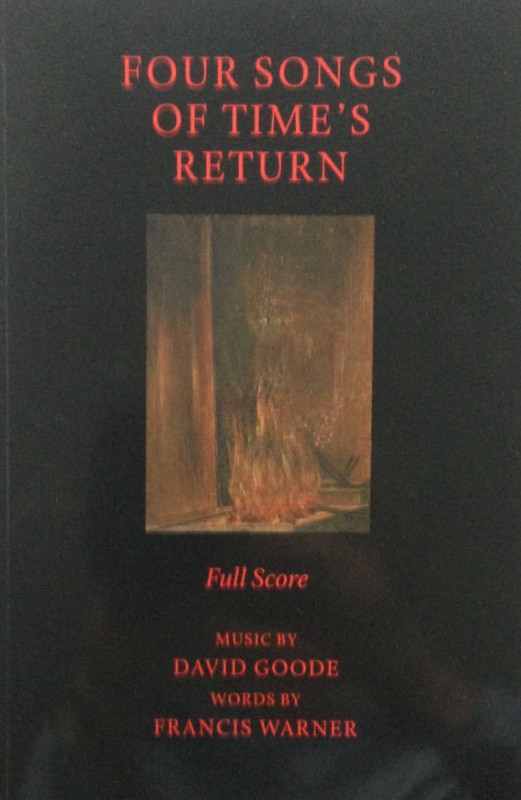
Four Songs of Time’s Return
Vocal Score: 27.0 x 19.0 cm. 64 pages. Paper covers £10.00 (978-0-86140-500-8)
Full score: 30.8 x 20.8 cm. 104 pages, Paper covers £15.00 (978-0-86140-501-5)
With colour illustrations of details of works by Sandro Botticelli and John Piper
Song Cycle. David Goode's setting for soprano and baritone, and piano of four extracts from Francis Warner's poems, the sections titled Fire, Earth, Water and Air. Fire reflects his schoolboy desire to become a blacksmith, during the extremely cold winter of 1946-47; Earth - ‘Amabile’ - is the speech of Simonetta as Primavera from Living Creation, his play on Botticelli and Medici Florence; Water, Summer, recalls the June Concert on the river Cam by Clare Bridge sung by the Cambridge University Madrigal Choir; and Air, the climax of his 1961 poem Perennia, a duet.
With a free CD recording, which can be bought separately at https://www.oxrecs.com/FourSongs.html
More info →