

The Old Lady Says ‘No!’
Edited, with an Introduction and Notes, by Christine St Peter
ISBN: 978-0-86140-357-8
21.6 x 13.8 cm. xiv, 140 pp. 1992
This definitive edition is based on Johnston's final 1977 version published in the Dramatic Works, the product of fifty years of revisions, and situates the play in its historical, theatrical, and biographical contexts. It is the first edition to have reference to all private and archival materials and to have had the assistance of the playwright in the preparation of its critical apparatus, which includes comprehensive annotations and analyses of all substantive changes in the multiple manuscripts. It will be of enduring interest to scholars specializing in Irish and European theatre history, as well as to students of Anglo-Irish literature and theatre directors.
Co-published with the Catholic University of America Press, Washington, D.C.
The Dramatic Works, Volume 2
ISBN: 978-0-901072-53-5
21.6 x 13.8 cm. iv, 404 pp. 1979 Volume 2 of the Dramatic Works of Denis Johnston
Contains: A Bride for the Unicorn, The Moon in the Yellow River, A Fourth for Bridge, The Golden Cuckoo, Nine Rivers from Jordan, The Tain (a pageant), and 'Introducing the enigmatic Dean Swift'.
More info →
Synge: the Medieval and the Grotesque
21.6 x 13.8 cm viii, 209 pp. 1982 Irish Literary Studies series (ISSN 0140-895X) volume 11
J. M. Synge’s plays have often been regarded as folk drama, but this study considers them from a new literary perspective. It stresses the importance of the playwright’s studies with two medievalists at the Sorbonne, Professors Henri d’Arbois de Jubainville and Louis Petit de Julleville, and makes, for the first time, a full examination of the various uses he made of medieval material. This is shown to contain grotesque motifs which accommodate both Synge’s inclusive antithetical vision and the Rabelaisian note in Irish peasant life, as he perceived it. Toni O’Brien Johnson also shows that the use of Hiberno-English language structures reinforces the clash inherent in the grotesque in Synge’s plays.
This book shows the operation of the dramatist’s dualist aesthetic through the copresence in his work of what is repulsive and sublime, cruel and noble, violent and heroic, pitiless and beautiful. It also emphasises the prominent role played by bodily life and the degenerative aspects of old age, death, and decay in Synge’s work.

Sir William Gregory of Coole, a Biography
23.6 x 15.6 cm.
William H. Gregory, to the extent that his name is familiar, is remembered merely as the husband of Lady Gregory, of Abbey Theatre and Irish Literary Revival fame. He contributed to this undeserved obscurity by failing to make the most of his undoubted abilities and by choosing as a bride a woman many years his junior who was to make the most of hers.
Yet in his lifetime he was a figure of sufficient prominence – politician, racing man, dilettante – to be included in the Vanity Fair series of portraits even before he went on to serve with great success as a colonial governor. Moreover, his career throws additional light on the problems of Irish landowners and MPs at a time when Ireland was again a central issue in British politics.
Author of the infamous ‘quarter-acre test' for relief during the famine, he paradoxically established an enviable reputation as a humane and progressive landlord, only to find himself at the end of his life an alien in his native land.
Professor Brian Jenkins has written a lively and interesting biography, setting his subject in the context of his position at the centre of Victorian life in Britain, and establishing Sir William as very much a personality in his own right.
More info →


Yeats The European
21.6 x 13.8 pp. xvi, 340 pp. 1989 Princess Grace Irish Library series (ISSN 0269-2619) volume 3
Contains the papers given at the 1987 conference held at the Princess Grace Irish Library, Monaco, with contributions assessing Yeats's influence on European authors and how much the European mainland and its authors, artists and sculptors influenced him.
The papers in this volume are by Michael Alexander, Birgit Bramsbäck, Toni Cerutti, Denis Donoghue, Jacqueline Genet, Warwick Gould, Bernard Hickey, John Kelly, Heinz Kosok, Peter Kuch, Alasdair Macrae, William M.Murphy, Andrew Parkin, Patrick Rafroidi, Ann Saddlemyer, Ronald Schuchard, Masaru Sekine, Michael Sidnell, C.K.Stead, Helen Vendler and George Watson, with opening and closing addresses by A. Norman Jeffares.
More info →

Yeats, Sligo And Ireland
21.6 x 13.8 pp. x, 267 pp. 1980 Irish Literary Studies series (ISSN 0140-895X) volume 6
The twenty-first Yeats International Summer School was held in Sligo in 1980, and the Yeats Society, wishing to mark the school’s coming of age, asked Professor A. Norman Jeffares to edit a volume of essays specially commissioned for the occasion. These essays are by Directors of the school and scholars who have lectured at it.
The essayists are Lester Conner, Denis Donoghue, Barbara Hardy, Seamus Heaney, T. R. Henn, John Holloway, A. Norman Jeffares, John Kelly, F. S. L. Lyons, Augustine Martin, D. E. S. Maxwell, William M. Murphy, Patrick Rafroidi, Ann Saddlemyer and Helen Vendler, together with a poem by Brendan Kennelly. OnIy one essay is not new, that by the late T. R. Henn; it was given as a lecture and included in his Last Essays: appositely it is on his native Sligo,
These essays show the breadth of Yeats studies, indicating eloquently the tremendous hold that Yeats exerts on scholar and general reader alike, stressing that he is the greatest poet Ireland and the twentieth century have produced.
'Remarkable for their vitality and freshness of interpretation.' ,i>Choice
CONTENTS<br
Acknowledgements <br
Introduction. A. Norman Jeffares<br
A MATTER OF CHARACTER: RED HANRAHAN AND CRAZY JANE. Lester I.Conner<br
ROMANTIC IRELAND. Denis Donoghue<br
THE WILDNESS OF CRAZY JANE. Barbara Hardy<br
YEATS AS AN EXAMPLE?. Seamus Heaney<br
THE PLACE OF SHELLS. T.R.Henn<br
HOW GOES THE WEATHER? John Holloway<br
YEATS AND THE WRONG LEVER. A.Norman Jeffares<br
THE VISITOR. Brendan Kennelly<br
YEATS AND VICTORIAN IRELAND. F.S.L.Lyons<br
HOUND VOICES WERE THEY ALL: AN EXPERIMENT IN YEATS CRITICISM. Augustine Martin<br
THE SHAPE-CHANGERS. D.E.S.Maxwell<br
HOME LIFE AMONG THE YEATSES. William M.Murphy<br
YEATS, NATURE AND THE SELF. Patrick Rafroidi<br
THE 'DWARF DRAMAS' OF THE EARLY ABBEY THEATRE. Ann Saddlemyer<br
FOUR ELEGIES. Helen Vendler<br
BOOKS AND NUMBERLESS DREAMS: YEATS'S RELATIONS WITH HIS EARLY PUBLISHERS. John S.Kelly<br
Notes on Contributors<br
Speakers at Sligo 1960-1980<br
Index

Parameters of Irish Literature In English
ISBN: 978-0-86140-246-5
21.0 x 15.0 cm. 44 pp. 1986 Princess Grace Irish Library Lectures series (ISSN 0950-5121) volume 1
In this lecture, given at the Princess Grace Irish Library on 25 April 1986, Professor Jeffares surveys creative writing in Ireland from the earliest times to its flowering in the last centuries.
The list of great Irish writers is truly remarkable: not only does it include 20th century figures such as Beckett, Joyce, Moore, O'Casey, Shaw, Synge and Yeats, but equally famous names from the 19th century and earlier, including the Banims, Boucicault, Carleton, Congreve, Edgeworth, Farquhar, Le Fanu, Lever, Lover, Sheridan, Swift, Wilde, and many more. There are countless others who have suffered from the vagaries of fashion and the lack of modern critical appreciation.
Irish authors have had a very wide readership, not only in Ireland and Britain, but throughout the English-speaking world, particularly in the United States of America, where they have always been extremely popular.
Professor Jeffares also provides a list of writers of Irish literature in English, as well as important writers in the Irish language.
More info →
The Dramatic Works, Volume 3
hardback ISBN: 0-86140-080-1 / 978-0-86140-080-5 £35.00
three-quarter leather signed edition limited to 25 copies
ISBN: 0-86140-081-X / 978-0-86140-081-2 £150.00
21.6 x 13.8 cm. 516 pp. 1992
Volume 3 of the Dramatic Works of Denis Johnston
Edited by Joseph Ronsley
Publication of the third volume completes the collection of Johnston's work. Volume 3, The Radio and Television Plays, is in many ways the most interesting, not least because Johnston was one of the founding fathers of BBC drama and a major influence on viewers' very perception of what a television play consists of. Also printed in this collection are a number of articles and other prose writings about drama on radio and television. After a very happy pre-war period working for BBC Radio Northern Ireland, he moved to the embryonic television service at Alexandra Palace - he was one of the few to have been temporarily thrown out of television when broadcasting ceased for the duration of hostilities and he became a BBC Radio War Reporter. An interesting feature of the TV scripts is the early development of television script-writing technique, which, as these faithful reproductions from extant typescripts show, grew out of the conventions used in play-scripts.
Contents:
Radio Plays: Lillibulero, Multiple Studio Blues, Great Parliamentarians: Lord Palmerston, High Command, The Gorgeous Lady Blessington, Amanda McKittrick Ros, In the Train;
Television Drama: The Parnell Commission, Weep for the Cyclops, The Call to Arms, Operations at Killyfaddy, Murder Hath No Tongue;
Essays on Broadcasting; Reviews; Appendices: Blind Man's Buff, Riders to the Sidhe; A Radio Talk.

Images of Invention: Essays on Irish Writing
21.6 x 13.8 cm. xii, 351 pp. 1996 Irish Literary Studies series (ISSN 0140-895X) volume 46
In this collection of twenty-two essays written over the last two decades, Professor Jeffares looks at the work of many of the most famous 17th to 20th century Irish writers - from Swift and Farquhar to Joyce, Yeats, Moore and Somerville & Ross, via Goldsmith, Lady Morgan, Lever, and Maturin, as well branching out with essays on Maud Gonne, Wilfrid Scawen Blunt and Sir Robert Richard Torrens.
The titles of the essays are
'Swift and the Ireland of his Day',
'Swift: The Practical Poet',
'Aspects of Swift as a Letter Writer',
'Farquhar's Final Comedies',
'Goodnatured Goldsmith',
'The Vicar of Wakefield',
'The Wild Irish Girl', Lady Morgan's O'Donnel',
'Maturin the Innovator',
'Reading Lever',
'Yeats and the Wrong Lever',
'Lord Kilgobbin',
'Torrens: Irishman in South Australia',
'George Moore: Portrait for Radio',
'Somerville and Ross: an Introduction',
'Yeats's Great Black Ragged Bird',
'Memories of Maud Gonne',
'The Fortunes of Richard Mahony: An Anglo-Irishman reconsidered',
'Blunt: Almost an Honorary Irishman',
'Joyce's Precursors',
'Joyce's "Done Half by Design"', and
'The Realistic Novel in Ireland 1900-1945'.
Together, they provide scholar and general reader alike with an important and stimulating overview of major authors and aspects of Irish literature, some of which deserve much more study than they presently receive.
A. Norman Jeffares (1920-2005) was the author of W.B.Yeats: Man and Poet (1949; 1962) and W.B.Yeats: A New Biography (1988), he has edited Yeats's Poems (1989), A Vision (1990) and various other books of Yeats as well as writing a Commentary (1968) and a New Commentary (1984) on Yeats's poems and, with A.S.Knowland, a Commentary on the plays. His co-edited books include The Scientific Background, with M. Bryn Davies, and Irish Childhoods, with Anthony Kamm. In addition to A History of Anglo-Irish Literature and various editions of and writings on English, Irish and American authors, he has edited twenty-four Restoration comedies for the Folio Society. As Derry Jeffares, he has written two books of poems: Brought Up in Dublin and Brought Up to Leave. His recent work includes The Selected Poems of Swift; The Gonne-Yeats Letters, with Anna MacBride White; Joycechoyce, with Brendan Kennelly; Ireland's Women, with Katie Donovan and Brendan Kennelly, the Collins Dictionary of Quotations with Martin Gray. He has also edited The Poems and Plays of Oliver St John Gogarty (2001) and wrote an extensive Introduction to The Poems of James Stephens (2006), both published by Colin Smythe Ltd.
More info →

Irish Influences on Korean Theatre during the 1920s and 1930s
21.6 x 13.8 cm. 262 pp. 2003
ISBN: 978-0-86140-453-7
It is well known that through their plays and lecture tours the dramatists of the Irish Literary Revival influenced and inspired those of America and elsewhere to set up their own national theatres and theatre movements, but most students of the Revival are unaware of just how far this influence extended. It would surely have surprised the founders and early playwrights of the Abbey Theatre to learn that their plays were not only being published in Japan (which they knew), but were also influencing translators, playwrights, critics and theatre associations in Korea – though it is hardly surprising that with little knowledge of Irish culture the translators often misinterpreted the plays and gave them political or social slants entirely lacking in the originals.
In the present work, Won-Jae Jang describes the development of Korean theatre societies such as the Theatre Arts Association, the Earth Moon Society, and the Theatre Arts Research Association during the first quarter of the 20th century, how plays by Lady Gregory, J.M. Synge, Lord Dunsany, Sean O’Casey and T.C. Murray were interpreted – or misinterpreted – by Korean translators, and then describes their impact on Korean dramatists, showing in particular how the work of Synge and O’Casey influenced Chi-Jin Yoo (translations of three of whose plays – The Cow, The Mud Hut and The Donkey – are published in a companion volume, ISBN 978-0-86140-452-0), and Murray influenced Se-Deok Ham. This work therefore opens up Irish Drama’s hitherto little-known influences on a region of the Eastern hemisphere.
Won-Jae Jang was born in Seoul, graduated from Korea University (BA), and Goldsmiths College, University of London (MA), and was granted his PhD from Royal Holloway, University of London in 2000. He is now working for Soongsil University as a Junior Professor.

The Poetry of Henry Newbolt: Patriotism is Not Enough
22.9 x 15.3 cm.
Henry Newbolt (1862-1938) was a celebrated man of letters at the turn of the century: poet, essayist, historian. But his popularity ebbed after the Great War, and since then the man and his poetry have received more than their share of hostile criticism. Even today critics oversimplify Newbolt. Most often he is typecast as the leading jingoist of the Edwardian age, not unlike Rudyard Kipling was until recently.
In The Poetry of Henry Newbolt, Vanessa Furse Jackson gives us a fresh look at the man, his poetry and their historical context. Her discussions of his heroic and lyric poems are framed by a close examination of the institutionalised values that lay behind Newbolt’s popularity. She looks at the intimate ties between his life-code and his education, particularly his public school education, and at the pervasive concepts of heroism, chivalry and patriotism inherited by the younger generation of the 1870s. She later examines how traditional Victorian and Edwardian attitudes, not just the general public’s but Newbolt’s as well, were irrevocably altered by the gruesome events of World War I.
Jackson provides nuance and perspective to show that Newbolt was not simply the blind patriot described by many literary historians. What he represents, she says, ‘is something much more interesting, and, in a complete history of the period, both more important and more complex.’ In addition to revealing much about the concepts, ideals and aspirations of the Victorian middle class in which he grew up, Newbolt ‘represents one of the last movements in poetry to occur in the fin-de-siècle anticipation and anxiety of the 1890s. [He] is a minor figure who represents major Victorian values and attitudes.’
In The Poetry of Henry Newbolt, Professor Jackson reconnects the poems to their context and offers new insights into Henry Newbolt, his work, and the Transi¬tion era itself.
VANESSA FURSE JACKSON, a great-granddaughter of Henry Newbolt, spent ten years in theatre in England before returning to college in 1981 and completing a BA (hons) in Related Arts at the West Sussex Institute of Higher Education. After graduating in 1984, she came to the United States and received an MFA in Creative Writing at Bowling Green State Uni¬versity in 1986. She completed her Ph.D. at Bowling Green in 1990. Professor Jackson spent her time teaching at Texas A & M University – Corpus Christi, before returning to live in England.

Selected Plays of Douglas Hyde – ‘An Craoibhin Aoibhin’
Chosen and Introduced by Janet Egleson Dunleavy and Gareth Dunleavy
The seventh volume of the Irish Drama Selections series (ISSN 0260-7962), General Editors: Joseph Ronsley and Ann Saddlemyer.
Hardcover ISBN: 0-86140-095-X / 987-0-86140-095-9 £25.00
Paperback ISBN: 0-86140-096-8 / 978-0-86140-096-6 £8.99
21.6 x 13.8 cm 192 pp. 1991
Contains: The Twisting of the Rope, The Marriage, The Lost Saint, The Nativity, King James, The Bursting of the Bubble, The Tinker and the Sheeog, The Matchmaking, The School-master, bibliographical checklist. This volume publishes the original Irish language texts with Lady Gregory's translations.
When Douglas Hyde was elected in 1938 as first President of Ireland, he brought to this last of many rôles the prestige of an important scholar, a noted author and a leader of the cultural nationalist movement. Born in 1860, the son of the Church of Ireland rector at Frenchpark, Co. Roscommon, he grew up among the local people, learning Irish and listening to folk tales, which he began to record and which proved valuable experience when writing dialogue for his plays. After study at Trinity he became a founder member of the Gaelic League, formed in 1893 to preserve and promote the Irish language, and he was its President for twenty-two years.
Hyde was struck by the idea of promoting the Irish language through drama, especially puppet shows and short plays. In the hands of a writer less gifted in mimicry, with a less-developed sense of humour, the results of an effort undertaken for admittedly propagandist purposes might have been deadly. In his hands they ushered in a new dramatic tradition. That his one-act plays, classics of the modern Irish theatre, continue to be performed today, both in their original Irish and in Lady Gregory's English translations is but one indication of the versatility of his talent and his appeal to both popular and artistic tastes. Eight one-act plays are reproduced here with Lady Gregory's translations on the facing pages.
More than three decades after his death, the inevitable reassessment is under way and new stock must be taken of his rôles as folklorist, poet, translator and playwright, each assumed at a carefully chosen time for what it could contribute to the goal of his life: first the cultural, then the social and political independence of Ireland.
More info →

Mountmellick Work, Irish White Embroidery
ISBN: 978-0-85105-512-1
29.8 x 21.0 cm. 80 pp. 2nd edition 1996
White-on-white embroidery in various forms has been practised in Ireland for several centuries. Mountmellick work is probably the best-known style of Irish white embroidery and is named after the town where the craft was developed in the early decades of the nineteenth century. Mountmellick is in the centre of the area in which Ireland's cotton spinning and weaving industry developed a century earlier and here, in about 1830, Mrs Johanna Carter invented the style of embroidering in thick cotton thread which is named after her native town.
Many of the characteristic designs are based on natural forms, especially on the abundant flora of the area, worked into richly decorative patterns. Mountmellick work became widely known in a few decades and was shown at several international exhibitions. The craft declined in the early years of the present century, but the old paper patterns, many in extremely fragile condition, were preserved by local enthusiasts and by the devoted sisters of the Mountmellick convent who continued to work the designs. Jane Houston-Almqvist has had access to these original patterns in preparing her book which not only tells the story of the craft, but is a practical manual with many full-size patterns based on the originals. Mountmellick Work will be welcomed by all lovers and practitioners of fine needlecraft. Jane Houston-Almqvist was born in Massachusetts of Scots-Irish stock. Her studies in psychology, painting and design let to work as an occupational therapist which took her to Denmark where she became interested in traditional needlework techniques. A further period of study at Uppsala University in Sweden helped to deepen her interest in the decorative arts, particularly in textiles. She has lived in Ireland for the past fifteen years and her skill in embroidery has led to commissions for church work, to exhibitions of needlework and patchwork, and to teaching. She likes Ireland and has made it her permanent home. Mountmellick Work is her first book, and was originally published by the Dolmen Press in 1985.
The bibliography and list of suppliers have been updated and enlarged, and further illustrations have been added to this second edition.
More info →
Hugh Clifford and the Discipline of English Literature in the Straits Settlements and Malaya 1895-1907
The first volume in the MODERN SUBJECTS/COLONIAL TEXTS series
22.9 x 15.3 cm. viii, 192 pp.
Fiction written under colonialism at the turn of the nineteenth century continues to be a highly contested area of intellectual enquiry. Writers who put imperialism into focus – Rudyard Kipling, Rider Haggard, Joseph Conrad – are now also seen as important agents in creating and reinforcing notions of national culture and gender roles. Much recent colonial discourse analysis, however, has neglected writers who were part of colonial communities in favour of metropolitan travellers and visitors.
Hugh Clifford’s position as both colonial official and writer sets him apart from such contemporaries. His career as colonial administrator in the Malaya and Straits Settlements spanned five decades, and his Malayan short stories, novels and sketches draw an elaborate series of parallels between the act of governing the colony and the discipline of writing a literary text. In Modern Subjects/Colonial Texts Philip Holden places Clifford’s writing in the context of the British "Forward Movement" in the Malay Peninsula, the evolving strategies of colonial governance, and their reception and reinscription by colonial elites.
What makes Holden’s study especially interesting is his careful analysis not only of Clifford’s unique role as administrator and writer, but his probing of Clifford’s doubts about the colonial enterprise. The central contradiction of colonialism pervades his fiction. In its late nineteenth-century guise colonialism promised improvement and the uplifting of subject peoples, yet it could not admit them to a position of social equality since at that moment the basis for colonialism would vanish. Holden reveals how the experience as a colonial administrator made Clifford suspicious of the economic expediency which often underlies the rhetoric of mission and duty. Clifford also comes to have doubts about the success of masculinity as a practice of the regulation of the self. As the last chapter of Holden's study shows, such doubts and contradictions were exploited in the reception of Clifford's texts by colonial elites such as the Straits Chinese.
Interweaving constructions of masculinity, femininity, race, bodily purity in Clifford’s fiction and their reinscription by non-European bourgeois communities create a complex mixture of complicity and resistance, one Holden believes might find surprising affinities with our own world at the turn of the twentieth century.
PHILIP HOLDEN is Assistant Professor of Literature and Drama at the National Institute of Education, Singapore. He is author of Orienting Masculinity, Orienting Nation: W. Somerset Maugham's Exotic Fiction, and a number of articles on colonial and postcolonial writing and culture in journals such as ARIEL, Journal of Commonwealth Literature, Jouvert, and Communal/Plural. With his co-editor Richard Ruppell, he is editing a volume of essays provisionally entitled Queer Theory, Colonial Texts for publication by University of Minnesota Press.
More info →
The Art of the Amateur 1916-1920
ISBN: 978-0-85105-372-1
21.6 x 13.8 cm 368 pp. 1984 Volume 5 of The Modern Irish Drama, a documentary history
The Art of the Amateur, the fifth volume in the documentary history, The Modern Irish Drama, describes and documents the Irish theatre from 1916-1920, some of the most turbulent years of the emerging nation. Against the background of the Easter Rising in Dublin and its violent aftermath, and of the Great War in Europe, the authors chart how the Irish theatre coped with, mirrored, and curiously, often ignored the trauma of the times.
As the authors of The Art of the Amateur note, the theatre, especially the theatre as entertainment, flourishes in times of public horror. With the deaths of Pearse, MacDonagh, MacSwiney and Sean Connolly, the Abbey player, there was more than enough horror. If few masterpieces immediately emerged, the stage in the period covered in this volume, both public and private, was being set for the emergence of the plays of Sean O’Casey and Denis Johnston.
The Modern Irish Drama, of which The Art of the Amateur is the fifth volume, is a documentary history with transcriptions of contemporary reviews and full cast lists. As The Irish Press commented, ‘Professor Hogan and his distinguished collaborators . . . have produced a rich, fascinating and, to the drama-junkie, indispensable book on a generally neglected period of Irish theatrical history.’
More info →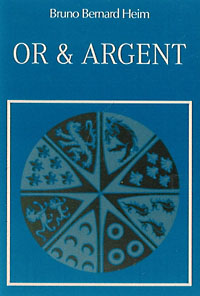
Or and Argent
Hardcover ISBN: 0-905715-24-1 / 978-0-905715-24-7
Limited signed edition, three-quarter leather, ISBN: 0-9-5715-36-5 / 978-0-905715-36-0 £250
24.5 x 18.3 cm. 135 pp. 1994 Van Duren with 23 pages of colour plates, and numerous b/w illus.
With a Preface by the Duke of Norfolk, KG, GCVO, CB, CBE
Earl Marshal of England
As a record of past glories, nothing delights the student as much as heraldry. The information that a coat of arms can give the serious scholar is considerable, and over the past 800 years rules have been evolved to control what can be put in one’s personal arms and how to show one’s descent from other armigerous families.
One of the most intriguing rules is that one is not allowed to put metal on metal – gold and silver (Or and Argent in heraldic terms) – or next to each other. Similarly one must not put colour on colour. The reasoning behind these rules has long been suspect, however, so Archbishop Heim’s work on the history of, and rules concerning, this subject is most timely. While many authorities maintain that the rules of heraldry forbid such neighbourliness, the author here provides ample evidence that this rule is broken as often as it is adhered to.
As a lifelong heraldist and one whose own arms break this ‘sacred’ rule, Archbishop Heim has always been interested in where and when it was made, so he has researched hundreds of works, some dating from the twelfth century, in an attempt to track down its origins. As a result of his detective work he has painted many examples of arms that break the rule, and also shows how earlier writers have got round such a tricky subject.
Or and Argent contains twenty-four full colour plates containing over 360 coats of arms, with examples from every European country, and many others in black and white in the text, all of which break this so-called immutable rule, and a bibliography giving the most important authorities.
As well as the standard edition there is an edition limited to 50 numbered copies hand-bound in morocco and vellum, and signed by the author.
Published by VAN DUREN, an imprint of Colin Smythe Limited
More info →

Armorial Bruno B. Heim
Edited and Introduced by Peter Bander van Duren
Preface by The Earl Marshal of England Major General His Grace the Duke of Norfolk CB, CBE, MC
Blazons for the 'Liber Amicorum et Illustrorum Hospitum' by John George, Garioch Pursuivant
21.5 x 15.5 cm. 224pp. with reproductions in b/w of 143 pages + 18 colour illus Van Duren 1981
This is by any standard the most unusual armorial ever to have been published. In his Preface the Earl Marshal, His Grace the Duke of Norfolk, says: ‘What makes the Liber Amicorum an unusual armorial is that it extends beyond national insularity and embraces heraldry varying in origin and authority, but whatever the source, the creative and imaginative style which Archbishop Heim has developed, makes every shield and crest and device which he treats, a spectacular example of heraldic art. Here the heraldry of Europe is represented side by side with British armorial bearings, and while different heraldic tastes and practices are catered for, by Archbishop Heim’s artistic skills all are brought into colourful harmony. No more fitting tribute could be paid to Archbishop Heim than the first publication of this important and unique work of art.’
In his introduction, the Editor presents a profusely illustrated biographical chapter on Archbishop Bruno B. Heim, the Holy See’s Authority on heraldic matters and the man to whom heraldry in the Catholic Church owes the high standards today.
This is not just an armorial but a unique historic record of one of the most exciting periods in the history of the Catholic Church. Archbishop Bruno B. Heim, the Apostolic Delegate to Great Britain, has done more than any other man towards the creation of harmony and unity between the Holy See and Great Britain, whose relations had been strained for over four hundred years. Historians and heraldists of the future will find this armorial an invaluable source of information because many of the armigers in this volume have a share in the joyful development of those relations between the Holy See and Great Britain.
Some words by Peter Bander-van Duren
Archbishop Heim's ARMORIAL or Liber Amicorum, his guest book for special friends, was published in 1981 to celebrate his seventieth birthday and the centenary of the birth of Pope John XXIII. Apart from having been Pope John's Secretary when the Pontiff was still Archbishop Angelo Roncalli, Apostolic Nuncio to France, none of Pope John's biographies had made mention of his contribution to heraldry. The appointment of Mons. Bruno Heim to his first diplomatic post under Archbishop Roncalli was the beginning of a close cooperation between two outstanding heraldic artists.
'Although I was able to include several facsimile letters from Archbishop Roncalli and other high dignitaries who consulted him on heraldic matters, unfortunately too late for inclusion in the book was a manuscript thesis by Pope John XXIII, written four weeks before his death, explaining the meaning of his personal coat of arms.
'Mons. Heim continued to add armorial bearings of friends and of illustrious guests who paid him a visit, especially when he himself had been consecrated Archbishop and appointed Apostolic Delegate and later Nuncio. During Mons. Heim's appointment to the Court of St. James (1973-1982 as Apostolic Delegate and from 1982 - 1985 as Nuncio) he entertained kings, queens, princes as well as prime ministers and leading figures in literature and the arts, not to mention Pope John Paul II and many eminent men of the Church.
'He had started his work as an heraldic painter at the age of sixteen, and by the time he arrived in the United Kingdom, Archbishop Heim was a well known and highly respected ecclesiastical heraldic artist.
'Medieval simplicity in his heraldic representations was his hallmark, but he was adventurous and never hesitated to give a "rebus" (a heraldic emblem) to those visitors who were not armigerous. Two of them were published all over the world: that of Dame Agatha Christie, the author, and that of The Rt. Hon. Margaret Thatcher, MP, PC, (later Prime Minister and then Baroness Thatcher, Dame of the Noble Order of the Garter). Lady Thatcher is now armigerous; her heraldic banner hangs in St. George's Chapel, Windsor.
'Archbishop Heim designed the coats of arms for Pope John XXIII, Pope Paul VI, Pope John Paul I and Pope John Paul II as well as the armorial bearings for countless cardinals, patriarchs, archbishops and high prelates in the Catholic Church. His book HERALDRY IN THE CATHOLIC CHURCH became the standard reference work in ecclesiastical heraldry. After his retirement from the Holy See's diplomatic service in 1985 it took him more than ten years to complete his last heraldic work Or and Argent, which was originally planned for publication in 1983 but eventually appeared in 1994.
'On occasion Archbishop Heim gave reign to a wicked sense of humour. When a prelate asked him to design for him a coat of arms appropriate to his high social status, he proposed a donkey's head.
Archbishop Heim was later to issue a reproduction of the Liber Amicorum in full colour, with the limitation notice: 'Only thirty copies of this privately produced and augmented coloured edition of my "Liber Amicorum" were made. They are not for sale. This is number [30]"
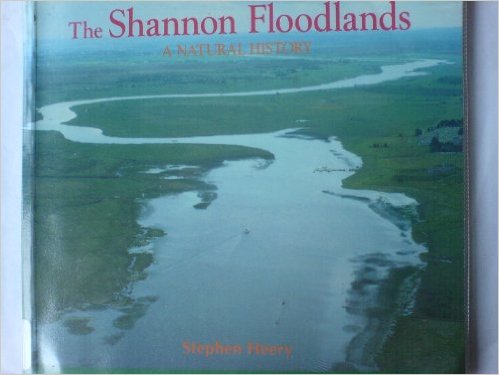
The Shannon Floodlands. A Natural History
167pp, 20.5 x 22.0 cm, 12 colour & 70 b&w illustrations 1993
A study of the Shannon Callows, the fascinating and distinctive landscape seasonally flooded by the River Shannon, and the rich variety of plants, animals and birds found in this unspoilt wetland habitat.
"This book will have an immediate appeal for all those who love the wild places and their inhabitants. It is a work that should be on the shelves of every nature lover."
" The great virtue of Stephen Heery's book is its revelation of the Callows entire and very special ecosystem – a complete web of wild lives and
"eco-hydrology" shaped over thousands of years."

Ireland and France, a Bountiful Friendship
Literature, History and Ideas. Essays in honour of Patrick Rafroidi
21.6 x 13.8 cm. xii, 221 pp. 1992 Irish Literary Studies series (ISSN 0140-895X) volume 42
Ireland and France, A Bountiful Friendship: Literature, History and Ideas is a collection of essays looking at 'Irish matters' in a new and exciting way. Accepting the historical significance of France as a catalyst for Irish genius and a fertile field for missionaries, wild geese and assorted Irish expatriates, the book explores compatibilities and contrasts between the Irish and the French. Has French republicanism come to life again in the IRA? Are Paisley and Le Pen mirror images of each other or of `national' impulses? If Irish intellectual history is imbricated with the Enlightenment and the counter-reformation, how do we read Edmund Burke?
If Irish writers from Wilde to Beckett seem equally at home in French and in English perhaps this suggests the value of tracing the footsteps of others: Charles Maturin, John Banim, James Stephens, Denis Devlin and Derek Mahon, whose work in varying ways draws upon and mediates French influence. On the other hand, a French perspective on things Irish, as in several essays included here, provides new insights and assessments, new versions of understanding.
The inspiring presence of this book is the late Patrick Rafroidi, whose study of Irish romanticism has become a standard work and who has proven himself among the best French commentators on Irish culture in recent times. As Rafroidi's family history and career exemplified Irish-French interactions, so these essays in his honour celebrate the fruitfulness of a long-standing affaire.
More info →
Carleton’s ‘Traits and Stories’ and the 19th Century Anglo-Irish Tradition
21.6 x 13.8 cm. xiv, 432 pp. 1983 Irish Literary Studies series (ISSN 0140-895X) volume 12
The twenty-nine stories in William Carleton’s Traits and Stories of the Irish Peasantry each had a different publishing history. Some had appeared in periodicals as different as the Christian Examiner and the Dublin Literary Gazette; every story underwent revision when it first appeared in a book and in subsequent editions. These revisions were not slight. On occasion Carleton transformed the story almost out of recognition: ‘The Landlord and Tenant’ was doubled into ‘Tubber Derg or the Red Well’; he censored ‘An Essay on Irish Swearing’; ‘Going to Maynooth’ was improved by lengthy interpolations.
In this study, Dr. Hayley follows the development of all the stories from their earliest appearances, through all the editions of the First and Second Series of Traits and Stories, up to the definitive ‘New Edition’ of the collection of 1842-44, with observations on later editions. She comments on all the changes to each story in this important work, which was so popular and influential on both sides of the Atlantic in the 19th Century.
Traits and Stories marks a significant period in Irish letters and in Irish publishing. By having his books published in Dublin rather than London, Carleton led the revival of Irish literature and publishing that took place in the 1830s and 1840s. The revisions that he made to the collection were a response to the changing literary and political climate of Ireland, and also to the reactions of his wide readership abroad. For this reason, and for its own unusual history, this chronicle of the development of a book is an interesting and valuable study.
More info →