

Reviews and Essays of Austin Clarke
Edited by Gregory A. Schirmer
21.6 x 13.8 cm. Irish Literary Studies series (ISSN 0140-895X) volume 40
Austin Clarke is widely regarded as one of 20th-century Ireland's most important poets. In this selection of nearly fifty essays and reviews written over Clarke's long career, he demonstrates that he is an astute and provocative literary critic as well.
Having grown up in Dublin when the excitement of the Irish Literary Revival was still running high, Clarke knew many of the principal figures of that movement personally, and his readings of Yeats, Joyce, Synge, O'Casey, Lady Gregory, George Moore, and others, enjoy the advantages of an insider's point of view. Moreover, committed in his own poetry to the basic assumption that fuelled the Literary Revival – that the most productive course for Irish literature lay in the direction not of England but of Ireland – Clarke in his criticism provides a way of understanding, and judging, the Revival's major writers in terms of their relationships to Ireland's rich literary and cultural traditions. At the same time, these essays call attention to a number of distinctly Irish, but often overlooked, writers working on the margins of the revival.
As Yeats observed more than once, the Irish, for all the contributions that they have made to modern fiction, poetry, and drama, have fallen somewhat short in the genre of literary criticism. Austin Clarke's essays and reviews, many of which were written under a pseudonym and so not attributed to Clarke for years, go a long way towards filling that gap.
A selection of Clarke's writings on Yeats is followed by one on other Irish writers and the Irish Literary Revival, and on Modern English and American literature. Included as an appendix is an exhaustive list of Clarke's literary criticism, mostly in periodicals, including over 400 anonymous reviews written for the Times Literary Supplement.
Gregory A.Schirmer is the author of The Poetry of Austin Clarke and William Trevor: A Study of His Fiction, and has written widely on a variety of other modern Irish writers. He is Professor of English at the University of Mississippi.

The Great Queens: Irish Goddesses from the Morrigan to Cathleen ni Houlihan
21.6 x 13.8 cm x, 277 pp. 1991 Irish Literary Studies series (ISSN 0140-895X) volume 34
Though men dominated early Irish society, women dominated the supernatural. Goddesses of war, fertility, and sovereignty ordered human destiny. Christian monks, in recording the old stories, turned these pagan deities into saints, like St Brigit, or into mortal queens like Medb of Connacht. The Morrigan, the Great Queen, war goddess, remains a figure of awe, but her pagan functions are glossed over. She perches, crow of battle, on the dying warrior CuChulainn’s pillar stone, but her role as his tutelary deity, and as planner and fomentor of the whole tremendous Tain, the war between Ulster and Connacht, is obscured. Unlike the Anglo-Irish authors who in modem times treated the same material in English, the good Irish monks were not shocked by her sexual aggressiveness. They show her coupling with the Dagda, the ‘good god’ of the Tuatha De Danann before the second battle of Mag Tuired, but they conceal that this act – by a goddess of war, fertility and sovereignty – gives the Dagda’s people victory and the possession of Ireland. Or they reduce the sovereignty to allegory – when Niall of the Nine Hostages sleeps with the Hag she is allegorical of the trials of kingship!
With the English invasion and colonisation, the power of the goddesses diminishes further. The Sovereignty has no kingship to bestow. In the aisling poets she becomes unattainable sexually, a vision of Irish independence. She no longer legitimises the king, but dreams of a Jacobite rescue. Yeats’s Cathleen ni Houlihan combines this inaccessible vision-woman with the hag, the Poor Old Woman. She offers only death for a dream, though she has the walk of a queen. The Great Queens juxtaposes early Irish texts – such as Tain Bo Reganina, Togail Bruidne Da Derga, and many others – with Anglo-Irish treatments of the same themes by Standish O’Grady, Lady Gregory, James Stephens, and W. B. Yeats. The book shows the fall in status of the pagan goddesses, first under medieval Christianity and then under Anglo-Irish culture. That this fall shows a loss in the recognition of the roles of women seems evident from the texts. This human loss only begins to be restored when, presiding over the severed heads in Yeats’s The Death of Cuchulain, the Morrigu declares, ‘I arranged the Dance.’
More info →

Yeats at Songs and Choruses
23.3 x 15. 8 cm. xxiv, 283 pp. with over 50 illustrations
A critical work about one of the leading figures in modern poetry, this book shows how Yeats perfected great songs – “Crazy Jane on the Day of Judgment”, “Three Things”, “After Long Silence”, “Her Triumph” – and great choruses – “Colonus’ Praise”, “From ‘Œdipus at Colonus’” and “From the ‘Antigone’”. The author follows the manuscript development of each poem to discover its full context in life and culture, to illuminate obscurities in the finished text, or simply to witness in amazement the emergence of a true poem from a tangle of abstractions. As a result, the reader is given original and interesting interpretations of the songs and choruses as final works of art.
“When I prepared ‘Œdipus at Colonus’ . . . wrote Yeats, “I saw that the wood of the Furies . . . was any Irish haunted wood.” Clark shows that Yeats remembered Greece when he wrote songs for Crazy Jane. Greek myth appears in the songs, and Greek choruses appear in the “Irish” song cycles. The last word in “A Man Young and Old” is spoken of Œdipus and the last word in “A Woman Young and Old” of Antigone. Classical figures rub elbows with Huddon and Duddon and Daniel O’Leary. In “Her Triumph” the woman sees herself and her lover as Perseus and Andromeda.
Paintings, often of mythological subjects, were part of the context for Yeats’s poems. Yeats was an art student and the son and brother of well-known painters. The manuscripts show exactly what paintings – by Bellini, Carpaccio, Titian – were in Yeats’s thought when he wrote “Her Triumph” and Clark concludes that one of Burne-Jones’s Perseus series was the chief model for the poem’s imagery. Other poems, too, were written in the context of Yeats’s knowledge of art. Relevant illustrations are included. Manuscripts too are photographically reproduced.
Among the many comments on Clark’s skill as an interpreter of Yeats are: “Clark varies his approach to fit the materials at hand: with one poem he will emphasize the visual sources, for example, whereas with another lyric he will concern himself with biographical matters . . . Clark’s scholarship is quite sound, and he is working at the frontiers of Yeats scholarship.” – Richard J. Finneran, editor, Anglo-Irish Literature, A Review of Research
“Clark’s intricate analysis of Yeats’s ‘After Long Silence’ is a jewel of scholarship, moving and illuminating: in his analysis of the poem, and of the manuscripts out of which it emerged, Clark seems to have moved for a moment into Yeats’s mind.” - Robert O’Driscoll, The University of Toronto Quarterly.
'A pleasure to read....a book for anyone interested in Yeats or the creative process, a real contribution to Yeats studies.' Books Ireland'A pleasure to read....a book for anyone interested in Yeats or the creative process, a real contribution to Yeats studies.' Books Ireland
Professor of English at the University of Massachusetts, Amherst, David Clark was the author of Lyric Resonance: Glosses on Some Poems by Yeats, Frost, Crane, Cummings and Others and of Dry Tree: Poems. He has also either edited or coedited a number of works on modern literature and on Irish culture.

Four Plays by The Charabanc Theatre Company: ‘Inventing Women’s Work’
Chosen, edited and introduced by Claudia Harris
ISBN: 978-0-86140-438-4
21.6 x 13.8 cm. liv, 258pp. + 8pp. with 16 illus. hardback November 2005
>
The Charabanc Theatre Company played a major role in Northern Ireland’s theatrical renaissance during the 1980s. Charabanc was formed by five out-of-work Belfast actresses (Marie Jones, Maureen Macauly, Eleanor Methven, Carol Moore, Brenda Winter) who first collected stories and then collaborated in writing and performing highly original plays for enthusiastic audiences. From 1983 to 1995, the company toured twenty-tour productions extensively throughout Ireland and the world, spreading their own particular brand of exuberant, dark humour.
The four plays in this collection – Now You’re Talking (1985), Gold in the Streets (1986), The Girls in the Big Picture (1986), and Somewhere Over the Balcony (1987) – represent the creative high point of the company. These entertaining plays show the broad range of the company’s work: portraits of urban and rural women; early, mid-, and late twentieth century settings, and various social, religious, historical political, or personal relations.
Marie Jones, Eleanor Methven, and Carol Moore were the remaining company principals during the mid-1980s when these four plays were created and performed. Marie Jones became the main writer for Charabanc and after leaving the company in 1990 has continued to write, notably the award-winning Stones in His Pockets. Eleanor Methven and Carol Moore continued on as artistic directors until they disbanded the company in 1995. Eleanor Methven now lives in Dublin and is a sought-after actress for stage and screen, and her first screenplay is in development with Journeyman Films. Carol Moore obtained an MA from Queen’s University, Belfast, and still acts for stage and film, but is now primarily an accomplished stage and screen director; in May 2005 she received a NESTA (National Endowment for Science Technology and the Arts) Fellowship.
More info →


A Study of the Novels of George Moore
21.6 x 13.8 cm. 271 pp. 1978 Irish Literary Studies series (ISSN 0140-895X) volume 3
George Moore once complained, after warmly appreciative reviews of a novel, 'So few bother to analyse the book carefully. It would have been very easy to discuss the form, compare my treatment of it with others' treatment of similar themes and so on, yet apparently no one has ever thought of that.' This rueful remark was the starting point in Richard Cave's design of this study. He has examined each of Moore's novels in detail and viewed them within the pattern of his total development and in the context of Moore's current reading and ideas about technique, as well as assessing the value of a wide range of influences to him. Professor Cave's study is basically divided into three parts: 'The Novel of Social Realism', which deals with A Modern Lover, A Mummer's Wife, A Drama in Muslin and Esther Waters; 'A Phase of Experiment' deals with new influences and the resultant problems, the four novellas, Wagner's influence, Evelyn Innes and Sister Teresa; and 'Styles for Consciousness' – The Lake, The Brook Kerith and the late historical novels, followed by a conclusion.
Author's Note<br
Introduction Part One: THE NOVEL OF SOCIAL REALISM<br
1. A Modern Lover<br
2. A Mummer's Wife<br
3. A Drama in Muslin<br
4. Esther Waters Part Two: A PHASE OF EXPERIMENT<br
5. New Influences – New Problems<br
6. Four Novellas<br
7. Wagner and the Novel<br
8. Evelyn Innes and Sister Teresa Part Three: STYLES FOR CONSCIOUSNESS<br
9. The Lake – The Wagnerian Novel Perfected<br
10. The Brook Kerith and the Late Historical Novels<br
Conclusion Notes Index Richard Allen Cave, Emeritus Professor of Drama and Theatre Arts at Royal Holloway in the University of London, has published extensively in the fields of renaissance drama (Jonson, Webster, Brome), modern English and Irish theatre (Wilde, Yeats, Pinter, Beckett, Friel, Mc Guinness), dance (Ninette de Valois, Robert Helpmann), stage design (Charles Ricketts, Robert Gregory) and direction (Terence Gray). Most recently, he devised and was General Editor of an AHRC-funded project to create an online edition of The Collected Plays of Richard Brome (2010), and published the monograph, Collaborations: Ninette de Valois and William Butler Yeats (2011). The Collected Brome is soon to be published in a more traditional book-format by Oxford University Press (2020). He has also edited the plays of Wilde, Yeats and T.C. Murray; and the manuscript versions of Yeats’s The King of the Great Clock Tower and A Full Moon in March. Professor Cave is a trained Feldenkrais practitioner who works on vocal techniques with professional actors and on extending movement skills with performers in physical theatre.
<br

New British Drama in Performance on the London Stage 1970-1985
ISBN: 978-0-86140-321-9
21.6 x 13.8 cm revised edition of the 1988 hbk
The works of established dramatists and of new talents are examined from the stand-point of the original production and initial casts, the major dramatists studied being Alan Ayckbourn, Samuel Beckett, Edward Bond, Trevor Griffiths, David Hare, Harold Pinter, Tom Stoppard, and David Storey. A central theme of the book is the current relationship between the author and the actor.
CONTENTS
Harold Pinter
New Forms of Comedy: Ayckbourn and Stoppard
Monologues and Soliloquies: Samuel Beckett
Poetic Naturalism: David Storey
Political Drama and David Hare
Trevor Griffiths
The History Play: Edward Bond
'As drama in performance is now, rightly, given such prominence in the study of playwrights and plays there is obvious need for an intelligent and sensitive book which looks at recent drama in the context of the stage. This is exactly what Richard Cave presents in his latest work. . . . this is a book which future historians will be grateful for, and which ordinary readers can dip into for the pleasure of reliving, or vicariously experiencing for the first time, the peculiar excitement of seeing new plays that constitute a new theatrical event.' R.P.Draper in Times Higher Education Supplement
Richard Allen Cave, Emeritus Professor of Drama and Theatre Arts at Royal Holloway in the University of London, has published extensively in the fields of renaissance drama (Jonson, Webster, Brome), modern English and Irish theatre (Wilde, Yeats, Pinter, Beckett, Friel, Mc Guinness), dance (Ninette de Valois, Robert Helpmann), stage design (Charles Ricketts, Robert Gregory) and direction (Terence Gray). Most recently, he devised and was General Editor of an AHRC-funded project to create an online edition of The Collected Plays of Richard Brome (2010), and published the monograph, Collaborations: Ninette de Valois and William Butler Yeats (2011). The Collected Brome is soon to be published in a more traditional book-format by Oxford University Press (2020). He has also edited the plays of Wilde, Yeats and T.C. Murray; and the manuscript versions of Yeats’s The King of the Great Clock Tower and A Full Moon in March. Professor Cave is a trained Feldenkrais practitioner who works on vocal techniques with professional actors and on extending movement skills with performers in physical theatre.
More info →

Medieval Irish Lyrics
with The Irish Bardic Poet
ISBN: 978-0-85105-360-8
19.8 x 12.9 cm.
In Medieval Irish Lyrics Professor Carney gives us text and translation of early Irish Poems, both secular and religious. The translations are sensitive and felicitous, the fruit of some thirty years of research in Irish language and literature. Several of the poems have hitherto been known only to a handful of scholars and some appeared for the first time in this book.
Readers of all kinds will find here an introduction to the poetry of Ireland in verse translations which catch the movement of spirit of the originals. Professor Carney has prefaced the whole with an introduction in which he places the medieval Irish lyrics in their social and historical context.
The poets represented here wrote for a society which employed professional poets who could claim to stand in a direct succession from the druidic order of pre-Christian times. This new edition includes The Irish Bardic Poet, Professor Carney’s noted lecture to the Celtic School of the Dublin Institute of Advanced Studies (1958) in which he presents a comprehensive picture of the relationship between a Bardic poet, Eochaidh Ó hEoghusa and his patrons, the Maguire family of Fermanagh.
James Carney of the Dublin Institute for Advanced Studies, is the author of Studies in Early Irish Literature and History, The Problem of St. Patrick and The Poems of Blathmac.
'These translations of Professor Carney’s, from the point of view of a telling economy and a regard for the original image, its absolute rightness, are far and away superior to anything else I have read.' The Cork Examiner)
' Professor Carney has thrown light where there were shadows before, and for this he is, as scholar and poet, due our gratitude.' The Dublin Magazine)
More info →
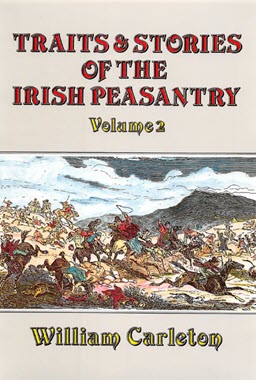
Traits and Stories of the Irish Peasantry, Vol.2
21.6 x 13.8 cm. with all the original illustrative etchings
Traits and Stories of the Irish Peasantry can be considered to be Carleton’s greatest work. It went through a number of transformations before the ‘definitive edition’ was published in 1842-44. This edition was the last that Carleton actually oversaw; thus it is the culmination of his own work on the collection, and for this reason is the edition we publish.
Traits and Stories contains a wealth of illustrations by famous illustrators of the time. They give a good impression of the tales themselves, being crowded with laughing, weeping, fighting, working, playing, dying, and praying peasants in sublime scenery, poverty-stricken cottages, cosy public houses, trim farms, broken-down barns, hillside chapels, hedge schools, and hovels. The inhabitants of Carleton’s world are villains, scholars, horse-thieves, pig-drivers, priests, farmers and shopkeepers. He aimed to show the Irish peasant honestly to the world, choosing simple, strong plots. Contemporary critics praised Carleton most for the ‘light and shade’ of his depictions of Irish character, and much of his power lies in the combination and contracts of light and shade, good and evil, fun and tragedy. He is a writer of great comic genius, as well as being able to convey the horrors of poverty and the peasant life.
He conveys, too, a sense of urgency. What he was describing was an Ireland of his youth that was passing or had already passed, hence his often lengthy annotations about the traditions, tales, customs and pastimes that he even then considered necessary for his readership.
A fine ability to tell a story distinguishes Carleton from many contemporary purveyors of folklore and folk life, and this contributed to his immense popularity in Ireland, England and across the Atlantic in the United States and Canada. There appeared over 50 editions of Traits and Stories, containing some or all the stories of the ‘Definitive Edition’, in the 19th Century alone. No other work of the first half of the 19th Century conveys so well the rural life of the period. Apart from being immensely entertaining, these stories are essential reading for the literary and history student of that period. This is the only complete printing of the ‘Definitive Edition’ presently available.
Volume 2 contains 'Geography of an Irish Oath' – 'The Lianhan Shee' – 'Going to Maynooth' – 'Phelim O'Toole's Courtship' – 'The Poor Scholar' – 'Wildgoose Lodge' – 'Tubber Derg'; or 'The Red Well' – 'Neal Malone'
Barbara Hayley died in a road accident at the time she was Professor of English at St Patrick’s College, Maynooth. Her publications include Carleton’s Traits and Stories and the 19th Century Anglo-Irish Tradition (1983), and A Bibliography of the Writings of William Carleton (1985). Her Carleton’s Alterations to ‘Traits & Stories of the Irish Peasantry’ is not yet published.
More info →

Traits and Stories of the Irish Peasantry, Vol.1
With an Introduction by Barbara Hayley
21.6 x 13.8 cm. with all the original illustrative etchings
Traits and Stories of the Irish Peasantry can be considered to be Carleton’s greatest work. It went through a number of transformations before the ‘definitive edition’ was published in 1842-44. This edition was the last that Carleton actually oversaw; thus it is the culmination of his own work on the collection, and for this reason is the edition we publish.
Traits and Stories contains a wealth of illustrations by famous illustrators of the time. They give a good impression of the tales themselves, being crowded with laughing, weeping, fighting, working, playing, dying, and praying peasants in sublime scenery, poverty-stricken cottages, cosy public houses, trim farms, broken-down barns, hillside chapels, hedge schools, and hovels. The inhabitants of Carleton’s world are villains, scholars, horse-thieves, pig-drivers, priests, farmers and shopkeepers. He aimed to show the Irish peasant honestly to the world, choosing simple, strong plots. Contemporary critics praised Carleton most for the ‘light and shade’ of his depictions of Irish character, and much of his power lies in the combination and contracts of light and shade, good and evil, fun and tragedy. He is a writer of great comic genius, as well as being able to convey the horrors of poverty and the peasant life.
He conveys, too, a sense of urgency. What he was describing was an Ireland of his youth that was passing or had already passed, hence his often lengthy annotations about the traditions, tales, customs and pastimes that he even then considered necessary for his readership.
A fine ability to tell a story distinguishes Carleton from many contemporary purveyors of folklore and folk life, and this contributed to his immense popularity in Ireland, England and across the Atlantic in the United States and Canada. There appeared over 50 editions of Traits and Stories, containing some or all the stories of the ‘Definitive Edition’, in the 19th Century alone. No other work of the first half of the 19th Century conveys so well the rural life of the period. Apart from being immensely entertaining, these stories are essential reading for the literary and history student of that period. This is the only complete printing of the ‘Definitive Edition’ presently available.
Volume 1 contains Professor Hayley’s foreword Carleton’s Auto-biographical Introduction – 'Ned M'Keown' – 'The Three Tasks' – 'Shane Fadh's Wedding – 'Larry M'Farland's Wake' – 'The Battle of the Factions' – 'The Station' – 'The Party Fight and Funeral' – 'The Lough Derg Pilgrim' – 'The Hedge School' – 'The Midnight Mass' – 'The Donagh', or 'The Horse-stealers' – 'Phil Purcel the Pig-Driver'.
Barbara Hayley died in a road accident at the time she was Professor of English at St Patrick’s College, Maynooth. Her publications include Carleton’s Traits and Stories and the 19th Century Anglo-Irish Tradition (1983), and A Bibliography of the Writings of William Carleton (1985). Her Carleton’s Alterations to ‘Traits & Stories of the Irish Peasantry’ is not yet published.
More info →

Orders of Knighthood, Awards and the Holy See
Edited and Revised by Peter Bander van Duren
ISBN: 978-0-905715-26-1
23.4 x 15.6 cm. 336 pp. illus with 24pp colour illus and many b/w throughout the text
What follows is from the jacket of the third edition (published 25 October 1985). Although superseded by Peter Bander van Duren's magisterial work of a similar name, Orders of Knighthood and of Merit (1995), we still have copies of every edition of Archbishop Cardinale's work for sale. Details of the earlier editions can be found at the bottom of this page.
This authoritative work deals not only with the role of the Holy See in conferring Orders of Knighthood and awards but also with the Holy See's attitude to State, Crown and Dynastic Orders of Knighthood. Its relationship to most ancient Orders goes far deeper than mutual recognition: they were founded by Papal Brief and at the Holy See's initiative.
This work goes beyond the scope of an authoritative, historical, juridical and practical compendium: it shows clearly the Holy See's role as mater et magistra of all ancient Orders of Knighthood. The author strikes a most serious note when he clarifies the Holy See's uncompromising attitude towards self-styled orders of knighthood; for obvious reasons the attitude adopted by the Holy See towards individual orders usually makes the difference between international recognition and rejection.
The five Pontifical Orders of Knighthood, the Orders o Christ, of the Golden Spur, of Pius IX, of St Gregory the Great, and of Pope St Sylvester, the Sovereign Military Order of Malta, the Equestrian Order of the Holy Sepulchre (which is under the patronage of the Holy See), as well as the Teutonic Order, a former Religious Order of Knighthood which is no longer an order of chivalry, are dealt with in depth. The three Pontifical Awards, the Golden Rose, the Cross Pro Ecclesia et Pontifice, and especially the Medal Benemerenti (with the special medals struck as Benemerenti Medals which were awarded for a specific purpose or for a limited time only), have been placed in their rightful positions among international decorations of merit. An extensive section deals with the Pontifical Medal, which is often given by the Pontiff as a sign of his special favour.
The most important Catholic dynastic orders, such as the Noble Order of the Golden Fleece (of both Austria and Spain, and particularly the new rules of conferment of the Spanish Order), the Sacred and Military Constantinian Order of St George (it and the Most Noble Order of the Garter being the most ancient and important Orders of Knighthood under the patronage of St George, the Orders of the Annunziata, SS. Maurice & Lazarus, St Januarius, as well as the less exalted Catholic Orders that are still flourishing, are seen united behind the Supreme Pontiff and the Holy See. All Catholic-founded Orders, both those that have remained Catholic in character and those that became Crown or secular State Orders, were founded by Papal Brief; even behind the Iron Curtain there exists in Poland a Catholic-founded Order which, although suppressed in its country of origin, because of international law flourishes outside Poland, and the Grand Master, a President-in-exile, assumed responsibilities that are recognised by the international community. True chivalry transcends politics, ideologies and -isms.
The extensive lists of extinct Catholic Orders are of particular interest to layman and scholar alike, as they have been used for the setting-up of legions of self-styled and fantasy orders over the years.
[from the second edition: On 24 March 1983 the author died in Brussels. Before entering hospital early in February for an operation from which he never regained full consciousness, he asked his friend and collaborator, Peter Bander van Duren to ensure publication of the book on 25 March 1983, to coincide with the inauguration of the Holy Year.]
After the tragic death of His Excellency Archbishop Cardinale, on the day before publication of the first edition of this work, it became obviously that much work and revision remained to be done. Peter Bander van Duren was asked to become the Reviser and Editor of this work, which clearly and unambiguously expresses the Holy See's attitude to, and views on, the Orders of Knighthood. Sovereigns, Grand Masters, and Chancellors of all the principal Orders in the world that come within the sphere of the Holy See's magistral and maternal influence have given their wholehearted cooperation. The result is the most authoritative work ever written on the subject, prologued and endorsed by His Eminence the Papal Secretary of State, Agostino Cardinal Casaroli, and graciously approved by the Supreme Pontiff, qui sub Deo Fons est Honorum.
Earlier editions of Orders of Knighthood, Awards and the Holy See.
These are not officially in print, but as there are a few copies left anyone interested in purchasing a copy of either edition should get in touch with Colin Smythe Limited. There were considerable changes in the second and third editions, not only to the text, but in the illustrations, which makes them all of interest to the collector.
1st edition, published 25 March 1983
ISBN 0-905715-21-7 332pp.+ 20pp. in colour £35.00
[This edition is inaccurately listed in the book as having 0-905715-12-8 as its ISBN (International Standard Book Number), but this number had already been allocated to the limited edition of Archbishop Heim's Heraldry in the Catholic Church, and therefore had to be changed.]
2nd edition, published September 1984
edited and revised by Peter Bander van Duren
ISBN 0-905715-23-3 334pp + 20pp. in colour £35.00
More info →
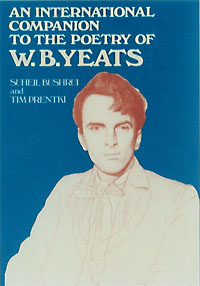
An International Companion to the Poems of W. B. Yeats
ISBN: 978-0-86140-193-2
21.6 x 13.8 cm 255 pp. 1989
W.B.Yeats is one of the most important and widely-read poets of the twentieth century, occupying a central position in literature courses throughout the world. Yet he is often presented in critical works as a ‘difficult’ poet who can only be understood by reference to other writings that must be used as keys to unlock the mysteries of his work. It is the belief of the authors of this book that the poetry must be approached on its own terms, and its meanings established in as simple a way as possible before these texts can be enriched by knowledge of the biographical, historical, philosophical or aesthetic contexts.
This book is an essential companion to the poetry of Yeats for students in every country where his work is known. It sets out to meet the demands both of those whose first language is English, and of those for whom it is their second. Consequently the core of this volume is a detailed study of some ninety poems which cover all phases of Yeats’s poetic development. Each poem is provided with a summary, glossary and commentary, based on the primary meaning. The poems are also set in both the immediate context of the collections in which they were first published, and the wider context of the evolution of Yeats’s art and philosophy.
The Companion has a general commentary section dealing with Yeats’s style, his symbolism, his vision, the people and places that appear in his works, and the role of magic, myth, legend, history, civilization, nationalism and politics in the poems. There is also a useful list of recommended works, and basic texts.

James Joyce: an International Perspective
21.6 x 13.8 cm. xiv, 301 pp. 1982 Irish Literary Studies series (ISSN 0140-895X) volume 10
Published to mark the centenary of Joyce's birth, this collection has a foreword by Richard Ellmann, a message from Samuel Beckett, and essays by Bernard Benstock, Paul & Sylvia Botheroyd, Terence Brown, Suheil Bushrui, Paul van Caspel, Dominic Daniel, Phillip Herring, Declan Kiberd, Augustine Martin, Vivian Mercier, David Norris, John Paul Riquelme, Charles Rossmann, Ann Saddlemyer, Thomas F.Staley and Francis Warner, as well as poems by Suzanne Brown, Suheil Bushrui, John Montague and Gearóid Ó Clérigh, and a chronology. It covers every aspect of Joyce's work, with essays on each of the major works, on his poetry, and studies on various aspects of his life, the influence of Rimbaud, Joyce's connections with the Irish Dramatic Movement, and Joyce in Dublin, as well as essays on Joyce scholarship up to the date of publication.
'All in all, a rewarding compilation, rarely arid, and frequently vivacious.' Sunday Tribune
'an excellent book, one of the most provocative and rewarding in the current centenary-year cornucopia.' Books Ireland'
CONTENTS<br
A Message from Samuel Beckett<br
In Memoriam Sir Desmond Cochrane 1918-1979<br
Foreword: JOYCE AFTER A HUNDRED YEARS. Richard Ellmann<br
Acknowledgements<br
Introduction. Suheil Badi Bushrui and Bernard Benstock<br
JAMES JOYCE - NÓ SÉAMAS SEOIGHE. Gearóid Ó Clérigh<br
DUBLIN OF DUBLINERS. Terence Brown<br
THE READER'S ROLE IN A PORTRAIT OF THE ARTIST AS A YOUNG MAN. Charles Rossman<br
EXILES: A MORAL STATEMENT. Dominic Daniel<br
ON THE NATURE OF EVIDENCE IN ULYSSES. Bernard Benstock<br
JOHN EGLINTON AS SOCRATES: A STUDY OF `SCYLLA AND CHARYBDIS'. Vivian Mercier<br
TWISTS OF THE TELLER'S TALE: FINNEGANS WAKE. John Paul Riquelme<br
THE POETRY OF JAMES JOYCE. FRANCIS WARNER<br
JAMES JOYCE. John Montague<br
A TURNIP FOR THE BOOKS: JAMES JOYCE, A CENTENARY TRIBUTE. David Norris<br
SIN AND SECRECY IN JOYCE'S FICTION. Augustine Martin<br
THE VULGARITY OF HEROICS: JOYCE'S ULYSSES. Declan Kiberd<br
NIGHT FOX: FOR JAMES JOYCE. Suzanne Brown<br
JOYCE AND RIMBAUD. AN INTRODUCTORY ESSAY. Phillip Herring<br
JAMES JOYCE AND THE IRISH DRAMATIC MOVEMENT. Ann Saddlemyer<br
THE WANDERS: FOR JAMES JOYCE. Suheil Bushrui<br
JOYCE STUDIES IN THE NETHERLANDS. Paul van Caspel<br
JOYCE IN GERMANY AND SWITZERLAND. Paul and Sylvia Botheroyd<br
JOYCE IN THE ARAB WORLD. Suheil Bushrui<br
FOLLOWING ARIADNE'S STRING: TRACING JOYCE SCHOLARSHIP<br
INTO THE EIGHTIES. Thomas F.Staley<br
CHRONOLOGY. Suheil Bushrui<br
Notes on Contributors<br
Index
More info →
Kahlil Gibran of Lebanon: A Re-evaluation of the Life and Works of the Author of ‘The Prophet’
ISBN: 978-0-86140-279-3
21.6 x 13.8 cm.
Kahlil Gibran of Lebanon is a guide for all those interested in the life and work of Kahlil Gibran who want further information, be they general readers or scholars.
It explains the fascinating world of the author of The Prophet which is one of the most celebrated works of the twentieth century. Modelled on Gibran’s own writings, simple and concise in presentation, the first half of this work is devoted to significant events in Gibran’s life. It provides the reader with the necessary back ground to his writing and painting, with particular reference to the individuals and and works that have been major influences. These are further explored in the second half, which is a critical study of Gibran’s work and contribution to the literature of the world.
Suheil died in September 2015. Obituaries can be found at http://ysnews.com/news/2015/09/suheil-badi-bushrui and at http://www.baltimoresun.com/news/obituaries/bs-md-ob-suheil-bushrui-20150927-story.html, https://arabhyphen.wordpress.com/2015/09/10/suheil-badi-bushrui-passes-away-1929-2015/ and elsewhere.
CONTENTS
Introduction
PART 1, HIS LIFE: Family background and early years - Kahlil Gibran and Mary Haskell - Early career in Boston, Paris and New York - Maturity - Last years.
PART 2, HIS WORK: Early Arabic writings - Influences and parallels in the mature works - Mature works up to The Prophet - The Prophet - Last works.
Notes.
Bibliography
More info →
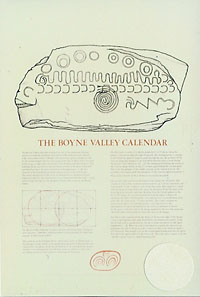

Kinvara, A Seaport Town on Galway Bay
ISBN: 978-1-873821-07-7
18.5 x 23.5 cm, 120 pp. 94 b&w photographs
A record, in image and word, of a coastal community's social and economic life, its traditions and the changes it has experienced since the late 19th century. The volume includes photographs taken between the 1890s and the 1960s which offer glimpses into an era when Kinvara was a busy port and market town, yet working and living at a slower pace – that of horse carts, sailing boats and manual labour. The explanatory captions which accompany the photographs contain details on folklore, traditions and local history. Quotes and anecdotes capture the wit and humour of the Kinvara people. The book's introduction places the town's development in a wider historical context.
'This book is first rate and recommended to all, even those who have never heard of Kinvara. A unique selection of historical photographs and a splendid compilation of locally sourced information. The photographs, spanning the period 1880 to 1960, reflect the lives of Kinvara's people before huge social and economic changes produced different moulds, imported patterns, new shadows for the same substance. This is a moving book.' Connacht Tribune
This book is full of information covered by the Kinvara Guide & Map. To go directly for information on the Kinvara Map Click Here
More info →

William Carleton, the Authentic Voice
21.6 x 13.8 cm. l, 455 pp. 2006 Irish Literary Studies series (ISSN 0140-895X) volume 53
The William Carleton Summer School is one of the most important literary festivals on the island in that there are very few that make a point of studying an aspect of Ireland before the Great Famine. William Carleton (1794-1869) is the greatest author to have written about the Irish peasant and the Ireland of the period immediately preceding it: he enables the reader to think back past the Famine into the culture – particularly the peasant culture – of that time, confused, rich, tortured, bilingual, that made him as a writer.
Enjoying immense popularity during his lifetime, his popularity dwindled but a century after his death it began to revive, not least because of the influence of the Summer School. The lectures given at the School and revised for publication in William Carleton, The Authentic Voice provide ample evidence that he was one of the greatest entertainers of Irish literature in English.
This volume also contains contemporary portraits of Carleton, reproduces previously unpublished letters and documents, a chronology, publication history of his writings, provides fine line illustrations by Sam Craig and detailed maps of the countryside he loved and wrote about, so this is an indispensable book for everyone interested in Carleton and pre-Famine Ireland.
Edited by Gordon Brand, the collection contains contributions by Gordon Brand, Terence Brown, Brian Earls, Peter Denman, Owen Dudley Edwards, Marianne Elliott, Thomas Flanagan, Roy Foster, Maurice Harmon, Seamus Heaney, Eamonn Hughes, Jack Johnston, John Kelly, Declan Kiberd, David Krause, Robin Marsh, John Montague, Pat John Rafferty, Sean Skeffington, Barry Sloan, Norman Vance, and Robert Welch.
More info →

Pater in the 1990s
ISBN: 978-0-944318-05-8
Walter Pater (1839-1894) was one of the Transition Era's most influential figures. In this collection of essays, distinguished scholars continue research into his life. Subjects are included for the apprentice as well as the expert: from a scandal during Pater's Oxford days, to the influences upon him by Wordsworth and Arnold, and in turn to his influence upon Hopkins and Joyce. Contributors include: Billie A. Inman, Gerald Monsman, J.P. Ward, Lesley Higgins, F.C. McGrath, Paul Tucker, Richard Dellamora, Hayden Ward, J.B. Bullen, M.F. Moran, Bernard Richards, Anne Varty, Jane Spirit.
More info →
All Cultivated People. A History of the United Arts Club, Dublin
ISBN: 978-0-86140-266-3
21.6 x 13.8 cm. xii, 296 pp. + 16pp. with 33 illus.
Founded in 1907, the history of the Club reflects the creative life of the city and nation, with a membership of many of the leading literary and artistic figures of the last eighty years. Patricia Boylan chronicles the ups and downs it suffered, how it was affected by historical events, and describes the often colourful lives of its more famous members.
Contents: Genesis – The People and the Place – Celebrated Names – Limited Company – An Auspicious Year – Minute by Minute – A Shameful Year: 1913 – Sad Goodbyes – The Club in Wartime: 1914-1915 – Rebellions: 1916 – The Real Irish? 1916-1918 – Business as Usual: 1919-1920 – A Neutral Zone: 1921-1922 – Carrying On: 1923-1924 – Coming and Going: 1925-1929 – Betty Bolts – A Cold Eye: 1933-1939 – The End of an Era – Changing Times – Doldrums – The Latest Chapter

Selected Plays of Dion Boucicault
Chosen and Introduced by Andrew Parkin
The fourth volume of the Irish Drama Selections series (ISSN 0260-7962), General Editors: Joseph Ronsley and Ann Saddlemyer.
21.6 x 13.8 cm. 416 pp. 2009 2nd, enlarged edition
Contains: London Assurance, The Corsican Brothers, The Octoroon, The Colleen Bawn, The Shaughraun, Robert Emmet, bibliographical checklist. plus Boucicault's "'Canterin' Jack' - A Sketch from Life. How The Shaughraun was originated'.
Dion Boucicault was a prominent playwright and prolific adapter of foreign plays and novels. He is known and loved especially for his high melodrama. Extremely popular on the Victorian commercial theatre for over forty years, his plays today still provide enjoyment to all audiences Born in Dublin, he achieved his first West End success with London Assurance in 1841. His work frankly catered to contemporary taste and fell rapidly into neglect after his death in 1890, but his lively observation of humanity in many moods, and his unerring sense of what works on the stage, have led his plays in recent years to successful revivals in Dublin, Belfast, Chichester and London, perhaps the most notable being the National Theatre's production of The Shaughraun starring Stephen Rea in the title role.
The works chosen for this volume illuminate Boucicault's consummate craft as a writer for the theatre in the age of actor-managers and melodrama. They also remind us of that Irish verve, charm and adroitness which made him the most popular playwright of his generation on both sides of the Atlantic. Arguably the father of both the Irish and American drama, his characteristic plotting and taste for sensation suggest that another of his heirs was the early movie industry.
This volume includes the great success of Boucicault's youth, London Assurance, together with his preface to the first edition; his durable version of the melodrama The Corsican Brothers; the exciting American plantation play The Octoroon, with both its endings; and three of his Irish plays, The Colleen Bawn, Robert Emmet, and The Shaughraun, to which has now been added his article on Cantherin' Jack, his inspiration for that play's title role. A selected bibliographical checklist, dates of first performances and cast lists are given, as are the songs, music and a glossary for the Irish plays.
The present selection from Boucicault's vast opus is chosen and introduced by Andrew Parkin. Andrew Parkin is Professor Emeritus of the Chinese University of Hong Kong and Honorary Senior Tutor of Shaw College. An Honorary Life Member of the Canadian Association for Irish Studies and Adviser to the Chinese Academy of Social Sciences in Beijing, he belongs to a number of other international scholarly organisations. A member of the Canadian Writers’ Union, he is also adviser to the Canadian Chinese Writers’ Association. Residing now in France, he is President of the Paris Decorative and Fine Arts Society. He publishes scholarly books, mainly on drama, as well as original poetry, and short fiction.
More info →
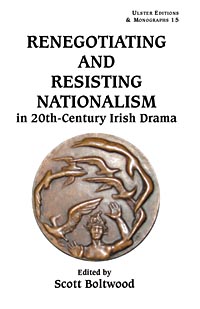
Renegotiating and Resisting Nationalism in 20th-Century Irish Drama
21.6 x 13.8 cm xiv, 211 pp. 2009 Ulster Editions & Monographs series (ISSN 0954-3392) volume 15
The essays in this collection seek to refine our understanding of the often polyvalent and conflicted engagement that Irish dramatists have entered into with nationalism, a cultural and political movement that they have often attempted to simultaneously resist and renegotiate.
These nine essays construct a genealogy of dissent, of loyal opposition, revealing the apprehension and dissatisfaction with which the twentieth century’s most influential playwrights have sometimes viewed the Irish state, from its emergence in the early 1900s to its maturity at the century’s end. The articles on W.B. Yeats, Augusta Gregory, J.M. Synge, and Sean O’Casey reveal the early Abbey Theatre’s struggle to critique the failures of and influence the development of the early state and its proscriptive brand of nationalist Irishness. The essays exploring the later plays of Samuel Beckett, Brian Friel, Frank McGuinness, Anne Devlin, Christina Reid, Marie Jones, and Marina Carr expose both the conceptual and political failures of mainstream Irishness in the second half of the twentieth century to satisfy the material or political aspirations of people on either side of the Irish border. While many of this collection’s essays share a common postcolonial interpretive strategy, individual articles also employ the strategies of ecocriticism, social anthropology, structuralism, feminism, and nationalist theory. The fifteenth volume in the Ulster Editions and Monographs series
CONTENTS
Scott Boltwood. Introduction
Colonialism and the Free State:
Hyangsoon Yi. The Traveller in Irish Drama and the Works of J.M.Synge and Seamus O’Kelly
Barbara Suess. Individualism and the Acceptance of Other: Yeats and Where There is Nothing
Scott Boltwood. ‘I keep silence for good or evil’: Lady Gregory’s Cloon plays and Home Rule
Paul Cantor. O’Casey’s Juno and the Paycock and the Problematic Freedom of the Irish Free State
The Republic and the North
Paul Davies. Earthing the Void: Beckett, Bio-regionalism, and Eco-poetics
Shaun Richards. Brian Friel: Seizing the Moment of Flux – Ros Dixon. Chekhov Bogged Down? Tom Kilroy’s version of The Seagull
Susan Cannon Harris. Her Blood and Her Brother: Gender and Sacrifice in Frank McGuinness’s Carthaginians
Rebecca Pelan. Two’s Company, Three’s a Community: Women’s Drama from Northern Ireland
Maria-Elena Doyle. ‘What Sort of Monsters Must We Have Been’: Irishness and the Gothic in McDonagh, Carr and McPherson
Notes – Bibliography – Contributors – Index
Front cover illustration. The Irish Academy of Letters' Gregory Medal, designed by Maurice Lambert (1901-1964) who called it 'Aengus and the Birds', although Yeats preferred the title 'Inspiration'. About seventeen copies were cast in bronze in 1934, and the mould destroyed. As originator of the project, W. B. Yeats was given one copy by Lambert. Yeats later presented one to Patrick McCartan, the major contributor to its cost, one was bought by the Royal Mint, and fifteen were for presentation by the Academy. These were lodged in a box in the Bank of Ireland, College Green. The actual recipients of the Medal were W. B. Yeats, George W. Russell ('AE'), and Bernard Shaw (all of whom were awarded it in 1935), Douglas Hyde (1937), E. Å’. Somerville (1941), Eoin MacNeill (1944), Stephen Gwynn (1949), Padraic Colum (1953), Seumas O'Sullivan (1957), Micheál mac Liammóir(1960), Austin Clarke (1968), Mary Lavin (1974), Arland Ussher (1975), and John Hewitt (1984). Yeats's intention was that once the medals had all been used, the Academy would commission a new design for future presentations of the Medal. The Academy unanimously agreed on 11 July 1974 that Peadar O'Donnell and Mary Lavin should both be awarded the Medal, but there is no record that O'Donnell ever received it. It is possible that he refused the honour. After Sean J. White removed the medal for Hewitt from the Academy's box at the Bank in 1984, he noted that only one remained. The Academy's archives are now in the National Library of Ireland (MSS 33,745-33,746).
More info →