

The House of Peter: The History of the Vatican
21.6 x 13.8 cm. viii, 145 pp. + 8pp. illus
ISBN: 978-0-905715-33-9
The author of this book has succeeded where many have failed: he has written the history of the Vatican, the House of Peter, from the days the first Christian martyrs were executed on the Vatican Hill, to the present, and he presents us with an account the reader will find difficult to put down.
The book’s outstanding quality is that it complements and enhances the splendid and sumptuous impression the Vatican gives today with St Peter’s Basilica in its centre and surrounded on one side by Bernini’s colonnades, and on the others by the many palaces which serve as residences and museums.
Reading this book we see far beyond the familiar façade of the Vatican: there is nothing boring about this kind of history; for example, the author’s description of the erection of the obelisk in St Peter’s Square makes the reader view that familiar landmark with a far greater understanding of the tremendous feat that was accomplished. Here, and elsewhere, the author’s narrative is complemented by largely unknown illustrations from the Vatican Archives.
Count Antonio Alberti-Poja was ideally placed to write on the subject: he was one of the consultori (member of the Council of State) of the Vatican City State, and Head of the Administrative Council of Peregrinato ad Petri Sedem for foreign visitors to the See of St Peter.
The author’s deep commitment to, and care for, the millions of visitors who come to the Vatican provided the motive, and his position in the government of the Vatican City State gave him the opportunity for his research, but neither would have guaranteed such an absorbing narrative.
To those who have visited the Vatican in the past,, it will bring back memories and probably change many concepts formed by that overpowering edifice that greets today’s visitors and pilgrims. After reading The House of Peter, those who come to the Vatican – for the first time or as seasoned visitors – will see the Holy City in a new light, looking beyond the splendid façade and the other works created by man for the greater glory of God, back through time to that first, small memorial that marked the grave of the rock of the Church, the Apostle Peter.
More info →
Irish Writers and the Theatre
This collection is the second volume in the IASAIL-JAPAN series, which was set up by the Japanese branch of the International Association for the Study of Anglo-Irish Literature.
Many major Irish authors have been dramatists as well as poets and novelists, and perhaps the most famous have gained their fame because of their dramatic output. Over the past three centuries many of the dramatists whose names are remembered have Irish connections - Farquhar, Steele, Goldsmith, Sheridan, Boucicault, Wilde, Synge, Shaw, Yeats, O'Casey, Behan, Beckett, Friel, and Leonard come to mind.
The essays in this collection deal primarily with dramatists of this century, particularly Shaw, Yeats, O'Casey, Behan, Robinson, Beckett and Stewart Parker, but there are more wide-ranging essays – on contemporary fashions in Irish theatre, on O’Casey's influence on modern drama, on the humour of deprivation, and on dramatisations of the life of Jonathan Swift.
The contributors are Eugene Benson, Richard Allen Cave, Emelie Fitzgibbon, Nicholas Grene, Heinz Kosok, Desmond Maxwell, Vivian Mercier, Christopher Murray, Andrew Parkin, Masaru Sekine, James Simmons, Sumiko Sugiyama, Robert Welch and Katherine Worth.

Ze-Ami and his Theories of Noh Drama
ISBN 978-0-86140-214-4 21.6 x 13.8 cm.
For over five centuries the essays of Ze-Ami – considered, with his father Kan-Ami, to be the founder of Noh, the classical dance-drama of Japan – were kept secret. They were not shown to more than one Noh actor in each generation until recently. Though they contain a large number of paradoxes and contradictory statements as well as a great deal of repetition, they were regarded as a Bible by actors in the Noh technique. As repetition was a constant feature in training and in techniques in many arts in Japan, and as paradox had often been used in the search for the truth in Zen, so Ze-Ami's essays were accepted, despite their repetitions, paradoxes and contradictions. They were not. however, easily translatable, and they benefit from being edited.
In this work therefore, Ze-Ami's ideas are dealt with in eight chapters: The History of Noh: Five Groups of Noh Plays: Training: Acting: Writing a Play: Public Tachiai Competitions and Grades of Acting: The Audience: and Hana. This arrangement presents Ze-Ami's ideas with some order and consistency. Relevant sections of eighteen essays by Ze-Ami are translated and discussed. These include Fushi-kaden, Kashū, Ongyoku-Kowadashi-kuden, Kukyō, Shikadō, Nikyoku-Santai-Ningyōzu, Sandō, Fushizuke-shidai Fukyokushū, Yūgaku-Shūdō-Fūcken, Goi, Kyūi, Rikugi, Shūgy-okutokuka, Goonkyoku-Jōjō, Goon, Shūdosho, Kyakurui-ku, and Zeshi-Roku-juigo-Sarugaku-Dangi.
This volume is a most useful introduction to an understanding of Noh history, practice, and technique, for all readers in the West, written as it is by a trained Noh actor..

Yeats and the Noh: A Comparative Study
21.6 x 13.8cm. Irish Literary Studies series 38
W.B. Yeats wrote the plays in Four Plays for Dancers (1921) when he was strongly influenced by Japanese Noh theatre, and was searching for some breakthrough in his efforts to promote poetic drama.
Since then, various books have been published on this topic but, with the notable exception of Richard Taylor, no scholar has been able to cope with both Yeats and Noh. Yeats and the Noh started in a small seminar room in University College Dublin, when both authors took part in productions of The Dreaming of the Bones and Nishikigi with their students. Masaru Sekine directed both plays and Christopher Murray performed in them: they were therefore equipped with live experience as well as their personal expertise in Irish literature and Noh drama.
Professor Augustine Martin introduces the volume, and apart from the main section of the book, Colleen Hanrahan, one of the students who took part in both UCD productions, writes about acting in Yeats’s play; Peter Davidson writes about Yeats, Pound, Rummel and Dulac; and Katharine Worth provides an essay on Yeats, Beckett and Noh. There are 16 pages of illustrations.
This volume is unique in providing detailed analysis of contrasts in theatrical aims, as well as examining why man seeks to explore tragic drama as a means of extending the limits of reality.

My Life and Music
Widely regarded as one of the 20th century’s finest pianists, Artur Schnabel (1882-1951) was especially renowned as an interpreter of Beethoven. In the words of his friend Edward Crankshaw, his performance of the Diabelli Variations in his last years was ‘like looking at the sun without dark glasses’. However, Schnabel also earned high praise for his playing of Schubert, Mozart, and Brahms. Indeed, his later concert repertoire was largely devoted to great composers in the Austro-German tradition. In explanation, Schnabel contended that he wished to play only ‘music that was better than it could be performed’.
His uncompromising, passionate commitment to penetrating the mysteries of the greatest music is clearly revealed in this absorbing, highly readable combination of personal reminiscence and musical manifesto. Not a conventional autobiography, it includes a transcript of 12 autobiographical lectures Schnabel gave to music students at the University of Chicago in 1945. The lectures were followed by informal sessions in which the pianist answered questions from the audience on a wide variety of musical topics. These questions and Schnabel’s revealing, unrehearsed replies comprise the second part of this book, offering rich insight into the pianist’s personality and musical philosophy. The final section, ‘Reflections on Music’, is a talk Schnabel gave on the occasion of receiving an honorary degree from the University of Manchester.
While his approach to music was highly intellectual, and his demeanour on the concert stage formidably serious (he seldom smiled and never played an encore), Schnabel in person was a warm, animated, and stimulating companion. Much of that personal appeal comes across in this book, as the pianist recalls his experiences as a child prodigy in turn-of-the-century Vienna, his family and social background, pianistic training and preferences in the repertoire, his attitude toward the great conductors and composers of the day, thoughts on the teaching of music, and many more topics.
Enhanced by 20 illustrations, including many photographs from the collection of Schnabel’s son, My Life and Music offers an in-depth portrait — in his own words — of one of the twentieth century’s greatest musicians. It will especially appeal to music lovers, but offers a rich reading experience to anyone fascinated by the passion, power and insight of a musician of genius.
Unabridged, this slightly corrected republication of My Life and Music and Reflections on Music was first published by Colin Smythe Ltd in 1970. The present edition has the joint imprint of Dover Publications and Colin Smythe Ltd. It has a Foreword by Sir Robert Mayer and an Introduction by Edward Crankshaw. There are 20 black-and-white illustrations.
More info →

‘Since O’Casey’ and other essays on Irish Drama
In this collection of lucid essays that cover the entire eighty years of modern Irish drama, Robert Hogan writes about the major Irish dramatists of the 20th century and their impact on audiences, and on other playwrights, as well as considering the works themselves. In them he uses a variety of critical techniques, ranging from biography to studies of influence, structure and dialogue, to history and anecdote, and the ill-treatment of several sacred cows.
In addition to essays on such giants as Synge, O'Casey, and Beckett, the book deals with more neglected figures such as W. J. Lawrence and the still insufficiently appreciated George Fitzmaurice and Denis Johnston. It also presents a full critical survey of the years 1963-83 in which exciting writers like Brian Friel, Hugh Leonard and John B. Keane made their mark. The author's style and varied ways of dealing with the subjects make this volume particularly enjoyable, as well as informative, reading.
CONTENTS<br
Preface<br
YEATS CREATES A CRITIC<br
THE INFLUENCE OF SYNGE<br
THERE IS REALISM AND REALISM<br
O'CASEY, THE STYLE AND THE ARTIST<br
O'CASEY, THE STYLE AND THE MAN<br
THE INFLUENCE OF O'CASEY<br
DENIS JOHNSTON'S HORSE LAUGH<br
TRYING TO LIKE BECKETT<br
SINCE O'CASEY<br
A Factual Appendix<br
A Critical Appendix, by W. J. Lawrence, containing his reviews of Birthright by T. C. Murray (1910), The Magic Glasses by George Fitzmaurice (1913), Shanwalla by Lady Gregory (1915), and Juno and the Paycock by Sean O'Casey (1924)<br
Notes<br
Index

Farewell, Victoria! English Literature 1880-1900
Although the Victorian era closed, literally, with the death of the Queen in January 1901, the post-Victorian transition had begun decades earlier. Farewell, Victoria! presents Stanley Weintraub’s engaging perspectives on late-Victorian literature, primarily but not exclusively its fiction, which looked backward to popular antecedents and forward to the societal and technological future.
The early 1880s saw the close of iconic Victorian literary careers—Disraeli, Rossetti, Eliot, Meredith, and Trollope among others. It was also the decade of new reputations that would continue in some cases into the middle of the next century. The 1890s witnessed a plethora of experiments in modernity. The Yellow Book and The Savoy, graphic realism and a redefinition of morals, futuristic prophecy and exotic fantasy would expand taste, enlarge the market for books, and write a finis to leftovers from the past.
Stanley Weintraub (Evan Pugh Professor Emeritus of Arts and Humanities at Pennsylvania State University and Adjunct Professor of English at the University of Delaware) offers more than a dozen critiques of the literature of these two decades, essays from many years collected, revised, and updated in this important addition to the 1880–1920 British Authors series. He is one of the most well-known and respected scholars in the field, author or editor of more than fifty books, many dealing with the Victorians and early moderns, including biographies of Victoria, Albert, Disraeli, Whistler, Shaw, and the Rossettis.
More info →
Walter Pater, ‘Gaston de Latour’: The Revised Text
Scarcely two years after Walter Pater's death, Macmillan & Company published Gaston de Latour; An Unfinished Romance. The author of works critical to the formation of the Transition and Modernist periods set his last novel in the turbulent years following the Reformation. Selected chapters first appeared serially in Macmillan's Magazine and Fortnightly Review, but the posthumous volume edited by Charles L. Shadwell, Pater's long-time friend, remains controversial. For a century readers have seen only a portion of what Pater wrote for Gaston de Latour. Shadwell withheld six manuscript chapters.
Pater's prominence and widening influence in late-nineteenth and early twentieth-century studies makes those unpublished chapters more intriguing than ever. Edited from the holographs and based on definitive material incorporating all known fragments, The Revised Text includes the crucial suppressed chapters. Professor Gerald Monsman's edition, meticulously edited and researched, is surely closer to Pater's own latest version. This comprehensive Gaston de Latour offers what many will see as a work closer to Pater's intention than the book Macmillan printed in 1896.
The Revised Text is notable in other ways, Pater's study of eroticism in his portrait of Queen Marguerite is a significant contribution to gender studies in the late-Victorian period. The Pater of the 1890s is revealed here too. As Monsman says, the “later Pater is in many ways the most interesting of all the successive Paters – certainly wearier, but also more candid, consummately polished artistically, self-consciously aware of a dawning modernism."
Gerald Monsman (University of Arizona) has worked for nearly a decade to bring this authoritative edition to print. His contributions to the field are well known: Pater’s Portraits (Johns Hopkins University Press, 1967), Walter Pater (G. K. Hall, 1977), Walter Pater’s Art of Autobiography (Yale University Press, 1980). Gaston de Latour: The Revised Text is a significant achievement. Scholars and students will find Monsman's Introduction, Explanatory Notes, Diplomatic Transcriptions, Emendations and Variants invaluable.

Fly-fishing, Fact vs. Fiction
This collection brings together Jo Rippier’s writings about fishing, fact and fiction, and in one case ‘dramatic’. He has recorded memorable experiences that occurred during his life in his pursuit of fish, and meeting unusual personalities, such as Mr Justice T. C. Kingsmill Moore (‘Saracen’), and Hugh Falkus, as well letting his imagination provide a number of fictional tales. Together they provide the reader with a variety of enjoyable stories and articles, and some historical illustrations, mostly from Punch, ideal for fishermen with time on their hands.
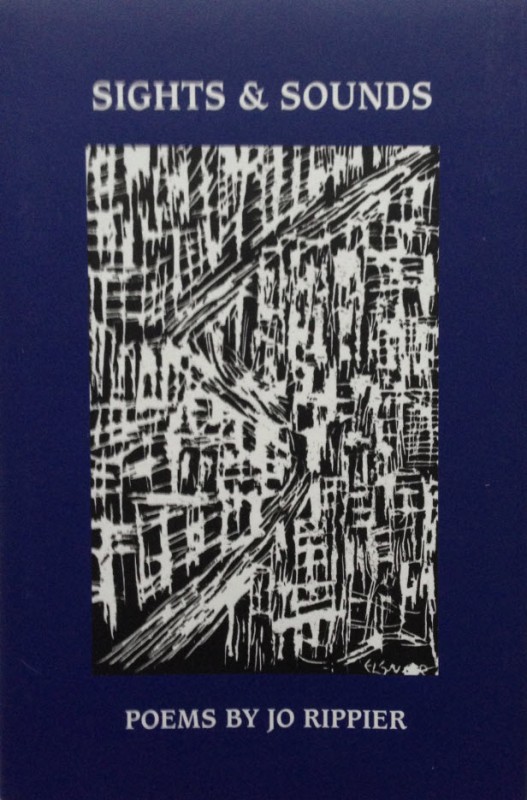
Sights and Sounds
38pp. 20.4cm hbk
The poems in the present collection are largely an attempt to put into words what is registered either in the mind, or when physically encountering the world around. But there are also reflections on what one experiences when looking back on the past.
.
More info →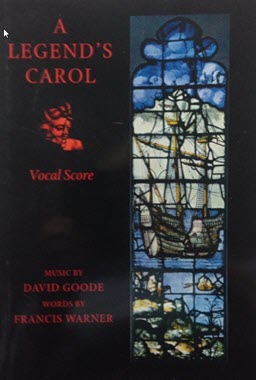
A Legend’s Carol
Vocal Score: 27.0 x 19.0 cm. 72 pages. Paper covers (978-0-86140-498-8) £10.00
Full score: 30.8 x 20.8 cm. 88 pages. Paper covers (987-0-86140-497-1) £15.00
With 11 colour illustrations from the 16th-century windows of King's College Chapel, Cambridge
Score of David Goode's setting of Francis Warner's 1962 Nativity poem, "A Legend's Carol", with a Note on the Poem by Glyn Pursglove.
With a free CD recording, which can be bought separately at https://www.oxrecs.com/ALegendsCarol.html
More info → 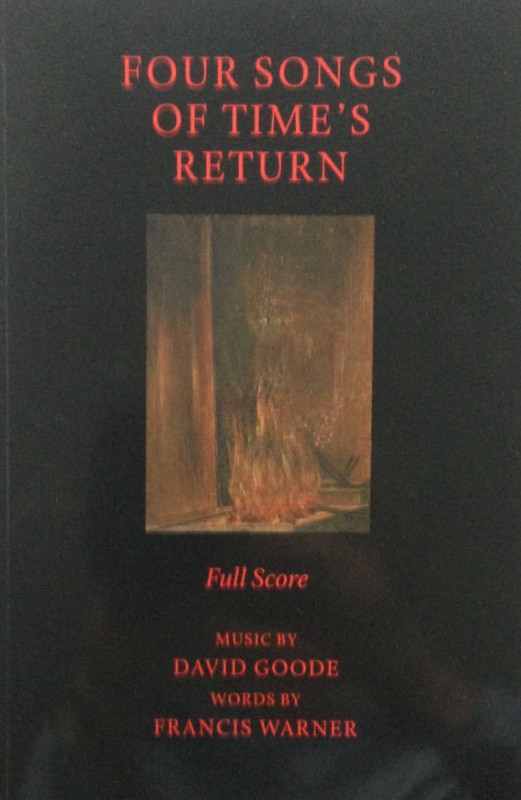
Four Songs of Time’s Return
Vocal Score: 27.0 x 19.0 cm. 64 pages. Paper covers £10.00 (978-0-86140-500-8)
Full score: 30.8 x 20.8 cm. 104 pages, Paper covers £15.00 (978-0-86140-501-5)
With colour illustrations of details of works by Sandro Botticelli and John Piper
Song Cycle. David Goode's setting for soprano and baritone, and piano of four extracts from Francis Warner's poems, the sections titled Fire, Earth, Water and Air. Fire reflects his schoolboy desire to become a blacksmith, during the extremely cold winter of 1946-47; Earth - ‘Amabile’ - is the speech of Simonetta as Primavera from Living Creation, his play on Botticelli and Medici Florence; Water, Summer, recalls the June Concert on the river Cam by Clare Bridge sung by the Cambridge University Madrigal Choir; and Air, the climax of his 1961 poem Perennia, a duet.
With a free CD recording, which can be bought separately at https://www.oxrecs.com/FourSongs.html
More info →

Lady Gregory’s Early Irish Writings 1883-1893
General Editors of the Coole Edition: T.R.Henn CBE and Colin Smythe
Edited and Introduced by James Pethica
23.4 x 15.5 cm. x, 248 pp. + 32 illus.
This sixteenth volume of the Coole Edition contains Lady Gregory’s first writings on Ireland. They include the two surviving versions of her unpublished first attempt at autobiography, 'An Emigrant's Note Book' (1883); three short stories she wrote under the pseudonym ‘Angus Grey’ —'A Philanthropist', 'A Gentleman' and 'Peeler Astore' (1890-91); and her anonymously-issued anti-Home Rule pamphlet A Phantom's Pilgrimage, or Home Ruin (1893). Appendices contain her lyric 'Alas, a woman may not love' (1886) and the poems she sent to Wilfrid Scawen Blunt following his imprisonment in Galway in 1888 for participating in a banned tenant protest against evictions. Also included is the newly-rediscovered text of Sir William Gregory’s prescient 1881 pamphlet on the Land League.
James Pethica’s Introduction sets these works within their biographical, political and creative contexts, charting the imperatives and aspirations driving Lady Gregory’s first sustained efforts as a writer. This remarkable collection throws an entirely new light on the years of her marriage and early widowhood, revealing the foundational influence of Sir William Gregory on her political views and self-conception as a landowner, and detailing the course of her turn to Irish themes and to the life of the Galway world she had grown up in for subject matter. Lady Gregory's Early Irish Writings shows her already finding core elements of her creative voice long before she met W.B. Yeats and emerged to later prominence as a folklore collector, dramatist, and cultural nationalist.
James Pethica teaches Irish Studies, Modern literature, and drama at Williams College in Massachussetts. He is preparing the authorized biography of Lady Gregory for Oxford University Press.
More info →

Horizons: Collected Poems
160pp. 20.4 cm 2018
The poems in this book represent a lifetime's struggle to recognise and come to terms both with the world around, and what is going on in the mind at moments of personal consequence. They also reflect an awareness of the work of writers from the past which, in some cases, may have influenced what appears in this book. There is no attempt to find solutions, but merely to register and search for words which try to present, in accessible language, what the author is feeling.
Some readers' comments:
"I don't think there was a single poem which however fragile or sad its emotion, however delicate or subtle its train of thought, didn't set up a poise and dignity for itself, a sort of tender formal strength."
"I always read the poems aloud, they have an internal music which I enjoy finding."
"You have surpassed yourself, you seem to me to have reached that stage in writing to which I can only apply the word 'exquisite'. Through the years you have refined your writing to the essential, the essence."
"a poetic voice, unmistakenly yours, gentle, altogether unassertive, tentatively exploring its ground, meditatively unfolding a thought, an idea, a feeling, a physical sight or spiritual insight, always taking the reader on an inner journey which leaves him wondering what it was that has suddenly made him calm and reflective."
"And whatever subject you treat, you have an unmistakable voice, not a whit of superfluous verbiage, but precision of a kind of lean clarity. and what stands out above all is what I once called 'tentative philosophy', no dogmatising but careful reflection which takes the subject beyond its immediate appearance into realms of thought and feeling."
"I find your poetry in its content and style reminiscent of Japanese poetry. It is a culture which has paid great attention to detail and careful observation. Appreciation of nature is fundamental to many aesthetic ideals in Japan."
"You are able to convey so delicately emotion, never letting imagery cloud the work."
You have such a way of making the reader see the ordinary in an extraordinary way."
"These poems exemplify in the purest manner your particular strength of catching nature on the wing - or rather gathering, from a fleeting impression or thought, a total ensemble; of turning a natural scene into words, as few or as many as needed, no more, no less, and therefore pure poetry."
More info → 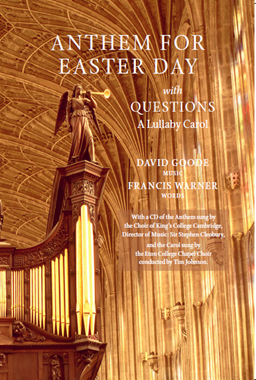
Anthem for Easter Day, with Questions, A Lullaby Carol
48pp. 27.00 × 19.00 cm.
In 2019, Sir Stephen Cleobury retired after half a century of greatly distinguished service to church music.A little part of that, happily, involved conducting and recording the collection of anthems by Francis and myself - and so it seemed fitting to write one more piece for him before his retirement. This piece is the Anthem for Easter Day. (as it happens, Easter remained unmarked in the collection, unless one counts the Anthem for Christ the King.) Francis' text focused on a more personal, less overtly triumphant, quality to the Resurrection story, seen from the view of Mary Magdalen, and my setting tried to reflect that, from the somewhat sombre F minor opening of the first eight lines evoking shades of black and white to the anthem's gentle conclusion in colour and scents of that new sprint dawn. David Goode
With a free CD which may be purchased from OxRecs
‘Questions: A Lullaby Carol’ was first performed during the Eton College Carol Service 2011 by the Chapel Choir. Director of Music: Tim Johnson. The recording was made by the choir on 15 January 2017.
The première of ‘Anthem for Easter Day’ was performed by the choir of King’s College in chapel on 12 May 2019. Director of Music: Stephen Cleobury, Organist Henry Websdale.
Issued in 2019 by OxRecs DIGITAL OXCD-148.
More info → 
BREAKTHROUGH An Amazing Experiment in Electronic Communication with the Dead
In 2021, the 50th anniversary of the first publication of Breakthrough, "What happens after physical death?" is still the big question concerning the nature of existence.
In his groundbreaking work, psychologist Konstantin Raudive experimented using a communication method known as Electronic Voice Phenomena (EVP), whereby deceased communicators appear to send messages and images via computers, radios, televisions and other electronic devices.
In 1959 Swedish artist and filmmaker Friedrich Jurgenson was making a tape recording and during playback he discovered what sounded like a human voice on the tape. He put it down to faulty equipment but when he searched other tapes, he found more voices, which seemed to be messages from his dead mother. Jurgenson recounted the experience in a book titled Voices from Space. The book impressed Raudive and subsequently he and Jurgenson collaborated for a time and encountered more voices.
Later, Raudive undertook his own research amassing a collection of thousands of voice recordings and in 1968 his work was published in German under the title, Unhörbares Wird Hörbar (The Inaudible Becomes Audible).
In 1969 after being approached at the Frankfurt Book Fair, British publisher Colin Smythe asked his colleague Peter Bander to assess Raudive's book with a view to publishing it in English, and, unbeknown to Bander, did his own experiments with positive results.
Since that time Jurgenson and Raudive's experiments have been replicated thousands of times by researchers and enthusiasts all over the world and Breakthrough remains a classic in the genre.
The communicators overriding message? "We are not dead!"
More info → 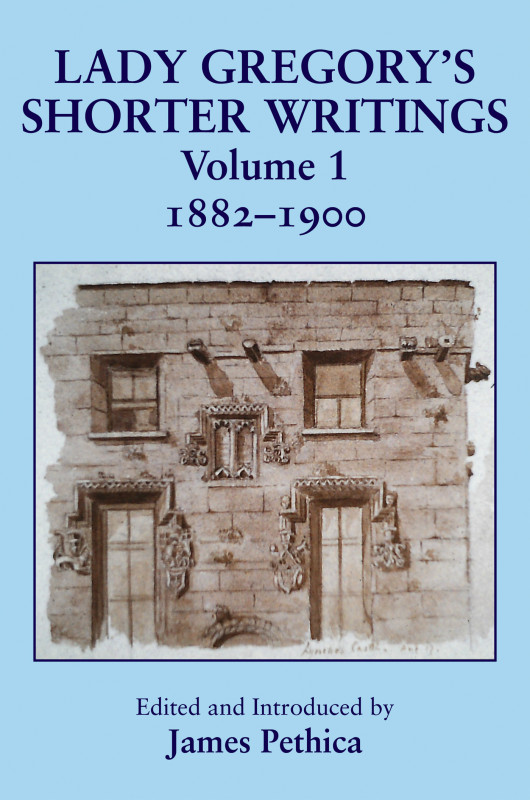
Lady Gregory’s Shorter Writings Volume 1; 1882-1900
General Editors of the Coole Edition: T.R. Henn CBE and Colin Smythe
Edited and Introduced by James Pethica
23.4 x 15.5 cm. x, 298 pp.
This first volume of Lady Gregory’s Shorter Writings covers the years 1882-1900. Edited and introduced by James Pethica, whose authorized biography of Gregory is in preparation for Oxford University Press, it makes available all the previously uncollected work she wrote for publication during the period, including newly-discovered articles, material that was never printed, and items that appeared anonymously or pseudonymously.
The volume begins with her first independent publication, Arabi and His Household (1882), written in support of the deposed leader of the Egyptian Nationalist rebellion, who faced likely execution by the British. Gregory's travel journalism and other occasional writings of the 1880s were sufficient to catch the attention of Oscar Wilde, who praised her "clever pen" and invited her to contribute to The Woman’s World, the periodical he edited. Also included here are more than a dozen unpublished poems, often highly personal, written during her travels to India and Ceylon, along with the sequence of twelve sonnets she gave Wilfrid Scawen Blunt in 1883 as they ended their clandestine affair. Writings from the early 1890s include one short story set in Italy, and another with a plot her friend Henry James briefly considered using as the basis for a novel.
Gregory’s publications from the mid-1890s offer sharp new insight into her growing interest in Irish folklore, her emergence as an Irish nationalist, and her enthusiasm for the Irish language and the Gaelic League. Key works include a previously unpublished pamphlet on the inequities of Irish taxation, and Gregory’s first substantial folklore essays. The last writings in the volume register her increasing centrality in the emergence of the Irish Literary Theatre, her developing friendship and collaborations with W.B.Yeats, and her growing confidence in her creative voice as she began her rise to prominence.
James Pethica teaches Irish Studies, Modern literature, and drama at Williams College in Massachusetts. He is preparing the authorized biography of Lady Gregory for Oxford University Press.
More info → 