

The Dramatic Works, Volume 1
ISBN: 978-0-901072-52-8
12.6 x 13.8 cm. iv, 395 pp. 1977 Volume 1 of the Dramatic Works of Denis Johnston
Containing: General Introduction, The Old Lady Says `No!' and 'A Note on what happened', The Scythe and the Sunset, Storm Song, The Dreaming Dust, 'Strange Occurrence on Ireland's Eye' and accompanying prose writings about these plays.
More info →

The Voyage of St. Brendan
Written in about AD800, Navigato Sancti Brendani Abbatis is one of the most famous and enduring stories of western Christendom. While the question whether Saint Brendan reached America remains a subject of controversy, the tale itself is of great interest – a strongly integrated text which derives from several centuries of Irish literary tradition. The text is illustrated by the relevant woodcuts from a German version of the tale which was printed in Augsburg in 1476.
John J. O’Meara has here translated one of the most famous and enduring stories of western Christendom, the Navigatio Sancti Brendani Abbatis, written in Ireland perhaps as early as the year 800. While the routes of Saint Brendan’s journeys remain a subject of controversy, the tale itself is of great interest – a strongly integrated text which derives from several centuries of Irish literary tradition.
The Voyage of Saint Brendan presents Professor O’Meara’s translation of the only scientific edition of the original Latin text, with his introduction, and is illustrated by the relevant woodcuts from a German version of the tale, Sankt Brandans Seefahrt, printed in Augsburg in 1476. When this version was published By the Dolmen Press in 1975 it was acclaimed by critics on both sides of the Atlantic:
‘It’s a fascinating book’ (Quidnunc, The Irish Times); ‘has the simplicity, the joyous naiveté, the suspension of reality which captivate the most sceptical reader of the Franciscan Fioretti and the same pervasive innocence and fiery spirituality’ (The Irish Independent); ‘valuable both as scholarship and literature’ (The Malahat Review); ‘A worthwhile book in every respect‘ (Choice, U.S.A.).
It was designed by Liam Miller.
More info →


Limerick Lace: A Social History and a Maker’s Manual
ISBN: 978-0-86140-368-4
29.6 x 21.0 cm. 91 pp. with 115 illus.
Limerick is probably the most famous of all Irish laces. When President Kennedy came to Limerick in 1963 the Lord Mayor presented him with a Christening robe of the lace, and other important visitors have been delighted to receive gifts of this prestigious material.
The making of this form of lace became possible when machine-made net became readily available, as it is a form of embroidery on net, being either chain-stitch (tambour) or darned net (also called run-lace), or a combination of both techniques.
This volume is produced in the same format as Carrickmacross Lace and Mountmellick Work, and is in three sections. The first deals with the invention of Limerick lace and its history, the second with Mrs Florence Vere O'Brien and her contribution to Limerick and its lace-workers, while the third deals with the techniques used in making Limerick Lace, the materials and designs, preparation and sewing, and filling and embroidery stitches.
The book contains many illustrations of fine piece of lacework from the authors' collections, as well as pictures of prizewinning examples from photos in the possession of the Royal Dublin Society.
About the authors
Nellie O Cléirigh was born in Clonmel, County Tipperary, and is a graduate of University College Dublin, in History and Irish, but she also attended embroidery classes at the Dublin School of Art. She formed a collection of old Irish lace which has been exhibited in Ireland and abroad, and this led to her study of the history of lace making in Ireland and of the people who contributed to it development. Publication of her Carrickmacross Lace in 1985 has led to lectures, publications and broadcasts in Ireland and abroad. She worked as a civil servant in Dublin until her marriage to Cormac, when she established a handicraft business in Dublin, and later a craft shop in Knightstown, Valentia Island, Co.Kerry. Her Valentia, A Different Irish Island was published in 1992.
Veronica Rowe (née Hardy) grew up at Walterstown, Crusheen, Co. Clare, not far from the home of her maternal grandmother, Florence Vere O'Brien (whose work for the Limerick lace industry is told in Section Two of this book). She trained as a textile designer in Scotland and worked with several handweaving firms in Ireland. She gained an Arts Council scholarship to France and Italy, and a Diploma in the History of European Painting. She is a past chairman of the Irish Guild of Spinners, Weavers and Dyers, and was its representative on the Crafts Council of Ireland. She is a member of the Arts Committee of the Royal Dublin Society, of its Crafts Sub-committee, and of the committee that in 1988 organised an important lace exhibition in Dublin (later displayed in Lisburn Museum, Co.Down), at which her collection of Florence Vere O'Brien's lace was shown. She organised an exhibition of Clare Embroidery in County Clare and County Down, and has written articles and a booklet on the subject.
More info →

The Harvest Festival
ISBN: 978-0-86140-045-4
22.9 x 14.5 cm. xvi, 91 pp. 1979
The Harvest Festival is Sean O’Casey’s earliest extant play. Written in about 1918 or 1919, it was the second play that O’Casey offered the Abbey Theatre. It was turned down, but he kept the manuscript and it now forms part of the extensive O’Casey archive in the Berg Collection of the New York Public Library. It has never been performed, and this is its first publication in the U.K. and Ireland, following on its U.S. publication by only a few months.
The plot focuses on the turmoil of an outside world of strikes and riots converging on a Dublin city church in the midst of its preparations for a harvest festival. Set in 1913, it deals with Irish workers’ battles against economic oppression and religious hypocrisy, with that vital combination of passion, humour and pathos that distinguishes O’Casey’s later plays. It is a rich melodrama of class struggle, with ironically pointed clashes involving representatives of Church, Employers and Labour.
An incomplete revision of the first act, which O’Casey kept with the original manuscript, is included as an Appendix to show the direction the playwright might have gone had he chosen to revise the entire play: as it is, students of drama will see in The Harvest Festival the seeds of O’Casey’s later works, and the lineal descendants of its characters appear in Red Roses for Me, The Drums of Father Ned, and The Bishop’s Bonfire.
Eileen O’Casey has contributed a foreword entitled ‘Clench Your Teeth’, and John O’Riordan has written an Introduction.
A three-quarter leather edition with wood veneer panels, marbled endpapers, top edges gilt, intended to be limited to 50 copies, ISBN 0-86140-052-6, signed by the writers of the Foreword and Introduction, Eileen O'Casey and John O'Riordan, was also published, but of the 50 copies only 30 were actually bound.
More info →
Cock-A-Doodle Dandy
Edited, with an introduction and Notes, by David Krause
ISBN: 978-0-86140-342-4
21.6 x 13.8 cm. xxiv, 119 pp. 1991 Irish Dramatic Texts 5
Regarded by O'Casey as his best play, this dark comedy about Irish rural life at mid-century symbolises the struggle between repression and liberty. Although the final victory is to the forces of oppression (in the shape of Father Domineer and his gombeen men) the play is highly amusing. Initially it was regarded as anti-Catholic and suppressed in Ireland and New York. This publication is the only definitive edition available, having been compared with the original manuscript (in the New York Public Library). Professor Krause is the official biographer of O'Casey.
Co-published with the Catholic University of America Press, Washington, D.C.
More info →

Planting Out
ISBN: 978-0-86140-440-7
22.5 x 15.0 cm vi, 257 pp. 2001
The Second of The Borough Novels
What does it feel like to be turned into a saint? Well, a lot of fuss and bother, probably. So the corpse of the ancient Gardener, cooling on a slab in The Borough's secret Abbey, isn't waiting to find out. It's happy being dead. All it wants is peace. That and to be far beyond the reach of its Abbot's unholy ambitions.
And then there's the microchip that knows everything there is to know. But it's lost and cold and dying in the winter's ice and snow. The last of its transistors begins to flicker out. Is there anything at all that can save it now?
Planting Out is the second of the Books of The Borough by Gerry O’Brien. The soap saga continues, open and read...
Soldier, sailor, dolls' house maker, Gerry O'Brien has been them all though not necessarily in that order, it's just the way it scans best. And that in itself should tell you all you need to know about him, and maybe more than you want. (That and the fact that, arguably, he begins too many sentences with conjunctions.)
But of course there have been other things too – lorry driving, stacking shelves, bread delivery, scrapes with death. Though that was all years and years ago. Now he's been a full-time writer for longer than anything else except a husband, a father and alive. And his two children are lovely a lot of the time. And he is married to an extraordinarily patient woman who is also lovely more on than off.
e was educated, yes.
Getting The Books of The Borough off the ground is nearly the most exciting thing that's ever happened to him. And if that sounds unlikely then try getting your own books published and you'll see.

Cleaning Up
ISBN: 978-0-86140-416-2
17.9 x 11.2 cm. The first of The Borough Novels
The Diamond is a psychopath. It wants to rule the world and it’s not messing about. It’s a Diamond that means business. And there’s only one man who can stop it.
Just one man? But surely. . . There has to be. . .
Dream on.
Down in London’s infamous Borough the denizens are rushing to grab the Diamond first – before someone else does.
Can the Diamond be stopped? Can decency overcome greed? Will the fabric of Time, space and hospital corridors ever be the same again?
Enquire within.
'O'Brien's debut is a fresh, fast-paced tale ... and takes us smartly through the intricate consequences of what occurs when a desirable diamond ends up in the hands of the wrong people. It's packed full of motors, shooters, East End vernacular and plenty of old-fashioned London villains, who are prone to a comic cock-up or two. Sounds good? Now, imagine that a writer influenced by Terry Pratchett has decided to spice it up with a bit of fantasy, alternative reality and anthropomorphism. Yes, anthropomorphism. The diamond can think and converse with other inanimate objects and is, in fact, probably the most fully realised character in the novel - we even see the robbery from its perspective. If this sounds like a mess, it's not, as long as you can get along with a thinking, talking gemstone for a hero, the rest of the story pulls you in with its vigour and humour. Although clever-clever, Cleaning Up is intelligent as well, and you'll have a good time with it.' The Mail on Sunday's Night and Day
'Has a warm and ingenious inanity that recalls the writing of Terry Pratchett: to coin a nasty new verb, we could say it Pratchetts away merrily. Be encouraged or warned, according to taste.' Sunday Times
More info →

Possession and Exorcism: Understanding the Human Psyche in Turmoil
Foreword by Martin Ebon
22.8 x 15.5 cm. xviii, 186 pp.
This book is a challenge to everyone who grants the possiblity of survival of consciousness after physical death.
‘Dr Naegeli provides a scholarly contribution to a better understanding of a complex and disturbing phenomenon. With increasing reports of cases of possession, this book offers a very helpful focus by a highly respected psychiatrist.’ Lee Pulos, PhD, clinical psychologist.
‘this book reveals the courage of a man who unapologetically accepts the reality of possession – a largely unpopular view – and the perspicacity of a thinker who has puzzled through the implications of this phenomenon and the relationship between possession and mental illness. A major step in the attempt to grapple with a most baffling condition.’ Adam Crabtree, psychotherapist and author of Multiple Man: Possession and Multiple Personality.
‘demonic possession has been part of culture throughout human history. Since some form of life after death – the existence of a soul – is widely accepted, the possibility of discarnate evil also exists. After all, the soul of a criminal does not suddenly become saintly at death.’ C.Normal Shealy, MP PhD. First President of the American Holistic Medical Association, physician, author and lecturer
‘a breakthrough in mental health concepts, a must for those in the helaing arts.’ Dr Edith Fiore, clinical psychologist and author of The Unquiet Dead.
‘An in-depth overview of possession and exorcism by a practising psychiatrist [who] deals with rare and not-so-rare phenomena all too often ignored by the establishment but which will not go away. His reports beg for a fresh look, re-examination and innovative experimentation, challenging both the practical-minded and the theoretician.’ Berthold Eric Schwarz MD, psychiatrist and author of The Psychic Nexus.
CONTENTS
Foreword by Martin Ebon
Preface by Walter and Mary Jo Uphoff
- Introduction
- Present Day Views of Possession
The Author’s View of Possession; The “Creed” of Rationalism; The Importance of Experience - Natural Philosophy and Natural Science
- Good and Evil
- The Demonic (Evil)
The Demonic as Qualitative Reality; The Demonic in the Ancient World View; The Ethereal Embodiment of Demons; The Demonic in Theology; Western Man’s View of the Demonic; Manifestations of the Demonic; Need for Expanded lliinking; Religious Aspect of the Human Soul - Possession
General Observations Concerning Possession; Forms of Possession; Causes of Possession; Psychic Prerequisites; Nature of Possession; Characteristics of Possession - Positive Possession
- The Exorcism
Major Exorcism; Minor Exorcism; Exorcism Within the Protestant Church - Types of Exorcism
By Martin Luther; In the Christian Philippines; Baptismal Exorcism; Non-Christian Exorcism - Medical Exorcism
In Brazil; The Author’s Method; Dr. Carl Wickland’s Method; Observations by Wilson Van Dusen, Ph.D. - The Case History of Gottliebin Dittus
The Course of Events; Pastor Blumhardt’s Personal Opinions Compared With Contemporary Viewpoints in Parapsychology; The Case History of Gottliebin Dittus from the Viewpoint of Modem Psychiatry - Other Cases of Possession
The Possession of Mrs. P. 1952; The Possessed M.M.; The Possessed Mrs. C. - Unusual Cases of Possession
The Lads of Illfurt; Jeanne Ferry; A Possessed Girl in Lowenberg; The Nut-Eating Bewitched Woman; Several Possessed Boys; The Possessed Youth; About a Possessed Girl; The Possessed Nuns in the Convent of Kentorff; The Possessed Servant; Agnes Katherina Schleicher; Germana Cele; The Possessed Cat - Cults and Charismatics
Cultic Possession; Similarities Between Charismatics and the Possessed - Anneliese Michel
A Case that Went to Court; Expiatory Suffering - Harassment and Multiple Personality
Multiple Personality Disorder; Harassment Differs from Possession; Treatment of a Non-Schizophrenic Patient Suffering from Harassment - The Electronic Voice Phenomenon
The Potential Risk of Intense Preoccupation with Paranormal Taped Voices; The “Spiricom” Experiments - Infestation: The Mildest Form of Possession
Mrs. L. in B.; Events Surrounding Mrs. F.; Mrs. M.G.; Miss H. N.; Mr. R.; Miss O. - Witchcraft and Possession
- Summary and Conclusions
Bibliography
Index

Selected Plays of T.C. Murray
Chosen and Introduced by Richard Allen Cave
The tenth volume of the Irish Drama Selections series (ISSN 0260-7962), General Editors: Joseph Ronsley and Ann Saddlemyer.
Hardback ISBN: 0-86140-142-5 / 978-0-86140-142-0 £30.00
Paperback ISBN: 0-86140-143-3 / 978-0-86140-143-7 £ 10.95
21.6 x 13.8 cm.
Contains: Sovereign Love, Birthright, Maurice Harte, The Briery Gap, Autumn Fire, The Pipe in the Fields, the essay ‘George Shiels, Brinsley MacNamara, Etc.’, and the previously unpublished Illumination , bibliographical checklist.
The playwriting career of Thomas Cornelius Murray (1873-1959) started in 1909 with the production of his first play, Wheel of Fortune (which he revised in 1913 and renamed Sovereign Love), at the Cork Little Theatre, but it was his Birthright, produced at the Abbey Theatre in the following year that established him as a writer of stark and tragic realism. His most enduring plays were all written during the next two decades, but none of the plays written after 1930 can be compared for quality with his earlier work.
The present selection contains Sovereign Love (1909, revised 1913), Birthright (1911), Maurice Harte (1912), The Briery Gap (1917), Autumn Fire (1925), and The Pipe in the Fields (1927), together with Appendices containing Murray's essay 'George Shiels, Brinsley MacNamara, Etc.' (1939), which not only discusses these authors' work but sheds considerable light on his own views about playwriting, and Illumination (1939) which despite its evident weaknesses is still the best of his later dramas. There is a bibliographical checklist of his writings.
More info →

Paul Muldoon: Poetry, Prose, & Drama. A Collection of Critical Essays
21.6 x 13.8 cm. viii, 291 pp. 2006
Ulster Editions & Monographs Series (ISSN 0954-3392) volume 14
Ever since his student efforts thrilled Seamus Heaney in the early 1970s, Paul Muldoon has written poetry acclaimed for its brilliance and originality, its mischievousness, wit and complex artifice. Today, Muldoon is widely considered to be the greatest poet of his generation, not just in Ireland, but throughout the English-speaking world.
The twelve essays collected here chart the development of this unpredictable, innovative and challenging talent over the last thirty years. They offer a kaleidoscopic examination of Muldoon’s writings in the three genres of poetry, prose and drama, from a variety of perspectives, and without any polemical intention beyond that of celebrating his achievement.
Taken together, these essays attempt to map the continuity of Muldoon’s diverse and substantial oeuvre, but also to highlight its constant experimentalism; they demonstrate how difficult it is for us to know how seriously we should take anything Muldoon says, but alert us to the ways in which the playfulness and cleverness contribute to a profound ethical seriousness; they explore his complexly deconstructive technique to show how it represents a constant renewal of the self and of form; they show how the momentum for escape from the past is always contained within the recognition of the impossibility of escape; they examine the work as a means of both evasive self-protection from the world and self-expression of an intense emotional life; they calculate the ratios of scepticism and passion, unknowing and knowingness, which give the work its uniquely compelling power; they orientate the reader towards the Muldoonian home as always being located where it is not; they help us to see the way the writing folds back or feeds upon itself, and upon others’ writings, yet yearns for freedom and transcendence. They are confirmation of the validity of Heaney’s comment of nearly thirty years ago, when he said that Muldoon was the kind of writer who doesn’t offer us answers, but keep us alive in the middle of the question.
The contributors are (in order of the essays) Peter Denman, Richard York, Kathleen McCracken, Tim Kendall, Tim Hancock, Elmer Kennedy-Andrews, Stan Smith, Ivan Phillips, Clair Wills, Heather O’Donoghue, Guinn Batten, and Jerzy Jarniewicz. A number of these essays were originally delivered as lectures at the fifth Ulster Symposium at the University of Ulster at Coleraine in 2000. Also included is a transcript of the symposium interview that Neil Corcoran conducted with the poet.
Elmer Kennedy-Andrews is Emeritus Professor of English at the University of Ulster at Coleraine. His books include The Poetry of Seamus Heaney: All the Realms of Whisper (1988); (editor) Seamus Heaney: A Collection of Critical Essays (1992); (editor) Contemporary Irish Poetry: A Collection of Critical Essays (1992); The Art of Brian Friel: Neither Dreams nor Reality (1995); The Poetry of Seamus Heaney; Icon Critical Guides (1998), (editor) Irish Fiction Since 1960 (2004), Fiction and the Northern Ireland Troubles: (De-) Constructing the North (2003), and Writing Home: Poetry and Place in Northern Ireland 1968-2008 (2009).
More info →
A Small Nation’s Contribution to the World: Essays on Anglo-Irish Literature and Language
21.4 x 13.6 cm. xiv, 248 pp. 1993 Irish Literary Studies Series (ISSN 0140-895X) volume 45
A Small Nation’s Contribution to the World contains a selection from the papers given at the 1989 conference of the International Association for the Study of Anglo-Irish Literature, with Professor Robert Welch as Chairman. The conference, the first ever held in Eastern-Central Europe, convened in Debrecen, Hungary, chaired by Professor Istvan Palffy. This selection is broadly representative of the truly international nature of the conference – whose delegates came from every continent – and of the study of Irish literature today. It includes essays on Beckett, Joyce, Friel, Yeats, O'Casey, Parker, Clarke, Kinsella, Muldoon, Mahon, Banville, Brian Moore, Edna O'Brien, Swift and Edgeworth as well as on critical issues, such as: the uses of the fantastic in prose and drama, modernism and romanticism, Irish semiotics, social criticism in contemporary Irish poetry and. especially appropriate for the occasion, the relationship and influence of Hungary and Ireland on one another's literature.
Contributors to this volume are Csilla Bertha, Eoin Bourke, Patrick Burke, Martin J. Croghan, Ruth Fleischmann, Maurice Harmon, Werner Huber. Thomas Kabdebo, Veronika Kniezsa, Mária Kurdi, Donald E. Morse, Ruth Neil, István Rácz, Marius Byron Raizis, Aladár Sarbu, Bernice Schrank, Joseph Swann and András Ungar.

The Untilled Field
With an Introduction by Richard Allen Cave
21.6 x 13.8 cm. xxxiv, 225 pp. 1903, and revised by Moore in 1926, and 1931.
This edition first published in 2000
Bubbling with enthusiasm for the revival of Gaelic in Ireland, George Moore suggested to the Gaelic League that it should publish a translation of a modern work that children might study in school and that artists might imitate and so begin a new tradition of Gaelic Literature. It was a sensible idea that was delayed at first for want of agreement within the League over a suitable text. Spurred on by his friends, Moore himself then set about writing some tales of Irish life for this end. They were translated by Taidgh O’Donohue and published in 1902 in the New Ireland Review. Later a collection of these and more stories appeared under the title An T-Úr-Gort, Sgéalta; a version of this, reworked by Moore in English as The Untilled Field, followed in 1903. It proved subsequently the one of his works that pleased Moore best for its affectionate portraits of Irish rural life.
Though modelled initially on Turgenev’s Tales of a Sportsman, the stories soon became original inspirations woven out of Moore’s memories of the peasants who lived and worked on his family estate in Mayo. Moore took as his theme the pathos of their existence: the bleakness; the imaginative, cultural and emotional austerity that compelled many, often whole parishes, to emigrate and leave their homes in ruins; the indefatigable resilience of those who stayed and endured; and the fragile consolations offered by their religion. The painfulness of his subjects he offset by the gentle humour of his treatment. Moore’s antipathy to the Catholic clergy was soon to become notorious but the tragi-comic plight of the parish priest who finds his power and moral authority undermined by the poverty of his parishioners and the cunning they develop in order to survive provokes in these tales some barbed satire but much compassion and amusement. The delicacy of discrimination, the emotional control that reveals Moore’s understanding and pity through a technique of powerful understatement is unusual in his work and unusual too in the tradition of Irish fiction.
Moore once wrote of The Untilled Field: ‘It is a dry book and does not claim the affections at once.’ But Moore was wrong: level and dispassionate in tone it may be, but the book is one of the richest and most perfectly written of his works and the depth of feeling that went into its composition is evident throughout.
This new printing of the text of the 1931 edition also contains the texts of ‘In the Clay’ and ‘The Way Back’ which Moore omitted from that edition. It has an Introduction by Richard Allen Cave.
More info → 
Selected Plays of George Moore and Edward Martyn
Chosen and Introduced by David B. Eakin and Michael Case
The eighth volume of the Irish Drama Selections series (ISSN 0260-7962), General Editors: Joseph Ronsley and Ann Saddlemyer.
Hardcover ISBN:0-86140-144-1 / 978-0-86140-144-4 £35.00
Paperback ISBN: 0-86140-145-X / 978-0-86140-145-1 £9.95
21.6 x 13.8 cm.
Contains: George Moore's The Strike at Arlingford, The Bending of the Bough, The Coming of Gabrielle, The Passing of the Essenes; and Edward Martyn's The Heather Field, Maeve, The Tale of a Town, bibliographical checklist.
GEORGE MOORE is best known as a master of English prose, but he also wrote plays, usually in collaboration with other authors, and occasionally based on or on the precursors of his own novels, the best known of which are probably Diarmuid and Grania (with W.B.Yeats), The Strike at Arlingford, and The Bending of the Bough (based on Edward Martyn's The Tale of a Town). Apart from the last two, this selection also contains Moore's The Coming of Gabrielle and The Passing of the Essenes.
EDWARD MARTYN was, with W.B.Yeats and Lady Gregory, a founder of the Irish Literary Theatre, the second production of which, opening on 9 May 1899, the day after Yeats's The Countess Cathleen, was his The Heather Field. Apart from this play, the present volume also contains Maeve and The Tale of a Town.
As well as the introduction by David B. Eakin and Michael Case, there are also bibliographical checklists of Moore's and Martyn's works.
More info →

The Lake
With an Afterword by Richard Allen Cave
ISBN: 978-0-901072-82-5
21.6 x 13.8 cm. xii, 274 pp. 1980
The Lake is George Moore’s most poetic and perfectly crafted novel. It tells of a priest’s loss not of faith, but of commitment to the principles fostered in him during his training and his discovery of a more fulfilling religion that celebrates instinct as being, if rightly understood, man’s true mode of communion with his soul. Father Gogarty’s parish is in a remote district of Mayo beside Lough Carra and his new philosophy is worked out during his long walks and rides round the lake where he learns how the changing quality of his perceptions of the landscape about him can reveal the fluctuating moods of that ‘underlife’ of his psyche that shapes his being.
The Lake is a novel about self-discovery through guilt (Gogarty fears he has brought about the death of a parishioner through vigorously denouncing her way of life from the altar) and atonement in renouncing a creed which demands that a man continually repress his capacity for joy. But it is also a novel about the satisfactions of living close to nature in Ireland; the atmosphere of the Mayo countryside, the play of light on mountain, wood and lake, the rich historical associations in every church, castle or abbey ruin and farmstead are evoked with a rare skill, subtly illuminating the relationship that Moore takes as his theme between place and the Irish personality. If in studying the motives that compel his priest to the decision, ‘Non Serviam’, Moore is establishing a pattern in Irish fiction that Joyce will elaborate with his Portrait of an Artist, then in his poetic rendering of consciousness as the sum of a character’s perceptions, Moore is anticipating the technique of Virginia Woolf and Elizabeth Bowen.
Published in 1905, The Lake underwent considerable revision in two further editions before Moore was satisfied with its complex form and the disciplined style that form exacted. (The present edition reprints the last revised text of 1921.) In an Afterword, Professor Richard Allen Cave of Royal Holloway, University of London, examines the nature of this discipline, the influence of Zola and of Dujardin on Moore’s choice of a structure: and the ways first the composition and later the revision of The Lake were made easier by the writing of the stories in The Untilled Field (1903) and the autobiography, Hail and Farewell! (1911-1914). Significantly, all three works – each a masterpiece of its kind and, viewed together, the triumph of Moore’s career – were the product of the novelist’s return to his native land to champion the cause of the Irish renaissance. With them Moore gave to Irish fiction a new method and a new voice and, before Joyce and Beckett, set exacting standards of scruple and dedication in the pursuit of a finished artistry in prose.
Richard Allen Cave, Emeritus Professor of Drama and Theatre Arts at Royal Holloway in the University of London, has published extensively in the fields of renaissance drama (Jonson, Webster, Brome), modern English and Irish theatre (Wilde, Yeats, Pinter, Beckett, Friel, Mc Guinness), dance (Ninette de Valois, Robert Helpmann), stage design (Charles Ricketts, Robert Gregory) and direction (Terence Gray). Most recently, he devised and was General Editor of an AHRC-funded project to create an online edition of The Collected Plays of Richard Brome (2010), and published the monograph, Collaborations: Ninette de Valois and William Butler Yeats (2011). The Collected Brome is soon to be published in a more traditional book-format by Oxford University Press (2020). He has also edited the plays of Wilde, Yeats and T.C. Murray; and the manuscript versions of Yeats’s The King of the Great Clock Tower and A Full Moon in March. Professor Cave is a trained Feldenkrais practitioner who works on vocal techniques with professional actors and on extending movement skills with performers in physical theatre.
More info → 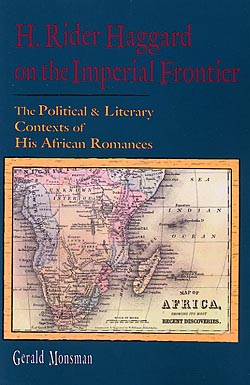
H. Rider Haggard on the Imperial Frontier: The Political and Literary Contexts of His African Romances
22.9 x 15.3 cm. 304 pp. 2006
H. Rider Haggard on the Imperial Frontier, the first book-length study of H.R.H.'s African fiction, revises the image of Rider Haggard (1856–1925) as a mere writer of adventure stories, a brassy propagandist for British imperialism. Professor Monsman places Haggard’s imaginative works both in the context of colonial fiction writing and in the framework of subsequent postcolonial debates about history and its representation.
Like Olive Schreiner, Haggard was an Anglo-African writer straddling the moral divide of mixed allegiances—one empathetically African, the other quite English. The context for such Haggard tales as King Solomon’s Mines and She was a triad of extraordinary nineteenth-century cultures in conflict—British, Boer, and Zulu. Haggard mined his characters both from the ore of real-life Africa and from the depths of his subconscious, giving expression to feelings of cultural conflict, probing and subverting the dominant economic and social forces of imperialism. Monsman argues that Haggard endorses native religious powers as superior to the European empirical paradigm, celebrates autonomous female figures who defy patriarchal control, and covertly supports racial mixing. These social and political elements are integral to his thrilling story lines charged with an exoticism of lived nightmares and extraordinary ordeals.
H. Rider Haggard on the Imperial Frontier will be of interest to readers of imperial history and biography, “lost race” and supernatural literature, tales of terror, and heroic fantasies. The book’s unsettling relevance to contemporary issues will engage a wide audience, and the groundbreaking biographical account of Haggard’s close contemporary Bertram Mitford in the appendix will add appeal to specialists.
More info →

Selected Plays of M. J. Molloy
Chosen and Introduced by Robert O'Driscoll
The twelfth volume of the Irish Drama Selections series (ISSN 0260-7962), General Editors: Joseph Ronsley and Ann Saddlemyer.
Paperback ISBN; 0-86140-149-2 / 978-86140-149-9 10.50
21.6 x 13.8 cm.
Contains: The King of Friday's Men, The Paddy Pedlar, The Wood of the Whispering, Daughter from over the Water, Petticoat Loose and the previously unpublished The Bachelor's Daughter, bibliographical checklist.
Michael Joseph Molloy (1917-1994) was born and died in Milltown, Co. Galway. Originally intending to enter the priesthood, this was prevented by his being struck down by tuberculosis, and it was during the long periods he spent in hospital that he started writing plays, having been inspired by a childhood visit to the Abbey Theatre, Dublin. His first play, Old Road, was produced at the Abbey in 1943, as was The Visiting House in 1946, and The King of Friday’s Men in 1948. When the old theatre burned down and the company moved to the Queen’s Theatre his The Wood of the Whispering and The Paddy Pedlar were produced there in 1953, followed by The Will and the Way in 1955, The Right Rose Tree in 1958, and The Wooing of Duvesa in 1964.
After the company’s return to the rebuilt Theatre in 1966 his plays – with their romantic plots and Syngean dialogue – did not find favour with the new Abbey, and with the exception of Petticoat Loose in 1979, none of his later works were performed professionally. By the late 1980s he had come to believe – as he wrote in one letter to the publisher of this selection – that the Abbey no longer even read plays by authors based in the provinces until they had been produced elsewhere (here he cited himself and John B.Keane as examples), and that his works scared the ‘actor Artistic Directors who know nothing about provincial Ireland and nothing about the rules of playwriting’. He feared his plays might be the last full-length folk plays written in Ireland.
Robert O'Driscoll, an authority on Samuel Ferguson and on the early works of W. B. Yeats, was Professor of English Literature at St Michael's College, University of Toronto, until his retirememt. He died in 1996.
More info →

The Dialectics of Sense and Spirit in Pater and Joyce
Modernist scholars have written a handful of comparative studies on Peter and Joyce. This work is the first book-length exploration into the aesthetic development of these writers that underscores the importance of Pater's work in Joyce's works. Much of Pater's and Joyce's aesthetics evolves from the dialectical tension between the sensual and the spiritual. The Paterian-Joycean syntheses of basic antinomies - religion and sensuality, empiricism and idealism, Aristotelian mimesis and aestheticism - result in kindred theories of art.
Moliterno's highly readable account of the intellectual affinity between the two authors searches their relationship and Joyce's potential debt to Pater. In four main chapters Moliterno discusses the transition of Pater and Joyce from priests to artist and the parallel ways they portray this process in fiction: traces the Paterian elements of the aesthetics of Stephen Dedalus and of the mature Joyce; compares Pater's epiphanies with Joyce's to reveal how Pater helped shape the Joycean epiphany; and analyses the similar epistemologies behind the development of Pater's and Joyce's aesthetics.
To some they may seem an odd match. Joyce, who sought to mirror the everyday lives of Dubliners through revolutionary literary techniques, appears to have little in common in Pater, the precious "father of aestheticism", precursor of Wilde and other aesthete who detested the mimesis Joyce championed. As Moliterno's book reveals, Pater has more in common with Joyce in this regard than with the aesthetes of the fin de siècle.
The Dialectics of Sense and Spirit in Pater and Joyce carefully discriminates connections between one of the late nineteenth century's most influential writers and the early twentieth century's master novelist.
More info →
Frank McGuinness and His Theatre of Paradox
21.6 x 13.8 cm. xiv, 263 pp. + 12pp. colour and b/w illus.
Ulster Editions & Monographs series (ISSN 0954-3392) volume 12
Frank McGuinness and His Theatre of Paradox is a critical study of one of the most important contemporary Irish dramatists. It offers an overview of the McGuinness’s drama from his early plays right up to the recent, Dolly West's Kitchen. The author has chosen to treat the plays thematically, rather than chronologically, which highlights the playwright's major preoccupations in the contexts of modern and contemporary Ireland. She positions McGuinness exactly as a representative of a dynamic creative intelligence fully alive to the various factors, undercurrents, issues, problems, and tensions that are being lived through in present-day Irish society, North and South.
Contents:
1. Folk Memory as Lethal Cultural Weapon: Protestant Ireland vs. Catholic Ireland (Observe the Sons of Ulster Marching Towards the Somme, and Carthaginians);
2. Visualising McGuinness’s Verbal Theatre: Interpretation of Caravaggio’s Theatricality (Innocence);
3. ‘An Unhappy Marriage between Ireland and England’: A Post-Colonial Gaze at Ireland’s Past (Mary and Lizzie, Someone Who’ll Watch Over Me, and Mutabilitie);
4. ‘The Voices of the Voiceless’: Representation of Irish Women (The Factory Girls, Baglady, and The Hen House);
5. Families at War: McGuinness’s Irish Bad Comedy of Manners (The Bird Sanctuary, and Dolly West’s Kitchen);
Catalogue of the Tilling Archive of McGuinness material in the the Library at the University of Ulster, Coleraine.
Hiroko Mikami is Professor of English at Waseda University, Tokyo. She was a visiting research fellow at the Centre for Irish Literature and Bibliography, University of Ulster and obtained her Ph.D. on Frank McGuinness from University of Ulster where some of his typescripts and secondary materials are located in the Tilling Archive. She has translated many contemporary Irish plays into Japanese: Tom Murphy's Bailegangaire, A Thief of Christmas; Brian Friel's Freedom of the City, Making History; Thomas Kilroy's Double Cross, and Frank McGuinness's Innocence and Mutabilitie.
More info →
Selected Plays of Rutherford Mayne
Chosen and Introduced by Wolfgang Zach
The thirteenth volume of the Irish Drama Selections series (ISSN 0260-7962), General Editors: Joseph Ronsley and Ann Saddlemyer.
Paperback ISBN: 0-86140-293-6 / 978-0-86140-293-9 £8.95
21.6 x 13.8 cm
Contains: The Turn of the Road, The Drone, Red Turf, The Troth, Phantoms, Bridgehead and Peter, bibliographical checklist.
Note. Although the two articles ‘The Ulster Literary Theatre’ and ‘Meet Rutherford Mayne’ were announced as being part of this volume they were, for reasons the publisher is unable to explain, omitted from the published book. They can now be read HERE
Samuel John Waddell (1878-1967), who took on the stage-name Rutherford Mayne when he embarked on a theatrical career, was the most prolific, versatile, and successful playwright that the Irish Literary Revival in Ulster brought forth. In the course of his career as a dramatist, from 1906 to 1934, he wrote thirteen plays – ten plays for the Ulster Literary Theatre, one for the Dublin-based Theatre of Ireland, and two for the Abbey Theatre. Especially his early realistic Ulster 'peasant plays' were very successful, among them The Drone (1908), the most popular Irish folk comedy of the first half of the twentieth century. He also acted a great number of main parts in plays of his own and of other writers, to great acclaim, mainly in Belfast and Dublin but also on tours to England and Scotland, from 1904 onwards until late in his life. His plays disappeared from the stage in the 1950s and when he died at the age of 89, in 1967, his artistic achievements were almost forgotten.
In this selection of Rutherford Mayne's plays, seven of his eight published plays – his most important ones – have been included, The Turn of the Road, The Drone , The Troth, Red Turf, Phantoms, Peter and Bridge Head. Two important prose pieces (one of Mayne's essays and an interview), have been added to the plays as they provide direct insight into his personality, views, and career.
Wolfgang Zach’s introduction shows why the plays should be remembered today, providing a lengthy survey of Mayne's life and works, with particular emphasis on a discussion of all his plays, their critical reception, stage history, and specific features.
Wolfgang Zach was Professor of English (Chair) at the University of Innsbruck and Head of its English Department. Before his appointment to this present position in 1994/95, he taught at the University of Graz and also was a Visiting Professor at a great number of universities in each continent. From his Ph.D. thesis on Oliver Goldsmith (1969) onwards he has published widely in the field of Irish literature and was a Vice-President of IASIL (the International Association for the Study of Irish Literatures). He hosted an IASIL-Conference and edited its proceedings (with H. Kosok) on Literary Interrelations. Ireland, England and the World, 3 vols. (Tubingen: Narr, 1987), his most recent volume (ed. with R. Freiburg and A. Löffler) is on Swift: The Enigmatic Dean (Tübingen:Stauffenburg, 1998), and for many years he has been active as European Continental Editor of the Irish Literary Supplement.
More info →

Literary Inter-relations: Ireland, Egypt and the Far East
21.6 x 13.8 cm. x, 426 pp. 1996 Irish Literary Studies series (ISSN 0140-895X) volume 47
This volume publishes the papers given at the International Association for the Study of Anglo-Irish Literature's 1993 conference, hosted by the Ain Shams University, Cairo.
It was the first conference to be held with this theme, which covers Ireland's literary relationships with middle and far-eastern countries, and shows the similarities and differences between literary traditions in different countries as well as the influence of history – for example, both Ireland and Egypt had to extract themselves from British political domination, and both had to take extreme actions to succeed.
The contributions cover the themes of 'Irishness and Egyptianness', 'Myth, Fable and Folklore', 'Regionalism and Cultural Politics', 'Colonialism' and 'The 'Urban and the Rural', with keynote papers by Professors Maureen Murphy ('Folk Narrative Motifs in Egyptian, Irish and Native American Folklore and Literature'), Terry Eagleton ('Form and Ideology in the Anglo-Irish Novel'), Declan Kiberd ('Yeats and the National Longing for Form') and Richard Allen Cave ('The City versus the Village') with other papers covering Irish authors – Samuel Beckett, Elizabeth Bowen, Brendan Behan, Brian Friel, Sir William and Lady Gregory, Lafcadio Hearn, Jennifer Johnston, James Joyce, Brendan Kennelly, Thomas Kinsella, Edward Martyn, C.R.Maturin, George Moore and Thomas Moore, Thomas Murphy, Flann O'Brien, Sean O'Faolain, Eugene O'Neill, Bernard Shaw, James Stephens, Jonathan Swift (compared with Conrad), Honor Tracy, Oscar Wilde, W.B.Yeats – Egyptian, South African and Eastern authors – Abdel Rahman Al-Sharqawi, Mahmoud Diab, Tawfik Elhakim, Yusuf Idris, Goha, Naguib Mahfouz, Yukio Mishima, Etedal Othman, Karel Schoeman – contemporary poetry of Northern Ireland, Egyptian and Irish film, and the literary parallels between 18th century Anglo-Irish and 20th century Egyptian literature.
More info →