

An Irish Literary Dictionary & Glossary
ISBN: 978-0-86140-442-1
Approximately 800 years have passed since the introduction of the English language to Ireland and 400 since the establishment of an Irish Literature in English. However, for complex socio-political reasons there is, as yet, no comprehensive dictionary of the English of Ireland to which readers of Irish Literature – and indeed, of any aspect of Irish studies – can turn to for assistance when they encounter completely unfamiliar words and phrases, or apparently familiar words used unconventionally by Irish writers.
This work is designed to provide the general reader, as well as the specialist, with direct and easy access to this important but elusive and often-overlooked element of Irish Literature. Quotations from writers ranging from AE to Zozimus (including all four Nobel Laureates in literature: Yeats, Shaw, Beckett and Heaney) are used to illustrate vocabulary and idioms. Also are included are illustrative quotations from English writers, such as Spenser and Thackeray, who wrote about Ireland.
From archaeology (crannog) to zoology (graunogue), almost every aspect of Ireland and Irish life is reflected here in the mirror of art.
More info →

A Dictionary and Glossary for the Irish Literary Revival
ISBN: 978-0-86140-359-2
This work is intended to provide the general reader, as well as the specialist, with access to an important but neglected element of Irish literature in English: its vocabulary and idioms.
Over seventy years have elapsed since the establishment of an independent Irish state, but for complex socio-political reasons there is, as yet, no dictionary of Irish-English to which readers can turn for assistance when they encounter unfamiliar words and phrases or apparently familiar words usedunconventionally by Irish writers.
The focus of this work is the writers of the Irish Literary Revival, but their use of Irish-English is so extensive that it is relevant to the entirefield of Irish literature in English from its beginnings in the seventeenth century to the present.
Almost all aspects of Ireland and Irish life over the past 400 years are mirrored here: agricultural, economic, educational, linguistic, military, political, religious and social history as well as animals, emigration, drink, food, folklore, geography, music, mythology, plants, sports and even the mercurial Irish weather.
More info →

An Anglo-Irish Dialect Glossary for Joyce’s Works
This work is intended to provide the general reader as well as the specialist with access to an important but neglected element of Joyce's style: the Anglo-Irish (Hiberno-English) dialect.
Although some commentaries and editions of individual works include glossaries on a few terms, this is the first full scale reference work of its kind. It will be of use to others besides Joyceans also because Joyce's use of the dialect is so extensive that most examples a reader is likely to encounter elsewhere are identified and explained here.
More info →

The Collector’s Bag
(short stories)
A fascinating collection of stories based on the author's experiences as an Indian Civil Services Deputy Commissioner, or `Collector' in the Himalayan district of Garhwal, in which actual fact stands beside fiction, and where, if the story is not true, in whole or in part, it still gives a true insight into the life and mores of the people in that part of the subcontinent. Love, murder, rogues, humour, revenges, trial by ordeal, blood feuds, and Chinese-Tibetan plans for the invasion of India are featured, as well as an account of the author's meeting with Jawarhal Nehru.
The author has splendidly evoked a way of life of half a century ago, but much of it could still exist today: the world changes very little in the depths of the Indian hill country.
More info →
Words Apart, A Dictionary of Northern Ireland English
Words Apart is a study of the rich linguistic heritage of the people of Northern Ireland, providing an invaluable introduction to this remarkable and eloquent variety of English. The book is not simply a dictionary: it is a record of the unique interaction of three peoples, the Irish, the English and the Scots, and reflects a history of courage, humour and stoicism.
This study is in four sections. The first provides a brief account of the growth and development of the English language in Northern Ireland. Section Two offers a lexicon which includes pronunciations, etymologies and illustrative sentences from live recordings made in both rural and urban areas in all six counties. Section Three is an alphabetically-arranged list of English words followed by their equivalents in the dialect. The final section includes extended examples of verse, prose and recorded speech.
This book will be of value to the general reader as well as to those with a special interest in Irish studies, in variations in English and in the spread of English throughout the world.
More info →
J. M. Synge and the Western Mind
21.6 x 13.8 cm Irish Literary Studies series 4
Professor Thornton’s book calls into question the ideas generally held by critics of Synge that the religious milieu he was reared in had slight influence upon him, that his relationships with his family were of virtually no importance to him, and that he cared little for matters concerning ‘belief’ generally. The view presented here is that Synge was always more concerned about beliefs than he appeared to be with his taciturn public manner, and that the theme of the relationship between ‘beliefs’ and ‘reality’ is basic to his work.
This volume examines the impact the early years of Synge’s life and his visits to the Aran Islands had on him, generating themes and devices that became the staples of his drama. Dr. Thornton defines the philosophical premises which underlie the major plays and the developing theatrical techniques Synge devised to embody his explorations of the nature of belief. Deirdre of the Sorrows marks a fitting culmination to his career, showing how completely Synge had transformed his concern with stereotypes of response from a realisation to be articulated or a philosophical problem to be solved into a tool to facilitate the discovery of his individual viewpoint.
CONTENTS <br
Acknowledgements<br
Introduction<br
I. Seed Time of the Soul<br
II. The Verge of the Western World<br
III. The Shock of Some Inconceivable Idea<br
IV. First Fruits: The Shadow of the Glen; Riders to the Sea; The Tinker's Wedding<br
V. Dreamer's Vexation or Poet's Balm?: The Well of the Saints and The Playboy of the Western World<br
VI. A Sense that fits him to perceive objects unseen before: Deirdre of the Sorrows<br
Conclusion<br
Bibliography<br
Index

A Reader’s Guide to Dorothy Richardson’s ‘Pilgrimage’
Over the years, Pilgrimage (1915-1967) has been viewed as early Modernism's great documentary novel, as daring experimental fiction, as spiritual autobiography and pioneer of cinematographic technique. No matter what critical viewpoint readers use, Pilgrimage's reputation as a demanding text persists. Like James Joyce's Ulysses, Richardson's 2000 intricately woven pages have challenged readers for decades.
She explores a new way of presenting reality in Pilgrimage, one that is immediate rather than retrospective. As the resulting chronicle of events extends itself, however, the larger picture grows puzzling. Scenes change suddenly, characters spring from the long forgotten past, years disappear without a trace.
A Reader's Guide meets these difficulties with a detailed account of the time scheme of the narrative, and a precise chronology of events keyed to the novels by page number for easy reference. Relationships among the principal persons of the story are followed throughout, and all the characters are placed in context in an alphabetically arranged descriptive directory. The book concludes with a select annotated secondary bibliography.
Thomson's practical scholarship bridges the ruptures and absences in Richardson's narrative to help readers master Pilgrimage in its broader outlines, in its structure, time-scheme, and character relations. Kristin Bluemel, author of Experimenting on the Borders of Modernism: Dorothy Richardson's 'Pilgrimage' (University of Georgia, 1996), aptly captures Thomson's achievement:
"A Reader's Guide to Dorothy Richardson's 'Pilgrimage' does more than serve as a long-awaited reference tool; it also reminds us of the way Richardson's luminous multi-volume novel participates, despite or even because of all its difficulties of time, in the ongoing debates about the critical practices and literary priorities of modernity."
More info →
Notes on Pilgrimage: Dorothy Richardson Annotated
Dorothy Richardson's thirteen-volume Pilgrimage is crowded with references from the last decade of the Victorian era and the first decade of the twentieth century. The interests of the protagonist Miriam Henderson are wide-ranging, from ecology to economics, from fiction to philosophy, from the mores of the family to the morals of the nation. Pilgrimage's stream-of-consciousness narrative evokes these references and interests in elusive, complex ways. Even accomplished readers, following in the wake of the heroine's personal revelations, are hard-pressed to understand aspects of the more public scene from turn-of-the-century England.
Notes on 'Pilgrimage', by identifying historical persons, events, ideas, quotations and writings that underpin Richardson's story, illuminates these factual details and enriches understanding of the narrative. A translation of all foreign words and phrases, a record of textual misprints and a thorough index add to the value of the book.
Professor Thomson has for many years studied one of British literature's most challenging, most rewarding, most underestimated masterpieces. Notes on 'Pilgrimage': Dorothy Richardson Annotated is the culmination of that splendid research.
This new book complements Thomson's 1996 A Reader's Guide to Dorothy Richardson's 'Pilgrimage', an account of the time scheme and a precise chronology of events, with characters placed in context through a descriptive directory. Together Notes on 'Pilgrimage' and A Reader's Guide to Dorothy Richardson's 'Pilgrimage' make a lasting contribution to the study of Dorothy Richardson and will be asked for by students and scholars for decades to come.

The Well of the Saints
Edited, with an Introduction and Notes, by Nicholas Grene
J.M. Synge’s The Well of the Saints, to some extent overshadowed by his better-known plays Riders to the Sea and The Playboy of the Western World, well deserves an individual edition. A rich and complex tragicomic study of the conflict between imagination and reality, The Well centers on an old, blind couple, disillusioned by a miraculous cure, who finally prefer blindness to sight.
Nicholas Grene’s full introduction provides the historical background to the play and the reasons its first audiences, at Dublin’s Abbey Theatre, received it with a hostility prefiguring the Playboy riots a few years later. He shows how Synge embeds his parable-like story in the reality of the Irish countryside, and how the theme of the play is developed through a skilful dramatic control of audience response. The Well of the Saints, with its striking affinities to Beckett, can thus be recognized as a play before its time.
The play is fully annotated, with an explanatory note on the language and a glossary for those unfamiliar with Synge’s poetic-peasant dialect. And with access (denied previous editors) to the Abbey Theatre prompt-book in which Synge made important theatrical alterations, Prof. Grene has been able to supply an edition with new textual authority.

Arthur Symons, Critic Among Critics: An Annotated Bibliography
Arthur Symons’s (1865–1945) prominence at the end of the nineteenth century and subsequent influence on early-twentieth-century literature is well established. His biographer Karl Beckson aptly calls him “a major figure who helped stimulate the Modernist initiative.”
The breadth of his artistic interests and critical commentary remains extraordinary. In addition to writing short stories, poems, plays, travel sketches, and translations, Symons was a prolific critic and editor who wrote about literature and what he termed “the seven arts.” Yeats famously offered him the laurel “best critic of his generation.” Symons championed freedom of subject matter and literary style and thus influenced the work of Yeats, Eliot, Pound, Joyce, and others, particularly in introducing them to the evocative work of French symbolist writers.
Arthur Symons, Critic Among Critics: An Annotated Bibliography documents the scholarly attention Symons continues to receive not only for his critical influence, but for his own creative work. This annotated bibliography captures over 1000 articles, books, reviews, dissertations, and other writings about Symons, revising and updating Carol Simpson Stern’s 1974 bibliography published in English Literature in Transition, 1880–1920. Over 700 new items appear, some of these from unsigned articles now identified as written by authors such as Virginia Woolf and John Middleton Murry.
The book, arranged alphabetically by author with annotations in paraphrase style, includes a helpful index and provides a chronological list of works published from the1880s to 2005 that will prove useful in tracing the evolution of criticism about Symons. Arthur Symons, Critic Among Critics joins ELT Press’s Arthur Symons: A Bibliography (1990), which covers the primary works, to give scholars a comprehensive view of his writings.

Swift’s Irish Pamphlets
Edited by Joseph McMinn
This volume collects, for the first time, Jonathan Swift's major writings on Ireland and on Irish affairs, including the Story of an Injured Lady (1707) on Anglo-Irish relations after the union between England and Scotland; a number of the Drapier's Letters, in which he assumed the persona of M.B. Drapier to voice his countrymen's outrage at English insensitivity in dealing with Ireland; and the astonishing Modest Proposal seen here as a satirically logical outcome of the refusal of the authorities to heed his earlier pamphlets or alleviate the desperate straits in which Ireland found itself. Scholars of Irish and Anglo-Irish literature, students of history, and anyone who enjoys a biting, incisive prose style will welcome this collection of the best of Swift's Irish writings.
'This excellent selection shows Swift as a political man of his time, writing with savage eloquence about specific issues of the day... A salutary collection that takes literature into the bustle of the public realm.' The Observer
More info →

A Guide to the Books of William Blake for Innocent and Experienced Readers
With notes on interpretive criticism 1910 to 1984
ISBN 978-0-86140-408-7 874pp.
The writings of William Blake were not understood by his contemporaries or the Victorians, and it was only in 1910, with the publication of Joseph Wicksteed's Blake's Vision of the Book of Job, that the long process of comprehending Blake's works seriously began.
Part 1 of the present work consists of twelve chapters that are primarily intended to lead the reader who has little or no acquaintance with Blake's more difficult works through all his books. These consist of Poetical Sketches, Songs of Innocence and of Experience, three early prose tractates, the eleven shorter prophetic books (including The Marriage of Heaven and Hell), the lyrics of the Pickering Manuscript, The Four Zoas, Milton, Jerusalem, The Gates of Paradise, The Ghost of Abel and Illustrations of The Book of Job.
The reader who wishes to explore a work more fully can proceed to Part II, where a headnote outlines the main scholarly views of its structure and meaning. The headnote for each book is followed by a survey, laid out line by line, of how such details as proper names, Blakean symbols, political allusions, and obscure phrases have been interpreted. Where there are engraved designs, these are covered in a comparable fashion. Part II will also be useful to those who want an overview of the interpretations of a particular work or passage and to readers interested in the evolution of twentieth-century understanding of Blake.
There are two indexes providing ready access to explanations of terms and proper names.
'Its nearly 900 pages comprise the most helpful overview of Blake's works and of Blake criticism I have ever come across... Highly recommended.' Bill Goldman in The Journal of the Blake Society
HENRY SUMMERFIELD teaches in the Department of English at the University of Victoria, British Columbia. He is author of That Myriad-Minded Man, A Biography of G.W.Russell - 'AE', is General Editor of the Collected Works of G.W.Russell, and editor of A Selection from the Contributions to 'The Irish Homestead' by Russell. He is also author of An Introductory Guide to The Anathemata and the Sleeping Lord Sequence of David Jones.

Hearts And Minds
The Princess Grace Irish Library’s 2000 symposium brought together Irish critics and historians to assess the state of culture and society in the 'long nineteenth century' – 1800-1922 – during which the Act of Union defined the form of government and representation in Ireland as well as, to a great extent, the forms of opposition. Besides investigating the nature of the Union – its strengths and weaknesses, its character and progress – this bicentenary collection considers questions of private conscience and popular consciousness, language and iconography, science and evangelism, Diaspora and disempowerment, terror and consent, memory and amnesia, separation and adherence in the connected spheres of society, politics and culture.
The contributors are Anthony Cronin, Thomas Bartlett, Síghle Breathnach-Lynch, Claire Connolly, Tom Dunne, Marianne Elliott, J. W. Foster, Roy Foster, Luke Gibbons, Liam Kennedy, Joep Leerssen, W. J. McCormack, James Murphy, Patrick O'Sullivan, Gearóid Ó Tuathaigh and Norman Vance. It is the thirteenth publication in the Princess Grace Irish Library Literary series (ISSN 0269-2619).
BRUCE STEWART is the Literary Adviser of the Princess Grace Irish Library, Monaco, and teaches Anglo-Irish Literature at the University of Ulster at Coleraine. He served as Assistant Editor of The Oxford Companion to Irish Literature edited by Robert Welch (1995). More recently he was responsible for the setting up of PGIL EIRData, a large-scale website dedicated to Irish literary and biographical information and containing at its heart a bio-bibliographical account of some 4,500 Irish authors of all periods. It was launched by Her Excellency Mary McAleese, President of Ireland, and H. S. H. Prince Albert during the symposium, and is located at http://www.pgil-eirdata.org.
Front cover illustration (continuing onto front flap): 'The Wedding of the Princess Aoife of Leinster with Richard de Clare, Earl of Pembroke (Strongbow)' by Daniel Maclise.
More info →
Beckett and Beyond
21.6 x 13.8 cm
‘Beckett and Beyond’ a conference held at the Princess Grace Irish Library, Monaco, in 1991, gathered together thirty-two distinguished scholars, and so provided an unique opportunity to assess the works and career of the great Irish and European writer two years after his death. The conference proceedings, published here in a single volume, contain papers and addresses by his biographers, the editors of his correspondence and internationally known students of his plays and prose, including representatives of the Beckett Society and the Beckett Centre (Reading), and others from universities in Ireland, Britain, France, Italy, Spain, Norway and America.
The papers in this volume give a first in-depth view of the Beckett correspondence edited by Martha Fehsenfeld and Lois More Overbeck, and a wealth of material for the biographies by James Knowlson and Anthony Cronin, including the theatrical notebooks -- all discussed with the excitement of new discovery.
As well as a wide range of papers on individual works and series from all phases of the writer’s career and in all the media that he explored, subjects covered by the speakers include Beckett in relation to modernism, postmodernism, Dr Johnson, Joyce, Baudelaire, Camus, Freud, actors, directors, to his texts and his letters, to radio, television, video, film, and adaptations of his work.
Bruce Stewart was the Literary Adviser of the Princess Grace Irish Library, Monaco, and teaches Anglo-Irish Literature at the University of Ulster at Coleraine. He served as Assistant Editor of The Oxford Companion to Irish Literature edited by Robert Welch (1995).

That Other World
Volume 1 ISBN: 0-86140-417-2 / 978-0-86140-417-9 £40.00
Volume 2 ISBN: 0-86140-418-1 / 978-0-86140-418-6 £40.00
The Pair ISBN: 0-86140-419-X £80.00 / 978-0-86140-419-3
The Supernatural and the Fantastic in Irish Literature & its Contexts
As with every other region of Europe and the world, the traditional folklore of Ireland abounds with tales involving the supernatural and the fantastic, but nowhere else have these tales so influenced the literature and the shaping of that country, and no other country has produced so many world-famous authors whose work has shown those influences.
These intermingling themes were therefore the ideal subject for a symposium held at the Princess Grace Irish Library, Monaco, in May 1998 to which, reflecting the international interest in the subject, a host of international scholars contributed, and whose papers are published in these two volumes.
The subjects range from early Irish history and folklore to the present day, but mainly deal with nineteenth and twentieth century literature, from Gothic novels, Sheridan Le Fanu, Bram Stoker, and Oscar Wilde, through W.B.Yeats, Lord Dunsany, Elizabeth Bowen, Samuel Beckett, and Flann O'Brien, to Seamus Heaney and Nuala Ní Dhomhnaill.
More info →
The Irish Book Lover. An Irish Studies Reader
With an Introductory Lecture by Nicholas Allen and an Integrated Index by Bruce Stewart.
The Irish Book Lover ranks as the longest-lasting of all twentieth-century Irish literary journals, with a run of 227 issues published under the editorships of John S. Crone (1909-25), Séamus Ó Casaide (1928-1930) and Colm Ó Lochlainn (1930-57). As a bibliographical and reviewing journal rather than a forum for commentary, poetry or fiction, it is less often consulted than literary journals such as the Irish Review or The Bell but nevertheless illustrates with great clarity some of the key changes in modern Irish culture and society between 1909 and 1957.
While offering a unique source of information on older, antiquarian books in Ireland, The Irish Book Lover throws open a window on the attitude of the contemporary intelligentsia to works such as James Joyce’s Portrait of the Artist and W. B. Yeats’s Responsibilities, the novels of Liam O’Flaherty and Kate O’Brien or those of less-remembered writers of the day such as Temple Lane and Mrs. Thomas Concannon. Though superseded by a variety of reviewing organs, it gives an inspiring example to Irish book lovers in our own time.
The Princess Grace Irish Library has compiled a sampler of the journal here, together with an index of the entire series. The present volume also contains the introductory lecture given by Dr. Nicholas Allen at the “Irish Book Lover” Symposium held in Monaco to commemorate the journal. The symposium was also afforded a planned opportunity to survey existing resources for Irish literary history in the company of fifteen Irish publishers, librarians, teachers, critics and – last but not least – owners of Irish-studies websites.
The present volume is mirrored on the PGIL EIRData website, giving access to a body of digitised text that embraces a wider selection of the long-running journal together with an electronic index of its pages. This new departure for Irish studies has been conducted by Dr. Bruce Stewart under the terms of a contract between the Ireland Fund of Monaco to the University of Ulster under the aegis of the Princess Grace Irish Library (Monaco).
Bruce Stewart was Lecturer in Irish Literary History and Bibliography at the University of Ulster and Literary Adviser (Conseiller Littèraire) of the Princess Grace Irish Library in Monaco and director of the Library’s Biennial Symposium Series. He has edited three volumes in the Princess Grace Irish Library series and managed the production of several more. His articles and essays have been published in several leading Irish journals including Irish Review and Studies. Born in Dublin and educated at Glenstal Abbey School, Trinity College, Dublin, and the University of California, he has studied, worked and taught in America, the Middle East and England as well as Northern Ireland.
Contents
Editor’s Preface
Nicholas Allen: Introductory Lecture
The Irish Book Lover: An Irish Studies Reader
The Irish Book Lover: An Integrated Index
Bruce Stewart: Afterword
Appendix I: Chronology of Issues
Appendix II: Participants & Programme
More info →
The Poems of James Stephens
Edited by Shirley Mulligan
Introduction by A. Norman Jeffares
During the past decades there has been a substantial body of bibliographical, critical and biographical material published testifying to Stephens' significance as poet, novelist, essayist, and short story writer. There has been an edition of his Letters by Richard J. Finneran (1974) and a two volume Uncollected Prose edited by Patricia McFate (1983). In addition, some of his prose works have been reprinted (The Crock of Gold; Irish Fairy Tales; Deirdre and The Insurrection in Dublin are presently listed by Amazon.co.uk), so a volume of Stephens' poetry is long overdue.
At the present time it is virtually impossible to locate any volume of Stephens’ poetry outside a library. In the case of his Collected Poems (1954), even if one finds a copy, it is difficult to evaluate the poet's progress, influences, or interests at any given period since the poems are arranged thematically under charming but elusive titles which, for the most part, tell nothing about the contents or period of their composition, although we are at least fortunate that the last three books in that volume are chronologically arranged. Furthermore, over one hundred poems published in volumes, in magazines, or newspapers were omitted from the Collected Poems. A complete chronological collection of James Stephens' poetry is therefore necessary if readers are to be encouraged to enjoy and study his work in depth, and that is what the present editor provides.
This volume contains more than 320 poems by Stephens, a biographical and critical introduction by A. Norman Jeffares (his last work before his death in 2005), as well as notes, indexes to titles and first lines, and an Appendix listing those poems that appeared in the 1954 Collected Poems. It is an essential adjunct to the library of every lover of Irish poetry.
More info →

A Guide to Coole Park, Home of Lady Gregory
72pp. 23.3 x 15.7 cm
This booklet is a guide to the house and estate, and in the words of the Cara Magazine review of the first edition (later editions of which have been greatly enlarged), it 'recalls with affectionate brilliance and a wealth of information the kindly and gracious inspirer of the Abbey Theatre ... By intelligent selection of quotes and sensitive description Mr Smythe captures more than a little of the gracious and aristocratic – in the best sense – atmosphere of Coole'.
With over 80 illustrations and a Foreword by Anne Gregory.
CONTENTS
1. Today
2. Lady Gregory and Coole Park
3. The House and the Estate
Index
More info →

Studying Oscar Wilde: History, Criticism, & Myth
22.8 x 15.3 cm. 248 pp. 1880-1920 British Authors Series no. 22
Studying Oscar Wilde: History, Criticism, and Myth takes issue with many assumptions current in Wilde scholarship. It sets an engaging course in exploring Wilde’s literary reputation. In particular, Professors Guy and Small are interested in the tension between Wilde’s enduring popularity with the general reading public as a perennially witty entertainer and his status among academics as a complex, politicised writer attuned to the cultural and philosophical currents associated with modernity. Their argument focuses initially on the prominence of biographical readings of Wilde’s literary works, drawing attention to the contradictions in the ways biographers have described his life and to the problems of seeing his writing as a form of self-disclosure.
Subsequent chapters assess the usefulness of other forms of academic scholarship to understanding works that are not, on the surface, “difficult.” Here a number of commonly held views are challenged. To what extent is De Profundis autobiographical? How sophisticated is the learning exhibited in Intentions? In what ways are the society comedies “about” homosexuality? And how does The Picture of Dorian Gray relate to Wilde’s “mature” style?
The volume also examines some of Wilde’s lesser-known, unfinished works and scenarios, including The Cardinal of Avignon, La Sainte Courtisane, and A Florentine Tragedy (all printed as appendices), arguing that these “failed” works provide important insight into the reasons for Wilde’s popular success.
Since Guy and Small have authored numerous articles and books on Wilde, Studying Oscar Wilde: History, Criticism, and Myth will be a must read for scholars, but it is also written in a jargon-free language that will speak to that wider audience of readers who enjoy Oscar Wilde.
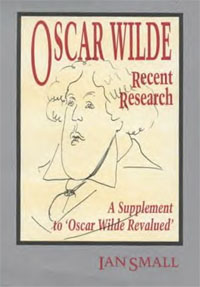
Oscar Wilde, Recent Research
A Supplement to Oscar Wilde Revalued.
Oscar Wilde Revalued, published by ELT Press in 1993, earned praise from Wilde scholars in the USA and Europe. Now, at the centenary of Wilde’s death, Professor Small’s 1993 book is succeeded by a completely new work, one that will also become essential for students of Wilde.
Oscar Wilde: Recent Research updates and reconceptualises the bibliographic objectives of the earlier volume, and surveys research on Wilde from 1992 to 2000, but in a much more explicitly evaluative manner.
The opening chapter, ‘Wilde in the 1990s’, traces the main directions of Wilde research over the past decade. Critical material is then reviewed under three broad categories. The first, ‘Biography’, is concerned with the continuing fascination with Wilde’s life, and its emphasis on how critics have moved on from dissatisfaction with Richard Ellmann’s Oscar Wilde (1987).
‘Recent Critical Paradigms’ evaluates research channelled through master-narratives that have emerged in the 1990s, ways of describing Wilde’s work: the ‘gay’ Wilde, the ‘Irish’ Wilde, and ‘Wilde and Consumerism’. ‘Wilde the Writer’, the third category, centres on an important trend in research during the last decade, what might be thought the less glamorous aspects of the oeuvre – from the seriousness with which Wilde took his role as a poet, to the sheer amount of time he devoted to writing journalism, to the complexities of the production and staging of his plays.
Oscar Wilde: Recent Research also contains sections devoted to sources and intertexts, to thematic studies, to essay collections, and to critical monographs which take Wilde as their sole subject. The book includes information about new research resources, and about manuscript discoveries and letters. It concludes with an extensive bibliography organised alphabetically and in terms of Wilde’s works, and an index of critics.
IAN SMALL has a personal chair in English literature at the University of Birmingham. He has written widely on a variety of literary figures and topics in the 1880-1920 era. He is co-general editor of the Oxford English Texts edition of The Complete Works of Oscar Wilde. Among his many publications are Oscar Wilde’s Profession: Writing and the Culture Industry in the Late Nineteenth Century (with Josephine M.Guy, OUP, 2000); Oscar Wilde Revalued (ELT Press, 1993); Politics and Value in English Studies: A Discipline in Crisis? (with Jacqueline M.Guy, CUP, 1993), and Conditions for Criticism (OUP, 1991).
More info →