


Kate O’Brien, a Literary Portrait
21.6 x 13.8 cm
Although Kate O’Brien is coming to be classed among the most original novelists of this century, her reputation underwent the usual period of eclipse that follows the decease of most writers. Now, just twelve years after her death in 1974, her novels are coming back into favour on both sides of the Atlantic.
At first glance, a romantic realist whose field of operations was the rise of the middle-class from post-Famine Ireland to the second half of the present century, on closer inspection she will be seen to be a subtly feminist writer whose heroines are in search of both freedom and love, freedom as a pre-requisite of love – and education as the first necessity of either.
Highly responsive though she was to the lyrical beauty of the Irish landscape and appreciative of Irish wit and charm, she was, nevertheless, contemptuous of narrow nationalistic claims, and would set Ireland always among the nations of Europe. Long before Europe set up its present Economic Community, of which Ireland in due course became a member state, she saw her country as linked by old associations of religion, history and culture to a continental civilisation.
Readers of a generation new to Kate O’Brien see her as depicting an Ireland they scarcely knew existed, an educated, aspiring, sometimes wealthy middle-class Ireland. On one side of her, just before her beginnings as an artist, lies the wild Ireland of the dispossessed, and on the other the Ireland of what she called the ‘Top People’, whose sole criterion is success in making money, and whom she despised.
This is the first study of Kate O’Brien’s novels as a whole, in which her development as a writer is traced and the underlying themes of her work revealed.

Yeats the Initiate. Essays on certain themes in the writings of W.B.Yeats
For many years Kathleen Raine has been known as the leading exponent of what she herself calls ‘the learning of the imagination’ in the work of Blake, Yeats and other poets and scholars within (using the word in its broadest sense) the Platonic tradition. Yeats the Initiate contains all Dr Raine’s essays on Yeats, covering many aspects of the traditions and influences that informed his great poetry. Several of her essays in this field are already regarded as definitive evaluations of their subjects and these, with other hitherto uncollected studies and some new papers here printed for the first time, all fully illustrated and annotated, make Yeats the Initiate one of the most important publications of recent years in the field of Yeats studies.
The essays collected in Yeats the Initiate include ‘Hades Wrapped in Cloud’, a study of Yeats and the occult, Dr Raine’s introduction to Yeats’s collections published as Fairy and Folk Tales of Ireland, and three major studies previously published separately – Yeats, the Tarot and the Golden Dawn; From Blake to ‘A Vision’ and ‘Death-in-Life’ and ‘Life-in-Death’. A major paper on ‘Yeats on Kabir’ is printed for the first time, as is a topographical paper on the Sligo area in the West of Ireland. A long essay on Yeats’s debt to Blake has been extensively revised, and other topics discussed include the play Purgatory, Yeats’s contemporary, Æ (G.W.Russell, the visionary), and Kathleen Raine’s own poetic debt to Yeats.
The essays that make up this volume reflect a lifetime’s knowledge presented with the fine perception of a great poet. The many illustrations form a graphic accompaniment to the text. It is essential reading for all students of the life and work of William Butler Yeats.

Irish Literature in English, The Romantic Period
Vol 1 ISBN: 0-86140-272-3 / 978-0-901072-272-4 £30.00 <br
Vol 2 ISBN:0-86140-273-1 / 978-0-901072-273-1 £30.00 <br
The Pair ISBN: 0-901072-40-0 / 978-0-901072-40-5 £60.00 Originally advertised as Ireland and Romanticism, Patrick Rafroidi’s work is a revised and updated translation of his much acclaimed L’Irlande et le romantisme (1972). It is now published for the first time in English in two volumes, the first a study of the period and its authors, and the second an important work of reference on all the Irish literary figures of the time. The study is divided into three sections, ‘Prelude to Romanticism’, ‘Nationalist Romanticism’, and ‘The Impact of Irish Romanticism’, with extensive notes and an index. Professor Rafroidi studies the causes of the movement, how it was influenced by political and literary landmarks of the time, and how the authors themselves influenced others, not only in England but also in the United States, in France and in Germany, and their rediscovery and use of Ireland’s early history and myths. The reference section contains a general bibliography, bio-bibliographies of the Irish authors whose work was published between 1789 and 1850, information as to the performances of their plays in the most important theatres in the British Isles, and a list of the principal Irish periodicals of the time. This is therefore a most useful work for all those interested in the period, and the bibliographies make it an essential work of reference which all libraries and students of Anglo-Irish Literature will need on their shelves, for continuous referral.

Irish Poetry after Feminism
These essays are revised versions of lectures given at the Princess Grace Irish Library in Monaco, and address some of the most exciting developments in Irish poetry over the last thirty years, concentrating especially on the work of Derek Mahon, Medbh McGuckian, Vona Groarke and Sinéad Morrissey. Irish Poetry after Feminism also includes forthright debate between the contributors about the relations between ideology and poetics. Gathering some of the finest critics, the volume makes an important contribution to one of the central debates about Irish literature.
'Feminism and Irish poetry are . . . natural allies, not antagonists; to posit them otherwise is to declare the redundancy of art in its capacity to change lives on its own terms. With such an understanding, students of the topic of Irish poetry after feminism are released to seek out its neglected aspect in an investigation of Irish feminism after poetry, in confidence that relations of hospitality and exchange, rather than those of absolutism and hierarchy, can be expected to prevail between the art form and the intellectual, social and political tradition concerned.' Catriona Clutterbuck
CONTENTS<br
Justin Quinn: Introduction<br
Moynagh Sullivan. Irish Poetry after Feminism: In Search of 'Male Poets' <br
Peter McDonald. The Touch of a Blind Man: Forms, Origins and 'Hermeneutics' in Poetry <br
Catriona Clutterbuck. An Unapproved Alliance: Feminism and Form in the Irish Poetry Debate <br
Derek Mahon: First Principles <br
Fran Brearton. On Derek Mahon's 'First Principles' <br
Lucy Collins. Northeast of Nowhere: Vona Groarke, Sinéad Morrissey and Post-Feminist Spaces <br
Selina Guinness. The Annotated House: Feminism and Form <br
Leontia Flynn. On the Sofa: Parody & McGuckian <br
David Wheatley. That They May Be Damned: Samuel Beckett and the Poetry of Misogyny</i
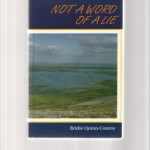
Not a Word of a Lie
ISBN 978-1-873821-01-5
Not a Word of a Lie is an evocative portrait of growing up in the West of Ireland. Recalling her childhood and youth in Duras, a narrow peninsula jutting out into Galway Bay, about four miles from the nearby town of Kinvara, Bridie Conroy-Quinn describes the small, self-contained farming community in which she grew up with affection and humour, but also with an acute understanding of the small tragedies and injustices that sometimes disturbed the normally tranquil pattern of the yearly round.
Bridie Quinn-Conroy was born and raised in Duras. Educated at Duras National School and Seamount College, she trained as a primary school teacher in Carysfort Training College, Dublin. She taught schools in South Galway and was Vice-President of Craughwell N.S. until she took early retirement in 1989. Married to Michael Conroy, she has four children.
More info →
Francis Warner’s Poetry: A Critical Assessment
The poetry of Francis Warner is unlike that of any of his contemporaries in its blend of passion and scholarship. It is the work of a mind steeped in the great traditions of poetry – work that is learned and allusive, but simultaneously intense in its lyricism.
Glyn Pursglove, author of an earlier study of Warner's plays Francis Warner and Tradition, provides a detailed account of this fascinating body of work, demonstrating both its indebtedness to tradition and its profound originality. In a manner both scholarly and sensitive he clarifies the complex craftsmanship of Warner's major poems and demonstrates the extraordinary formal inventiveness which characterises so much of his work.
Central to Francis Warner's achievement as a lyrical poet are several remarkable sequences of love poems. Theses are here afforded a poem-by-poem examination so that readers will find their pleasure in them enhanced by these meticulous and lively studies.
For all his attention to the detail of the poems, Glyn Pursglove does not neglect the larger themes that give continuity to Warner’s work. The reaffirmation of biblical and classical concepts of love – not just as a scholarly exercise but felt in the ' blood – is at the heart of all of his work as a poet and as a dramatist. It was perhaps inevitable that a poet so steeped in the lyrical forms of the Renaissance (the canzone, the madrigal, and above all the sonnet) should eventually turn his attention to Verse Drama. This study closes fittingly with two lengthy chapters devoted to Warner's verse plays Moving Reflections and Living Creation, theatrical and poetic explorations of love and creativity set in the age of the Gospels and Renaissance Florence.
When Francis Warner's Collected Poems appeared in 1985, The Scotsman described him as 'one of the most adroit and adventurous of living English poets' and observed that 'it is about time that critical appreciation caught up with him'. Glyn Pursglove's assessment answers that demand.
More info →
The Literary Works of Jack B. Yeats
There is far more to Jack Yeats than meets the eye, and it is to be hoped that he will soon be recognised as deserving of a place in the forefront of Irish letters. In recent years, however, his greatness as a painter has eclipsed his writings and this work seeks to redress the position. John Purser brings a knowledge of symbolism and language used in the West of Ireland to his study, and with the aid of previously unused evidence and a new chronology, new interpretations are given for many of Jack Yeats's works and an overall pattern is revealed.
The religious imagery of The Careless Flower and The Amaranthers is developed, and the significance of the theme of inheritance in the latter work is brought out for the first time, allowing the two halves of the novel to be seen more clearly as an integrated whole. The Charmed Life is shown to have an underlying Faustian and Christian significance, related to the progress of Ireland as a nation, and Ah Well is interpreted as a remarkable fable of a kind of Eden in reverse. Harlequin's Positions is interpreted as a riposte to Shaw and an assertion of Ireland's need and ability to maintain her independence in the face of the approaching war, and La La Noo, The Green Wave and In Sand are seen in part as approving extensions of that theme.
As well as his father, major literary figures recognised his genius – Synge (who shared a journey and vision of Ireland with him), Joyce (who recognised a shared methodology), his brother (who knew that few would recognise Jack's genius, though he saw it himself), and Beckett (who learned much from him and wrote in profound admiration of The Amaranthers). One day John Butler Yeats's prophecy, 'Some day I shall be remembered as the father of a great poet, and the poet is Jack', will come true.
More info →
Irishness in a Changing Society
In late May 1986, following the success of its first annual conference in 1985, the Princess Grace Irish Library hosted its second conference. It was attended by over thirty scholars, writers, journalists and policy-makers, who heard and gave papers concerning the concept of national identity, north and south of the Border.
This collection of the papers given at the conference has a wide-ranging appeal to anyone interested in what Irishness means. The lectures were delivered by experts in many fields: religion, history, politics, literature, economics and philosophy. The cross-currents and exchange of information and ideas between their various disciplines combined to present an exciting and thought-provoking view of Irishness as it has evolved, and is continuing to evolve today.
The contributors include R.V.Comerford, Hugh Leonard, Louis le Brocquy, Patrick Rafroidi, Maurice Harmon, Terence Brown, Richard Kearney, Mary E. Daly, Joseph Lee, David Harkness, John A. Murphy, Dermot Keogh, Maurice Goldring, Mark Mortimer, Garret Fitzgerald, John Hume, and Andy O'Mahony.
More info →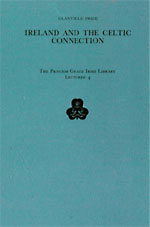
Ireland and the Celtic Connection
In his lecture given at the Princess Grace Irish Library, Monaco, in September 1985, Professor Glanville Price surveys relations between Ireland and the other Celtic nations from prehistoric times to the late twentieth century. The lecture is supplemented by an up-to-date bibliography of some 500 items compiled by Morfydd E.Owen that will serve as an introduction to the study of such fields as the archaeology, history and art of the ancient Celts and the history, languages, literature and folklore of the modern Celtic nations (Ireland, Scotland, the Isle of Man, Wales, Cornwall and Brittany).
More info →
The Celtic Connection
The Celtic nations of Brittany, Cornwall, Ireland, the Isle of Man, Scotland and Wales are well known for their literature, mythology, poetry and song. This volume is a study of the linguistic and literary achievements of those nations and provides a much-needed overview of the condition of all the Celtic languages. By emphasising the connection, these studies taken together illuminate the whole Celtic domain.
As the Editor points out, the Celtic identity is not one of race – the genetic links, if they are there at all, just cannot be proved – but it is of a common linguistic and cultural heritage. The Celtic Connection focuses on the similarities and differences in language across the Celtic nations and contributes to the resurgence of interest in the Celtic identity which is increasingly being supported by official bodies, both national and international.
The collection commences with a description of the languages and origins of early Celtic society. Each language is then examined by a leading expert in linguistics and literature. All the contributors have written their contributions keeping in mind the theme of the title – the extent to which links among the Celtic peoples have (or, indeed, have not) been significant.
Contents: The Celtic Languages (Glanville Price) – The Early Celts (Miranda J. Green) – The Irish Language (Máirtín Ó Murchú) – Early Irish Literature (Pádraig Ó Riain) – Post-Norman Irish Literature (Séamus Mac Mathúna) – The Scottish Gaelic Language (John MacInnes) – Scottish Gaelic Literature (Derek S. Thomson) – Manx Language and Literature (Robert L. Thomson) – The Welsh Language, Its History and Structure (David Thorne) – The Welsh Language (Glanville Price) – Welsh Literature (David R. Johnston) – The Breton Language (Humphrey Ll. Humphreys) – Breton Literature (Rita Williams) – Cornish Language and Literature (Glanville Price) – The Celtic Connection Today (Glanville Price). With a Foreword, 'Brittany and Myself', by Prince Louis de Polignac.
The Princess Grace Irish Library 6
More info →
The Light Fantastic
ISBN: 978-0-86140-203-8
In this sequel to the much-acclaimed The Colour of Magic, Rincewind, Twoflower and the many-legged luggage return to the Discworld with the help of the Octavo and overcome the attempts by the wizards of the Unseen University to capture them, and then save the Discworld from an invasion from the Dungeon Dimensions.
`Marvellous sequel... pure fantastic delight.' - Time Out
More info →

The First Discworld Novels
The Colour of Magic & The Light Fantastic
This is how the Discworld began...
In The Colour of Magic the failed wizard Rincewind burst upon the world and hasn't stopped running since. This was the book that started the phenomenally successful fantasy series. Here is the sapient pearwood Luggage, a mobile trunk which launders any clothes put in it and incidentally homicidally defends its owner. Here is Twoflower, an innocent tourist in a world of nightmares and fairy tales gone wrong. Here is Cohen the Barbarian, the world's oldest and greatest hero. Here is Death, not such a bad sort when you get to know him...
They have adventures. It'd take to long too explain. Just read it!
First published in 1983, The Colour of Magic has been translated into thirty languages, and has sold over two million copies in Corgi editions alone. The Light Fantastic, published in 1986, follows closely behind, and of all the Discworld novels it is the only true sequel to an earlier work. This two-in-one volume was first published in 1999.
More info → 
The Colour of Magic
ISBN: 978-0-86140-324-0
The first novel of the Discworld series
On a world supported on the back of a giant turtle (sex unknown), a wickedly eccentric expedition sets out. There’s Rincewind, an avaricious but inept wizard, Twoflower, a naive tourist whose murderous luggage moves on hundreds of little legs, dragons who only exist if you believe in them, and of course, the Edge of the Discworld, and its circumfence. . .
‘Pratchett is very good indeed’ - Standard
More info → 
Theatre of Shadows: Samuel Beckett’s Drama 1956-1976
21.6 x 13.8 cm. pbk edition of Irish Literary Studies Series (ISSN 0140-895X) volume 28
Perhaps nothing is more fascinating to the student of literature than an insight into a writer's creative process, a study of how the published works, from All That Fall to Footfalls, came to be as they are.
Theatre of Shadows both defines and takes as its subject the middle period of Samuel Beckett's dramatic writing. By making a close study of the structure, and of the largely unpublished manus-cript drafts, of the plays written from 1956 to 1976, this book offers considerable insight into Beckett's creative process. A combination of rigorous patterning and a movement away from concrete expression (what Beckett himself called a 'vaguening' of the text) is seen to be his customary working method during this period. Dr Pountney goes on to discuss how the plays work in the theatre, through a detailed analysis of Beckett's stagecraft.
In order to set the middle period in context some discussion of Beckett's early work for the theatre is included, and a final chapter on the late plays shows his dramatic imagination still finding new channels to explore. The book provides the student with as comprehensive an approach as possible to two decades of Beckett's drama. This is a paperback edition of the original 1988 publication.
Rosemary Pountney, whose first training was in theatre, performed the Irish premières of Not I (Mouth) and Footfalls (May) at the Dublin Theatre Festival in 1978. She combines her Lectureship in English at Jesus College, Oxford, with touring (most recently in Eastern Europe and New Zealand), lecturing on Beckett's work in the theatre, and performing Rockaby and other one-woman plays.
'a marvellous contribution to Beckett criticism.... painstakingly scholarly, meticulous in its observations, and illuminating in its detail' Review of English Studies, 1990
'If you want the best book on the background to Beckett's plays (without jargon) this is it. It is also the most useful for the actor.' Barry McGovern

The Letters of Saint Oliver Plunkett 1625-1681
Edited by Mgr John Hanly
ISBN: 978-0-85105-344-8
27.2 x 18.0 cm.
The illustrated end-papers reproduce a map of Rome published in 1676.
Note that our copies do not have a dust-jacket, only a clear protective cover. We took over a quantity of book blocks from the liquidators of Dolmen Press in 1987, which we then had cloth-bound. We were unable to find any jackets.
In March 1670 St. Oliver Plunkett, his long exile over, stepped ashore at Ringsend to the welcome of friends and relatives. For twenty-two years he had lived in Rome as clerical student and professor of theology. It was an exciting if also a sad time. Oliver Plunkett stepped into Restoration Ireland as Archbishop of Armagh and Primate. For ten years, until his arrest in December 1679, he applied himself to the task of rebuilding and repairing, knowing that the storm was by no means over. In the early years he was a man in a hurry, taking full advantage of a period of relative toleration and peace. In 1674 he was for many months a fugitive, determined not to forsake his flock until ‘they drag us to the ship with the rope around our necks’. The last few years of his life, including eighteen months in prison, were the years of the infamous Popish Plot of Titus Oates, of which he was the final victim, the last of the martyrs of Tyburn.
For the first time a complete chronological edition of Saint Oliver’s letters enables us to follow the story, as it evolves in his own words, of his work as Archbishop in Ulster, where the Plantation was barely two generations old. He emerges as a man of immense courage, deep conviction and priestly zeal with the sometimes all too human side of one who grew into sainthood; and in the final documents the magnificent calm with which he faced his cruel death stands out.
The Letters of Saint Oliver Plunkett give many interesting insights into various events and characters of his time. His pen ran freely, his policy was to be well informed, and to give a clear picture of all matters touching the Church in Ireland. There are many light-hearted passages too, as when he tells us that the farmer in whose barn he was hiding, and on whom he depended for his food, sometimes came back a little too merry from town, and his guest had to fast. . . .
The letters are printed in their original language, almost always Italian, with translation and commentary. The book is edited by Monsignor John Hanly who first worked on these letters for a doctoral thesis at the Gregorian University from 1959 to 1961, and who was Postulator of the Cause of Saint Oliver from 1968 until the canonisation in 1975.
Designed by Liam Miller.
More info →

The Poetry of Michael Longley
21.6 x 13.8 cm illus. Ulster Editions & Monographs Series (ISSN 0954-3392) volume 10
Nuala Ní Dhomhnail included Michael Longley’s ‘Ceasefire’ in her choice of ten representative poems of the 1990s in Irish poetry in the following terms: ‘it made its first electrifying appearance in print in The Irish Times to coincide with the announcement by the IRA of the first Northern Ireland ceasefire. . . its effect was dynamic, and rippled right through the community, both North and South, having a galvanising effect that can only be imagined of some lines of Yeats, perhaps, at the turn of the century’.
This underlines both Longley’s stature and his humane response to the Northern Irish ‘Troubles’; and the Homeric base of ‘Ceasefire’ exemplifies his distinctive ability to find trans-cultural perspectives on localised issues. A creative tension between the general and particular is the hall-mark of his work as love poet, nature poet, and poet of conflict; and the spare, concentrated focus of his lyric practice is at the heart of his ability to image the macrocosm in the microcosm.
His status as a poet resident in Belfast throughout the ‘Troubles’ has been of talismanic importance over the last three decades. Just as significantly for his open outlook, his ‘home from home’ in Carrigskeewaun in the West of Ireland has been the inspiration for a rich and luminous body of lyric poetry where what he sees as his basic themes of love and death are broached via a naturalist’s intimate involvement with the elemental processes of the physical world.
In his latest volume, The Weather in Japan, winner of the 2000 Hawthornden Prize for ‘best work of imaginative literature’, Italy and Japan further extend the geographical and cultural co-ordinates within which his poetry finds its moral and aesthetic realisation. This new collection continues the remarkable resurgence in Longley’s career during the 1990s, marked by the lyric intensities of Gorse Fires (1991) and the more unruly lyric energy of The Ghost Orchid (1995). These volumes consolidate Longley’s position at the forefront of contemporary Irish poetry.
The present volume, the first book devoted entirely to Longley’s work, brings together a number of experts on Longley and Irish poetry in general – Michael Allen, Terence Brown, Neil Corcoran, Douglas Dunn, Elmer Kennedy-Andrews, Peter McDonald, Alan Peacock and Robert Welch. Through a variety of thematic, contextual and technical approaches it examines the whole of his career up to and including The Weather in Japan.
The majority of the essays were given as papers at the 1996 session of the Ulster Symposium at the University of Ulster, Coleraine.
Kathleen Devine lectured in English at the University of Ulster at Coleraine, where Alan Peacock also lectured in Classics and English.

The Achievement of Brian Friel
21.6 x 13.8 cm. xx, 267 pp. 1883 Ulster Editions and Monoographs Series (ISSN 0954-3392) volume 4
The reception of Brian Friel's recent Dancing at Lughnasa confirmed his status as Ireland's leading dramatist. The body of work that he produced is outstanding in its breadth of sympathy and interest, its dramaturgical invention and its wide cultural and intellectual purview. At one level, it may be seen as a continuous examination of Irish culture and politics, committed and analytical, but not sectionally propagandist.
His outlook in his drama, however, was not amenable to simplistic categorization, political or otherwise. As this volume demonstrates, linguistically, allusively, and in terms of its broad transcultural analogising, he work ranges widely. He utilised ideas and terminologies drawn from various cultural sources and academic disciplines in a way that exemplified his central, insistent concern with the phenomenon of language and its implications.
As an Irish dramatist, however, he made Irish social, political and, notably, family life his focus and built upon a recognised tradition of twentieth century Irish play-writing.
This book addresses the variety and complexity of Friel's drama by bringing to bear a range of academic and other professional and creative approaches in order to highlight particular aspects of his work and thought. Hence, contributors include a playwright, poet, theatre-producer, historian and various specialists in relevant literatures. In this way, the book suggests the intellectual richness, humanity, and protean skill and invention of the work.
Among the contributors are John Cronin, Neil Corcoran, Desmond Maxwell, Christopher Murray, Thomas Kilroy, Seamus Deane, Robert Welch, Sean Connolly, Joe Dowling, Terence Brown, Fintan O'Toole and Seamus Heaney.

Gaston de Latour: The Revised Text
Edited by Gerald Monsman
ISBN: 978-0-944318-09-6
22.6 x 14.8 cm 384 pp. 1995
This is the most complete edition ever published of Pater's last work. Although a version was published in 1896, two years after his death, Charles L.Shadwell, its editor, omitted six chapters that existed in manuscript.
Scarcely two years after Walter Pater's death, Macmillan & Company published Gaston de Latour: An Unfinished Romance. The author of works critical to the formation of the Transition and Modernist periods set his last novel in the turbulent years following the Reformation. Selected chapters first appeared serially in Macmillan's Magazine and the Fortnightly Review, but the posthumous volume edited by Charles L. Shadwell, Pater's long-time friend, remains controversial. For a century readers have seen only a portion of what Pater wrote for Gaston de Latour. Shadwell withheld six manuscript chapters.
Pater's prominence and widening influence in late-nineteenth and early twentieth-century studies makes those missing chapters more intriguing than ever. ELT Press is pleased to publish this long-awaited new edition Gaston de Latour: The Revised Text.
Edited from the holographs and based on definitive material incorporating all known fragments, The Revised Text includes the crucial suppressed chapters. Professor Gerald Monsman's edition, meticulously edited and researched, is far more revelatory of Pater's intimate thoughts than the book Macmillan printed in 1896.
The Revised Text is notable in other ways. Pater's study of eroticism in his portrait of Queen Marguerite is a significant contribution to gender studies in the late-Victorian period. Through the imaginary portrait of Gaston and Gaston's contemporaries (Ronsard, Montaigne, Bruno, King Henry III) Pater's fictional fantasia perceptively confronts and admonishes the Yellow Nineties, Oscar Wilde not least. As Monsman says, the Pater of the 1890s, pondering the issues of art and morality, eroticism and guilt, "is in may ways the most interesting of all the successive Paters – certainly wearier, but also more candid, consummately polished artistically, self-consciously aware of a dawning modernism."
Gerald Monsman is a Professor of English at the University of Arizona and former Head of the Department. He has worked for nearly a decade to bring this authoritative edition to print. His contributions to the field are well known. Among other publications, he has written three books on Pater: Pater's Portraits (Johns Hopkins University Press, 1967), Walter Pater (G. K. Hall, 1977), Walter Pater's Art of Autobiography (Yale University Press, 1980).
Gaston de Latour: The Revised Text is a significant achievement. Scholars and students will find Monsman's Introduction, Explanatory Notes, Diplomatic Transcriptions, Emendations and Variants invaluable.
More info →
An Duanaire 1600-1900. Poems of the Dispossessed
ISBN: 978-0-85105-364-6
21.6 x 13.8 cm.
with 38 illustrations.
The primary purpose of this anthology is to demonstrate the nature and quality of the Irish poetic tradition during the troubled centuries from the collapse of the Gaelic order to the emergence of English as the dominant vernacular of the Irish people. The English translations, all new, have aimed at a close fidelity to the content of the originals while suggesting something of the poetic quality and the basic rhythms of the original Irish poems
More info →